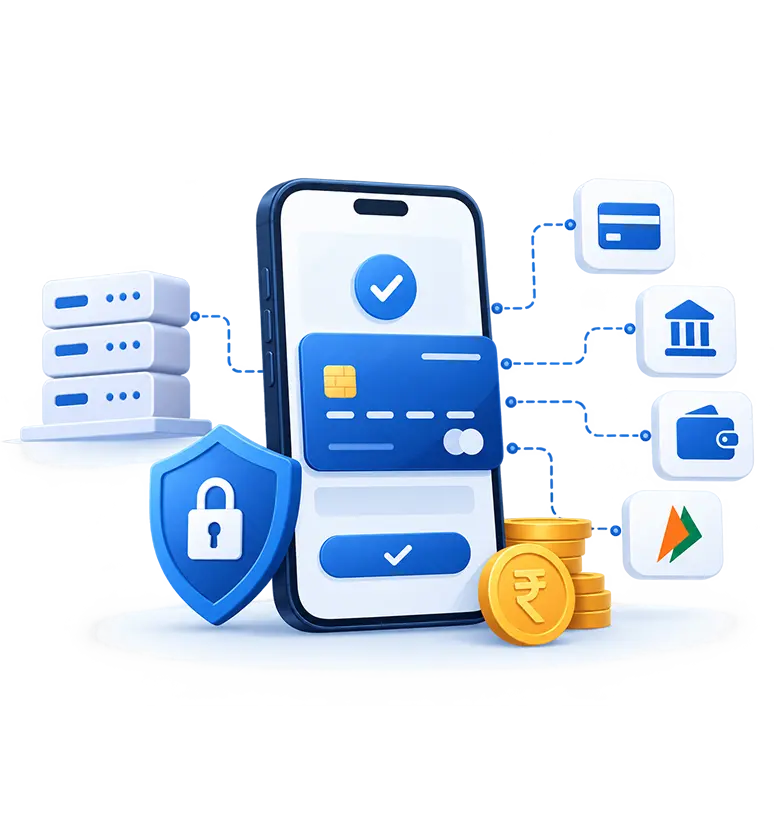
Mobile App Payment Gateway Integration Services

Secure in-app payments for Android, iOS and cross-platform apps

No matter how much customers enjoy your app, unless the payment gateway is secure and free-flowing. If you are planning to launch a new app or your current app is losing buyers at the checkout screen, it's time to get a better mobile app payment gateway.

Fulminous Software is a mobile app payment gateway integration company that helps Android, iOS and cross-platform product owners collect money inside the app quickly and safely. Our payment gateway integration engineers connect Stripe, Razorpay, PayPal, Braintree, Adyen, Square and other providers to native and hybrid apps. They also take care of tokenization, 3-D Secure, webhooks and refund logic, the unglamorous parts that decide whether a payment feature can be trusted.

Whether you need a single wallet button or a full billing engine, our mobile payment gateway integration specialists can take the work from planning to store release. Outsource the whole project, or hire payment developers from us at $20 to $60 per hour.

fulminous software Mobile-App-Payment-Gateway-Integration

Custom Payment Gateway Integration in Mobile Application Projects

No two apps earn money in the same way. A ride-hailing app needs pre-authorization and split payouts. A SaaS app needs recurring billing. A marketplace needs escrow and seller settlements. Fulminous Software has shipped 15+ mobile app payment gateway integration projects, and we shape each build around your revenue model instead of dropping in a generic checkout. Our team is strong in:

  • Stripe Integration
  • Razorpay Integration
  • PayPal and Braintree Integration
  • Adyen and Checkout.com Integration
  • Square Integration
  • Google Pay and UPI Integration
  • Subscription and Recurring Billing
  • Tokenization and Saved Cards
  • 3-D Secure and SCA Setup
  • Webhook, Refund and Dispute Automation
  • Wallet and Payout Systems

Tell us what you sell and who buys it, and we will map out the right payment gateway integration setup. Contact us now!

What Is a Mobile Payment Gateway?

A mobile payment gateway is the link between your app and the money. When a customer taps Pay, the gateway takes their card or wallet details, encrypts them, checks them with the card network and the issuing bank, and sends back a yes or a no. It usually all happens in a couple of seconds.

Several parties sit behind that single tap. The customer's bank issued the card. Your acquiring bank holds your merchant account and receives the funds. The processor carries messages between them, and the gateway is the front door your app actually talks to, either through an API or a ready-made SDK. Some providers bundle all of this into one account, while others make you set up the merchant account on your own.

Two terms come up constantly. A sandbox is a test mode where you can run fake payments before anything goes live. A white-label gateway runs under your own brand, so users never see the provider's name. Real card numbers are also swapped for tokens, which means your servers keep a harmless reference instead of sensitive card data.

App Types That Gain the Most From In-App Payments

Any app that takes money should let people pay inside it. Some kinds of apps feel the benefit sooner than others:

Shopping apps:

Shopping carts, saved cards and one-tap reorders. This includes stores already running on Shopify, WooCommerce or BigCommerce that want a proper app on top.

Subscription and SaaS apps:

trials, renewals, upgrades and automatic billing without chasing anyone for a card.

On-demand services:

rides, deliveries and home services, where payment, tips and driver payouts happen around the trip.

Marketplaces:

buyers pay once, and the money is split between sellers and your platform.

Digital-first startups:

teams that need to launch fast, sell in several currencies and keep the checkout flexible as they grow.

Apps used on patchy networks:

payment flows that survive a dropped connection, plus QR or voucher options where offline payments are common.

Wallet and fintech apps:

top-ups, transfers and withdrawals with strict identity checks.

If you are weighing up payment gateway integration in mobile application work for one of these, Fulminous Software will tell you plainly what you need and what you can skip.

Benefits of Professional In-App Payment Setup

A good checkout in mobile apps does more than move money. Here is what changes when experienced engineers handle payment gateway integration mobile app work for you.

Faster Checkout

Saved cards, wallets and biometrics cut the typing, so buyers finish in seconds.

Better Conversion

Fewer steps and fewer redirects mean fewer abandoned carts.

Stronger Security

Card data never touches your servers. Tokens, encryption and 3-D Secure carry the load.

Global Reach

Take payments in many currencies and local methods without rebuilding the app.

More Payment Choices

Cards, wallets, UPI, net banking and buy-now-pay-later, all in one flow.

Reliable Uptime

Retry logic and fallback gateways keep sales going when one provider has a bad day.

Cleaner Reconciliation

Every order, fee and refund lands in a format your finance team can actually read.

Fraud Protection

Risk rules and provider tools catch suspicious activity before it costs you.

Recurring Revenue

Trials, upgrades, renewals and failed-payment recovery handled automatically.

Low Maintenance

Clear code, monitoring and alerts keep upkeep light as your user base grows.

Must-Have Features in a Mobile Payment Gateway

Mobile app payment gateway integration providers are not all equal. Before you commit to one, check that it covers the following:

Security and PCI compliance:

encryption, tokenization and two-factor or 3-D Secure checks built in.

Multi-currency support:

charge in the buyer's own currency and settle in yours.

Plenty of payment options:

cards, digital wallets and one-tap payments, not just a card form.

Speed and uptime:

a gateway that answers quickly and rarely goes down.

Developer-friendly APIs:

clear documentation, mobile SDKs and a test mode.

Recurring billing:

automatic invoicing and automatic retries for cards that fail.

Real-time fraud monitoring:

rules and alerts that flag odd activity as it happens.

Analytics and dashboards:

sales, failures, refunds and payouts in one place.

A good mobile experience:

short forms, autofill and biometric approval.

Native, Flutter or React Native: Which Path Fits Your App?

The right payment gateway integration method depends on how your app is built and where you plan to grow. Here is how we usually approach each one:

ApproachBest ForHow We Build It
Native Android (Kotlin/Java)Apps that need deep device featuresGateway SDK plus Google Pay API
Native iOS (Swift)Apps focused on iPhone usersGateway SDK plus PassKit for Apple Pay
FlutterOne codebase for both storesOfficial plugins and platform channels
React NativeJavaScript teams shipping to both storesMaintained SDK wrappers and native modules
Hosted CheckoutQuick launches with a light PCI burdenProvider-hosted secure payment page

Three Ways to Connect a Payment Flow

There are three common patterns in mobile app payment gateway integration. The right one depends on how much control you want and how much compliance work you are ready to carry.

PatternWhat It MeansGood WhenWatch Out For
Hosted payment pageUsers pay on the provider's secure pageYou want a quick launch and the lightest compliance loadLess control over the look and an extra step for the buyer
SDK with built-in screensThe provider's own payment sheet sits inside your appYou want speed, polish and card data handled by the SDKLimited styling options
Direct API with a custom screenYou design the fields and call the provider's APIs yourselfYou need full control of the experienceMore build effort and more security duties

Most apps Fulminous Software builds use the SDK route with a custom server layer for orders and webhooks. Whichever pattern you pick, the server side works the same way: create the payment on your backend, confirm it with a webhook, and never trust the phone alone. We also write the test plan and test cases before any code, so nothing gets missed later.

Android Payment Integration

Our Android developers work in Kotlin and Java to add card entry, Google Pay, UPI intents and wallet flows. Fulminous Software sets up server-side order creation, confirms payments through webhooks, and handles the tricky states such as pending payments, app restarts mid-transaction and network drops. One note we always raise early: if you sell digital goods inside the app, Google Play Billing rules may apply, so we plan the payment model around store policy before a line of code is written.

Apple Pay Payment Gateway Integration

Apple Pay lets iPhone and Apple Watch users pay with Face ID or Touch ID, with no card number typed at all. Our iOS engineers handle the full setup: merchant IDs, payment processing certificates, PassKit configuration, domain and capability settings, and the link to your chosen processor. Fulminous Software tests on real devices and in sandbox so that approval at App Store review is smooth. As with Android, digital content may fall under Apple's in-app purchase rules, and we help you structure things correctly.

Flutter Payment Gateway Integration

One Dart codebase, two stores, one checkout that feels native on both. Our Flutter payment gateway integration work uses official and well-maintained plugins, and where a plugin falls short we write custom platform channels in Kotlin and Swift instead of hacking around the gap. The result is a single, testable payment layer that your team can extend without touching native code every time. Fulminous Software brings the same discipline to React Native projects.

Payment Methods We Integrate

Fulminous Software is proficient in plenty of mobile app payment gateway integration services:

  • Credit and Debit Cards
  • Apple Pay
  • Google Pay
  • UPI
  • QR Payments
  • Net Banking
  • Digital Wallets
  • Buy Now, Pay Later
  • Bank Transfers and ACH
  • SEPA Direct Debit
  • Recurring Mandates and Auto-Debit
  • In-App Wallet Top-Ups

Popular Payment Gateways for Mobile Apps

These are the names that come up most often in our mobile payment gateway integration projects:

ProviderKnown ForKeep in Mind
StripeClean APIs, strong mobile SDKs and wide country coverageFees differ by region and payment method
PayPalA name buyers already trustCheck dispute and account-hold policies
BraintreeA PayPal company that offers cards, PayPal and Venmo in one SDKVenmo works only for US users
SquareA good fit if you also take card payments in personAvailable in a limited set of countries
Authorize.NetA long-running gateway popular in the USFeels older than newer options
AdyenLarge-scale processing and many local payment methodsSuits bigger volumes better than small apps
Amazon PayBuyers pay with their Amazon accountWorks best when your audience shops on Amazon
RazorpayUPI, cards and wallets for Indian usersMainly focused on India
KlarnaBuy now, pay laterApproval rules and fees vary
2Checkout (Verifone)Selling digital products across bordersCompare fees with newer rivals

Apple Pay and Google Pay are wallets, not gateways. Our Apple Pay payment gateway integration work pairs the wallet with whichever processor you choose. Fees and supported countries change often, so Fulminous Software checks the provider's current terms with you before you sign.

Our Mobile App Payment Gateway Integration Services

Here is the full range of mobile app payment gateway integration work our team takes on:

Payment Consultancy

Fulminous Software studies your product, markets and margins, then recommends a payment setup and payment api gateway integration that fits.

Gateway Selection and Comparison

We compare fees, regions, payout speed and SDK quality side by side so you decide.

Native Android Payments

We build card, wallet and UPI payment flows for Android apps in Kotlin or Java.

Native iOS Payments

Our Swift developers create secure checkout for iPhone apps, with full Apple Pay support included.

Flutter Payment Gateway Integration

Fulminous Software builds your payment module once in Flutter and ships it to both stores.

React Native Payments

We build secure checkout for React Native apps so JavaScript teams can accept payments confidently.

Apple Pay Payment Gateway Integration

We handle wallet setup, certificates and processor connections end to end so Apple Pay works.

Subscription and Billing

We set up plans, trials, proration, invoices and failed-payment recovery so recurring revenue keeps flowing.

Marketplace and Split Payments

Pay sellers, take your commission and hold funds safely, with clear settlement rules built in.

Wallet and Payout Systems

We build in-app balances, easy withdrawals and wallet refunds that your users can rely on.

Gateway Migration

Switch providers without losing saved cards or order history, and with no disruption to customers.

Monitoring and Support

Fulminous Software provides live dashboards, instant alerts and quick fixes the moment a payment misbehaves.

Our Mobile App Payment Gateway Integration Process

  1. Step 1: Discovery

    Share your app, markets and payment needs. Fulminous Software confirms the scope, the gateway shortlist and the compliance limits.

  2. Step 2: Architecture

    Our mobile payment gateway integration experts design the payment flow, the server endpoints and the failure paths before building anything.

  3. Step 3: Development

    Our mobile app payment gateway integration engineers build the client checkout and the backend that creates, confirms and records every payment.

  4. Step 4: Connections

    We link webhooks, your order system, accounting tools, email receipts and analytics.

  5. Step 5: Testing and Launch

    Test cards, sandbox runs, device checks and a staged release go live with a rollback plan ready.

  6. Step 6: Support

    Fulminous Software stays on call after launch to watch success rates, fix edge cases and handle gateway updates.

How to Choose the Right Payment Gateway

A lower rate per transaction can still cost you more overall if the checkout converts badly, so look at the whole picture. We go through these points with every client:

Your audience:

which cards, wallets and local methods do your buyers already use?

Fees:

per-transaction charges, fixed monthly fees, setup fees, refund fees and currency conversion costs.

Reach:

the countries and currencies you sell in today and next year.

Security:

PCI DSS, tokenization standards and 3-D Secure support.

Checkout quality:

how much you can customise it, and how it affects conversion.

API quality:

clear documentation and idempotency keys, so a retried request never charges someone twice.

Hosted or self-hosted:

how much of the payment screen you want the provider to own.

Scalability:

whether it copes when traffic jumps tenfold.

Support:

how fast a real person answers when a payment goes wrong at 2 a.m.

How a Payment Gets Wired Into an App

The exact steps shift slightly between providers, but the path looks like this:

  • Open a merchant or developer account with the provider and complete business verification.
  • Read the API and SDK documentation, then settle on a pattern.
  • Collect your keys from the developer dashboard. Secret keys stay on the server and never go into the app.
  • Build the checkout screen: payment buttons, card fields or a wallet sheet.
  • On your backend, create a payment intent or order for the exact amount.
  • Let the app confirm the payment through the SDK and handle any 3-D Secure challenge.
  • Listen for webhooks to learn the final result, then update the order.
  • Handle declines, timeouts, duplicate taps and refunds.
  • Test with sandbox cards, then run quality assurance on real Android and iOS devices.
  • Switch to live keys, release in stages and watch the first transactions closely.

How to Choose a Payment Integration Partner

Payments are the wrong place to learn on the job. A general app studio may build a lovely checkout screen and still miss the pieces that protect your money. A team that has shipped payment gateway integration in mobile application projects before will ask about refunds, chargebacks and edge cases on the first call. Look for:

  • Hands-on experience with your chosen gateway
  • Knowledge of PCI DSS and strong customer authentication
  • Native Android and iOS skills
  • Flutter and React Native experience
  • Backend and webhook expertise
  • Experience with subscriptions and marketplaces
  • Careful handling of failed and duplicate payments
  • A solid testing and sandbox process
  • Clear pricing and honest timelines
  • Post-launch monitoring and support
  • Store policy awareness for Apple and Google
  • Readable documentation at handover

Why Choose Fulminous Software for Your Payment Project?

Specialised Payment Engineers

Our payment gateway integration mobile app team lives in gateway SDKs and webhooks every week, and brings focused mobile payment gateway integration experience to your build.

Android, iOS and Cross-Platform Skills

One payment gateway integration mobile app team covers Kotlin, Swift, Flutter and React Native.

Security First

Tokenization, encryption and least-privilege access are part of every project, not add-ons.

Agile Delivery

Short sprints with working demos so you can see real payments move early.

Fair Pricing

You get services from top payment gateway integration mobile app experts at rates from $20 to $60 per hour.

Flexible Hiring

Choose the engagement model for payment gateway integration mobile app that suits your roadmap.

Every Sector

Our payment gateway integration mobile app experts have built payment flows for retail, travel, health, education, finance and more.

Clean Handover

Documented code, runbooks and a walkthrough for your own team.

Security and Compliance Built Into Every Payment

Money and personal data call for care. Our mobile payment gateway integration process follows these safeguards from day one:

  • PCI DSS Alignment
  • Card Tokenization
  • End-to-End Encryption
  • 3-D Secure 2 and SCA
  • Secure Key and Secret Storage
  • Certificate Pinning
  • Root and Jailbreak Detection
  • Webhook Signature Verification
  • Idempotent Payment Requests
  • Fraud and Risk Rules
  • Audit Logs and Activity Tracking
  • Data Privacy and Consent Controls
  • Vulnerability and Penetration Checks

Beyond the app itself, we look at the layers around it. Know-your-customer and anti-money-laundering checks matter for wallets and payouts. Firewalls, DDoS protection and rate limits guard your API, and strict authorisation rules keep sensitive records from leaking. Every payment result is confirmed on the server rather than taken on trust from the phone.

Apps and Industries We Serve

  • eCommerce and Retail
  • Food Delivery and Restaurants
  • Ride-Hailing and Transport
  • FinTech and Digital Banking
  • Healthcare and Telemedicine
  • Education and eLearning
  • Travel and Hospitality
  • Gaming and Entertainment
  • On-Demand Service Marketplaces
  • SaaS and Subscription Apps
  • Real Estate and PropTech
  • Fitness and Wellness
  • Event Ticketing
  • Non-Profit and Donation Apps
  • Logistics and Delivery
  • Insurance Apps

Estimated Payment Integration Cost

Typical budgets for payment gateway integration mobile app projects depend on scope. These ranges give you a starting point:

Project TypeEstimated Cost
Payment Consulting and Gateway Selection$1,500 – $5,000+
Single Gateway Integration$2,500 – $6,000+
Multi-Gateway Setup$6,000 – $14,000+
Apple Pay or Google Pay Add-On$1,000 – $3,500+
Cross-Platform Payment Module$4,000 – $10,000+
Subscription and Billing Engine$7,000 – $18,000+
Marketplace and Split Payments$10,000 – $25,000+
In-App Wallet and Payouts$15,000 – $40,000+
Gateway Migration$4,000 – $12,000+

Fees You Will Pay Beyond Development

The build is a one-time cost. The charges below keep running, and they depend on your provider, so ask for them in writing. When you plan a payment gateway integration mobile app budget, add these to the development quote:

  • Setup fees, which some providers charge and many do not
  • Fixed monthly fees or licence fees
  • Per-transaction fees, usually a percentage plus a small fixed amount
  • Refund fees
  • Chargeback and dispute fees
  • Currency conversion and international card surcharges
  • PCI compliance fees, if your provider or bank passes them on
  • Merchant account fees, where the account is separate from the gateway

Building your own gateway from scratch costs far more upfront, with licensing, certification and audits to pay for. It rarely makes sense until your volumes are very large.

Engagement Models

When you hire our payment gateway integration in mobile application experts for payment gateway integration mobile app builds, pick the arrangement that suits your plans:

  • Dedicated Team
  • Fixed-Price Model
  • Time & Material Model
  • Staff Augmentation
  • Project-Based Hiring
  • Trial Projects

Hire Payment Integration Developers

Hourly Hiring:

$20 – $60 per hour

Dedicated Developer:

$2,500 – $8,000 per month

Flutter Payment Developer:

$2,500 – $6,500 per month

Single Gateway Setup:

Starts from $2,500 per project

Apple Pay or Google Pay Setup:

Starts from $1,000 per project

Subscription Billing Setup:

Starts from $5,000 per project

Managed Payment Support:

$400 – $3,000 per month

Payment Gateway Migration:

Starts from $3,000 per project

Real Project Stories

Food Delivery App: Faster Checkout, Fewer Failures

A regional food delivery startup was losing orders at payment. Cards were timing out, wallet payments were inconsistent, and refunds took days to reconcile. Our team of four rebuilt the payment layer with Razorpay on Android and iOS, added UPI and wallet support, and moved order confirmation to server-side webhooks. The new flow went live in six weeks.

Results:

  • Fewer failed and stuck payments
  • Refunds processed automatically
  • Cleaner daily reconciliation

Subscription Fitness App: Recurring Billing That Recovers Revenue

A fitness app with users in the US and UK needed trials, plan upgrades and automatic retries on declined cards. Our Flutter and backend engineers integrated Stripe, added Apple Pay and Google Pay, and set up dunning emails for failed renewals. The app kept a single codebase and passed both store reviews on the first submission.

Results:

  • Smooth trials and upgrades
  • Failed renewals recovered automatically
  • One shared payment module for both platforms

How the Pieces Fit Together

A payment gateway integration in mobile application setup has five moving parts, and each has one clear job:

The app:

shows the checkout, uses the SDK and sends only tokens, never raw card numbers.

Your backend:

creates orders and payments, holds the secret keys and talks to the gateway's API.

The gateway:

speaks to the card networks and banks and returns the result.

The webhook receiver:

checks the signature on every message from the gateway and updates the order.

Back-office systems:

the ledger, invoices, reports and support tools your team uses every day.

Before writing code we also agree on the non-functional needs: response times, expected load, uptime targets and how data is encrypted and logged. The cloud setup is sized to match, and Fulminous Software finishes with documentation your own team can follow without calling us.

Technologies We Use

  • Payment Gateways: Stripe, Razorpay, PayPal, Braintree, Adyen, Square, Checkout.com, Authorize.net, Mollie
  • Wallets and Methods: Apple Pay, Google Pay, UPI, Paytm, Samsung Pay
  • Mobile: Kotlin, Java, Swift, Flutter, Dart, React Native
  • Backend: Node.js, Python, Java, .NET, Django, Laravel
  • Cloud and DevOps: AWS, Docker, GitHub Actions, Terraform
  • Data: PostgreSQL, MySQL, MongoDB, Redis
  • Security Tools: Vault and KMS-based secret storage, OWASP checks, SAST scanners
  • Testing and Monitoring: Postman, Jest, Sentry, Datadog

Get Your Payments Working Today

Fulminous Software works with startups and established businesses across the globe to deliver mobile payment gateway integration that is secure, quick and built to scale. However complicated your pricing, regions or platforms, our mobile app payment gateway integration team can handle it.

Contact our payment gateway integration in mobile application experts today!

FAQs

That depends on your countries, currencies, fees, payout speed and the payment methods your buyers prefer. Fulminous Software compares the options with you before recommending one.

Let's Talk Business!

Leverage your business productivity with innovative Web3 healthcare app development services

Hire Dedicated Developers

To Upscale your Web3 healthcare app development capabilities

You can send email to info@fulminoussoftware.com