
AI in Project Management: Benefits, Use Cases, and Future Trends

Manish Kumawat
Last Updated on: 04 September 2026



The way teams plan, execute, and deliver projects has fundamentally changed — thanks to AI in project management. Where manual processes once led to missed deadlines, budget overruns, and communication gaps, artificial intelligence in project management now gives teams the power to work smarter, predict problems before they happen, and deliver results consistently. Whether you're a startup, an enterprise, or a growing agency, understanding how AI in project management works is no longer optional — it's a competitive necessity.
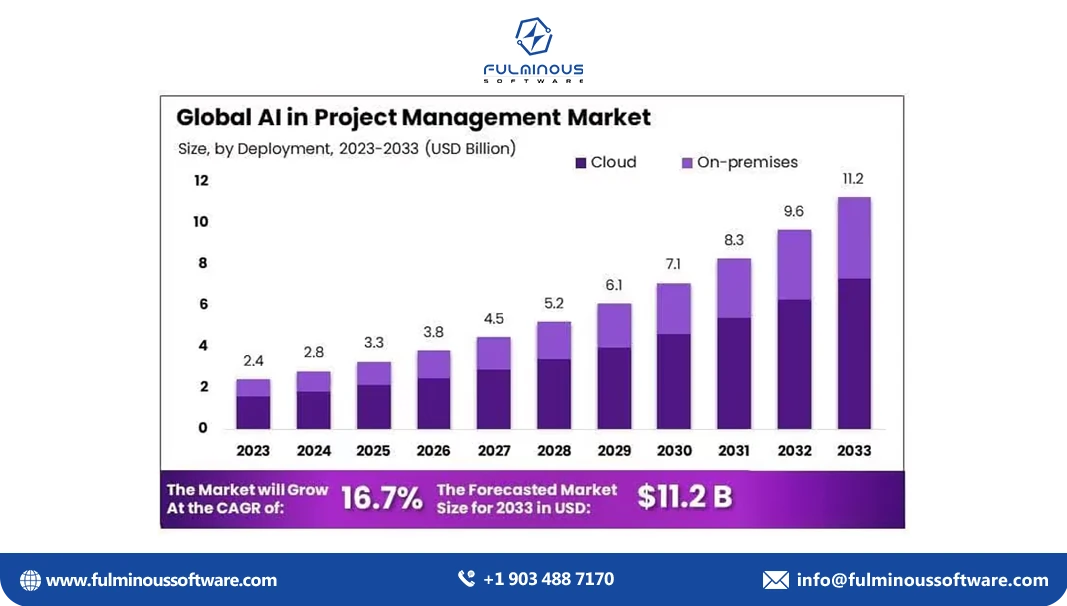
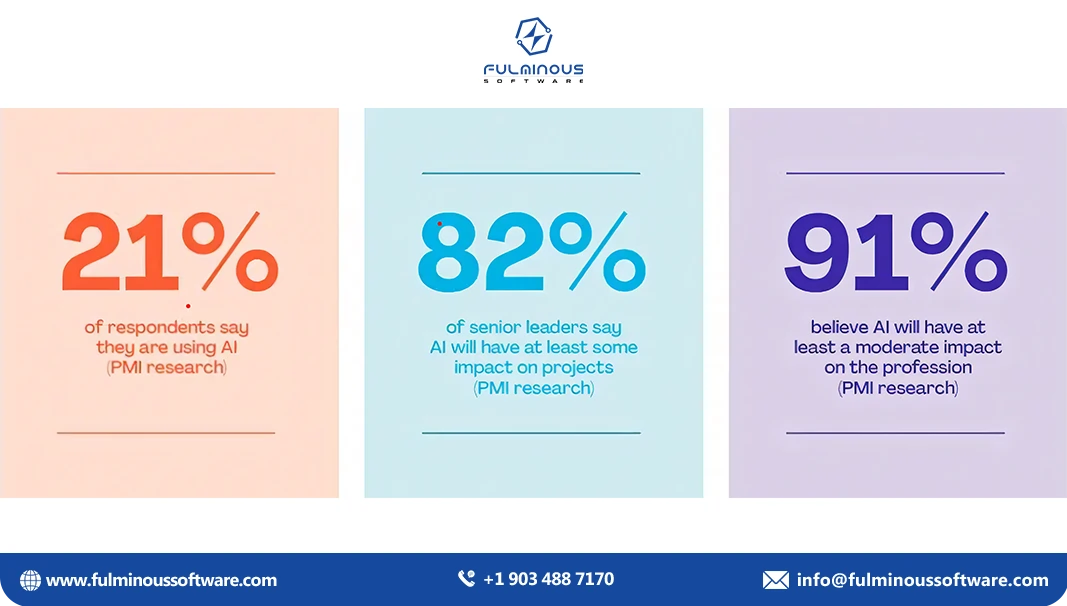
According to PMI's Pulse of the Profession report, organizations that adopt AI-driven project management tools report up to 28% higher project success rates compared to those relying on traditional methods. The adoption of AI in project management is accelerating rapidly — and this guide covers everything you need to know: how to use AI in project management, its real-world use cases, benefits, generative AI applications, challenges, future trends, and more.
No matter which industry you belong to — IT, construction, healthcare, finance, or retail — this guide on using AI for project management will benefit you.
📌 What This Blog Covers
This comprehensive guide on AI in project management answers the most important questions project managers and business leaders are asking today:
- How is AI used in project management across different stages?
- What are the real-world use cases and examples of AI in project management?
- What are the key benefits of using artificial intelligence in project management?
- How does generative AI assist project managers with documentation and decisions?
- What is the role of AI in agile project management?
- What are the challenges and limitations of AI in project management?
- What does the future of AI-driven project management look like in 2026–2030?
Table of Contents
- 1. How AI is Used in Project Management
- 2. Generative AI in Project Management
- 3. Role of AI in Agile Project Management
- 4. AI and Automation in Project Management
- 5. AI Use Cases in Project Management
- 6. Benefits of AI in Project Management
- 7. How AI in Project Management is Evolving in 2026–27
- 8. Challenges & Limitations
- 9. Future Outlook (2030+)
- 10. Fulminous Software — Our Services
- 11. Conclusion
- 12. FAQs
How AI is Used in Project Management
Need help with AI in project management? Get expert advice.
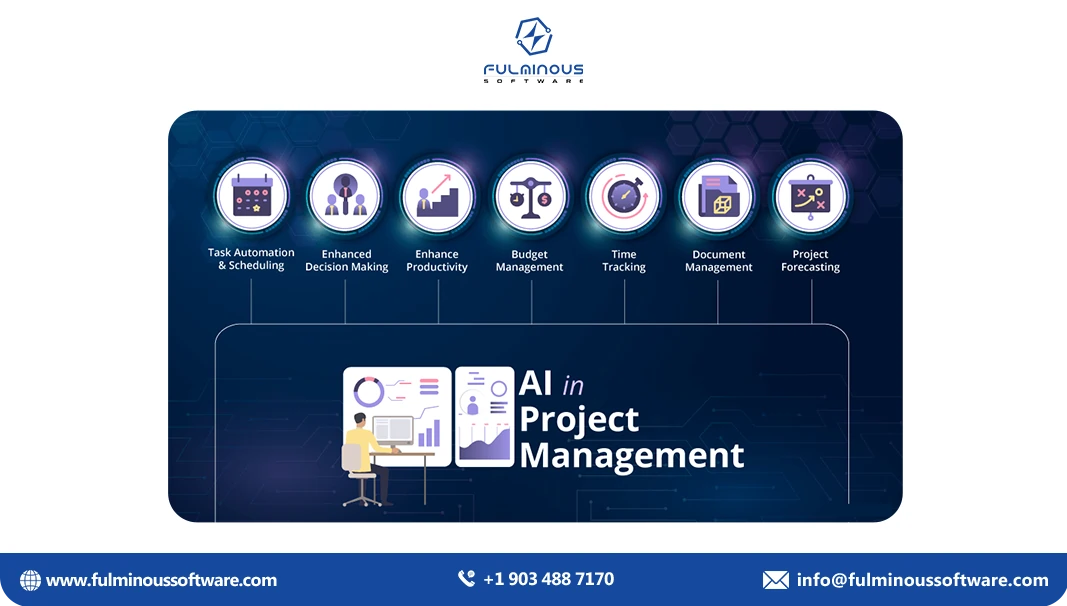
Get a Free ConsultationArtificial intelligence in project management isn't a single feature — it's a comprehensive system of capabilities that supports every phase of the project lifecycle. From the moment a project is scoped to the day it's delivered and beyond, AI actively assists project managers in making faster, more accurate decisions. Here's a breakdown of the primary ways AI is used in project management today:
AI-Powered Scheduling and Planning
Intelligent scheduling is one of the most impactful applications of AI in project management. AI tools analyze team availability, task dependencies, past project data, and workload distribution to create optimized schedules automatically — eliminating clashes and reducing planning time by up to 40%. Unlike manual scheduling, AI-powered project planning continuously adjusts timelines based on real-time inputs, ensuring your plan stays accurate even as conditions change.
Task Automation and Workflow Optimization
Repetitive, time-consuming tasks — such as status updates, progress reporting, meeting reminders, and task assignment notifications — can all be automated using AI. This frees project managers to focus on high-value strategic activities. AI-driven workflow optimization also identifies process inefficiencies, suggesting improvements that reduce cycle times and improve team output. Studies show that automating routine tasks with AI can recover up to 20–30% of a project manager's working week.
Predictive Analytics for Risks and Budgets
One of the most strategically valuable applications of AI in project management is predictive analytics. By analyzing historical project data, team velocity, resource utilization, and market variables, AI can forecast potential risks, budget overruns, and schedule delays weeks before they materialize. This gives project teams the critical lead time needed to course-correct — transforming reactive project management into proactive project leadership.
AI in Communication and Collaboration
Communication breakdowns are a leading cause of project failure. AI-driven collaboration tools — including Slack AI, Microsoft Copilot, Notion AI, and similar platforms — help bridge communication gaps by summarizing lengthy discussions, flagging important action items, translating for multilingual teams, and surfacing relevant project documents at the right moment. These tools are especially valuable for distributed and remote teams where context can easily be lost.
Intelligent Resource Allocation and Optimization
Allocating the right people and budget to the right tasks is a core challenge in project management. AI in project management solves this by analyzing skill sets, capacity, past performance, and project requirements to recommend optimal resource assignments. This ensures sustainable workload distribution, reduces team burnout, and maximizes the return on every resource — both human and financial.
AI-Powered Performance Tracking
Real-time performance monitoring is another critical application of AI in project management. AI dashboards provide live visibility into KPIs, milestone progress, team output, and budget consumption — enabling project managers to identify underperformance and realign efforts before issues escalate. Unlike manual reporting, AI-powered tracking is continuous, accurate, and requires no manual data entry.
Generative AI in Project Management
While AI in project management broadly covers automation and analytics, generative AI represents a more advanced layer — one that actively creates content, scenarios, and strategies to support project managers. Generative AI tools like ChatGPT, Claude, and Gemini are increasingly being embedded directly into project management workflows. Here's how:
Automatically Drafts Documentation & Reports
Project managers traditionally spend a significant portion — sometimes up to 30% — of their workweek on documentation. Generative AI dramatically reduces this burden by automatically drafting meeting summaries, status reports, risk registers, project charters, and progress updates. Simply feed the AI relevant data or meeting notes and receive polished, professional documents in seconds. This is one of the most immediately impactful examples of AI in project management for busy teams.
Brainstorming & Scenario Planning ("What-If" Analysis)
One of the most strategically valuable generative AI applications is scenario planning. Project managers can prompt AI models to simulate "what-if" scenarios—for example: "What happens to our timeline if the development team is reduced by 20%?" or "What is the budget impact of shifting from in-house to outsourced QA?" This accelerates strategic decision-making and helps teams prepare contingency plans well in advance.
Natural Language Progress Updates for Stakeholders
Keeping non-technical stakeholders informed with accurate, digestible project updates is a challenge. Generative AI can convert raw project data — milestone completion percentages, budget burn rates, risk statuses — into clear, human-readable progress summaries tailored to different audiences, from the C-suite to external clients.
Simplifies Knowledge Transfer and Onboarding
When new team members join a project mid-stream, getting them up to speed quickly is critical. Generative AI can compile onboarding guides, summarize project history, and answer team member questions in real time — significantly reducing the time-to-productivity for new hires and minimizing knowledge transfer bottlenecks.
Customized Project Templates for Any Methodology
Whether your team follows Agile, Scrum, Waterfall, PRINCE2, or a hybrid approach, generative AI can generate customized project templates tailored to your specific methodology and industry. This saves setup time and ensures every new project starts with a best-practice framework already in place.
Creative Content for Client Presentations
Communicating project progress, proposals, or results to clients and executives requires compelling visuals. Generative AI can draft slide content, suggest data visualization formats, and create structured timelines and charts — enabling project managers to produce professional presentations without heavy design effort.
AI-Powered Decision Support
When project managers face complex trade-offs — such as choosing among multiple vendors, adjusting resource allocation mid-sprint, or deciding whether to extend a deadline — generative AI serves as an intelligent decision-support layer. It analyzes constraints, historical data, and current project variables to recommend the optimal path forward.
The Role of AI in Agile Project Management
Agile methodology demands speed, adaptability, and continuous improvement. The role of AI in agile project management is to amplify these qualities — giving teams sharper insights, faster feedback loops, and smarter automation at every sprint. Here's how AI integrates into core agile activities:
| Agile Activity | AI's Role |
|---|---|
| Sprint Planning |
|
| Backlog Refinement |
|
| Team Productivity Tracking |
|
| Continuous Improvement |
|
| Automated Testing & QA |
|
| Predictive Delivery Timelines |
|
The integration of AI in agile project management is particularly powerful for software development teams, where speed, quality, and iteration frequency are critical competitive advantages. AI doesn't replace the agile mindset — it supercharges it.
AI and Automation in Project Management
When AI and automation work together in project management, the results are transformative. Automation handles the "what" — executing defined workflows reliably — while AI handles the "how" and "why," continuously learning and optimizing based on outcomes. Together, they eliminate human error, accelerate delivery, and free up project teams for high-impact strategic work.
Automated Resource Allocation
AI-powered automation can continuously monitor resource availability, project requirements, and team performance to dynamically reallocate tasks and budget in real time. This eliminates the manual overhead of resource planning and ensures optimal utilization at every stage of the project. Teams using automated resource allocation report up to 35% improvement in resource efficiency.
Eliminating Repetitive Manual Tasks
From generating weekly status reports and sending deadline reminders to updating task statuses and logging time entries, AI in project management automates dozens of repetitive tasks that collectively consume hours of project manager time each week. This is one of the most tangible benefits of AI and automation in project management for teams of all sizes.
Smart Alerts and Anomaly Detection
AI-powered smart alerts go beyond basic deadline reminders. They proactively monitor project health metrics — budget consumption rates, task completion velocity, team availability — and automatically flag anomalies, risks, or deviations from the project plan. Project managers receive actionable alerts before issues become crises, enabling faster, more confident responses.
Intelligent Workflow Orchestration
Modern AI-driven workflow orchestration connects your entire project tech stack — Jira, Trello, Slack, MS Teams, Google Workspace, and more — into a unified, automated ecosystem. Tasks automatically flow between systems, approvals are triggered without manual chasing, and project data stays synchronized across all platforms in real time. This is how AI and automation in project management eliminate information silos and keep distributed teams aligned.
Want to talk through AI in project management for your business?
Talk to Our TeamAI Use Cases in Project Management
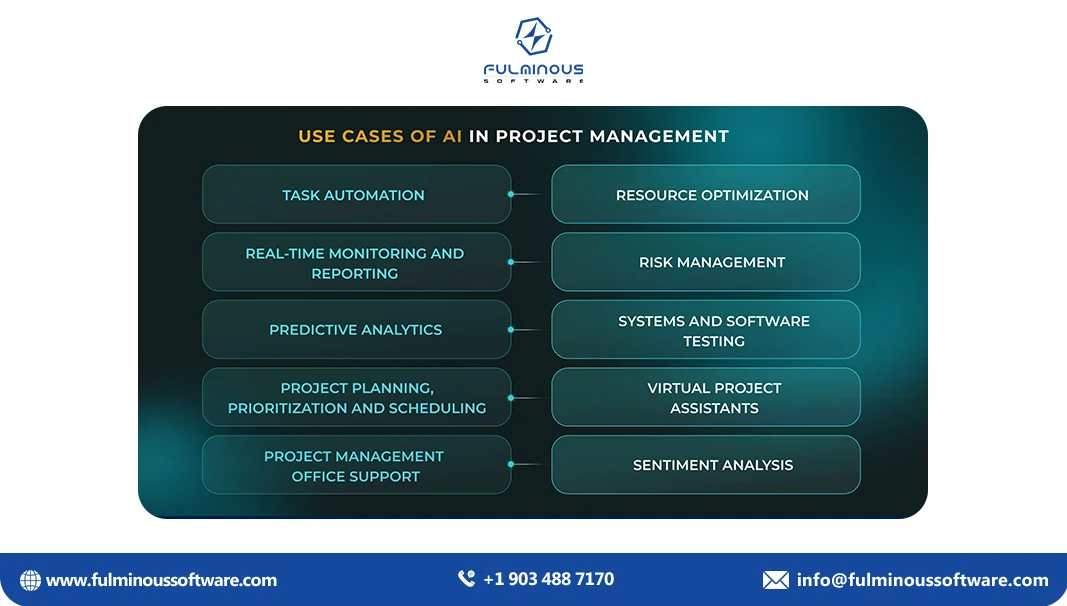
The applications of AI in project management span every industry and every project type. Below are the most impactful and proven AI use cases that project managers and organizations are deploying today:
1. Risk Management & Predictive Forecasting
AI in project management can analyze thousands of risk variables simultaneously — historical project failure patterns, team attrition data, market volatility, and dependency risks — to generate accurate risk forecasts and mitigation recommendations. This transforms risk management from a reactive exercise into a proactive, data-driven discipline. Organizations using AI-powered risk forecasting report up to 45% fewer project failures due to undetected risks.
2. Cost Estimation & Budget Tracking
Budget overruns are one of the most common and costly project management problems. AI tools analyze past project costs, current spending patterns, and real-time resource utilization to deliver highly accurate cost estimates and live budget tracking. Project managers receive early warnings when spending trajectories threaten to exceed approved budgets — enabling timely corrective action before overruns occur.
3. Team Performance Analytics
AI-powered analytics give project managers deep, unbiased insight into how teams are performing — not just at an aggregate level, but at the individual contributor level. By analyzing output quality, task completion rates, collaboration patterns, and workload balance, AI helps project managers identify high performers, at-risk team members, and workflow inefficiencies that would be invisible in traditional reporting.
4. AI in Remote Project Management
Remote project management introduces unique challenges: time zone coordination, communication barriers, cultural differences, and reduced visibility into day-to-day team activities. AI addresses all of these through virtual AI assistants, automated scheduling across time zones, real-time language translation, sentiment analysis on team communications, and intelligent task tracking. The result is remote teams that operate with the cohesion and efficiency of co-located teams.
5. Intelligent Resource Optimization
Getting the most value from both human capital and financial resources is a constant challenge. AI in project management continuously analyzes skill inventories, project requirements, current utilization rates, and future project demand to ensure the right resources are in the right place at the right time — with no over-allocation or under-utilization.
6. Predictive Scheduling with Machine Learning
Machine learning models trained on historical project data can predict task durations, identify likely schedule risks, and dynamically adjust project timelines based on real-world progress. This predictive scheduling capability is one of the most powerful examples of AI in project management — giving teams realistic delivery forecasts rather than aspirational guesses.
7. Automated Compliance Monitoring
In regulated industries — healthcare, finance, construction, and government contracting — maintaining compliance throughout a project is non-negotiable. AI in project management automatically monitors workflows, documentation, and outputs against compliance frameworks, flagging violations in real time. This eliminates compliance blind spots and dramatically reduces audit preparation time.
Benefits of AI in Project Management
Understanding the benefits of AI in project management is essential for any organization evaluating whether to adopt these technologies. The advantages are both immediate and long-term — spanning operational efficiency, cost savings, team performance, and strategic decision-making.
1. Dramatically Improved Efficiency & Productivity
By automating repetitive tasks, optimizing workflows, and providing intelligent scheduling, AI in project management can increase team productivity by 20–35%. Project managers spend less time on administrative overhead and more time on strategic leadership — exactly where their expertise adds the most value.
2. Superior, Data-Driven Decision-Making
Traditional project decisions are often based on intuition, incomplete data, or outdated reports. AI changes this by providing real-time, data-backed insights at every decision point — from resource allocation to risk mitigation to go/no-go decisions. Project managers who leverage AI consistently make faster and more accurate decisions, improving project outcomes at every stage.
3. Significant Cost Savings & Risk Reduction
Budget overruns and scope creep are endemic to manual project management. AI's predictive analytics and automated monitoring capabilities eliminate the root causes of these problems — catching budget anomalies, schedule risks, and resource conflicts before they escalate into costly project failures. Organizations report average cost savings of 15–25% on project budgets after implementing AI-powered project management tools.
4. Enhanced Team Collaboration
AI-powered communication and collaboration tools break down the silos that cause misalignment and miscommunication within project teams. By intelligently surfacing relevant information, automating status updates, and facilitating clearer stakeholder communication, AI ensures every team member — regardless of location, role, or time zone — stays aligned and informed.
5. Real-Time Monitoring & Actionable Reporting
AI transforms project reporting from a periodic, manual exercise into a continuous, automated process. Real-time dashboards provide up-to-the-minute visibility into project health, milestone progress, budget status, and risk indicators — empowering project managers to act on current data rather than information that's days or weeks out of date.
6. Higher Project Success Rates
The cumulative effect of better planning, smarter decisions, proactive risk management, and optimized resource allocation is significantly higher project success rates. Organizations using AI in project management report up to 28% higher on-time delivery and budget compliance compared to traditional methods — a direct bottom-line impact.
7. Long-Term Scalability
Perhaps the most underrated benefit of AI in project management is scalability. As your organization grows — managing more projects, larger teams, and more complex deliverables — AI scales with you. Unlike adding headcount to manage growth, AI-powered project management tools handle increased complexity without proportional cost increases, making them a permanent, future-proof investment.
Looking for expert help with AI in project management?
Get Expert AdviceHow AI in Project Management is Evolving in 2026
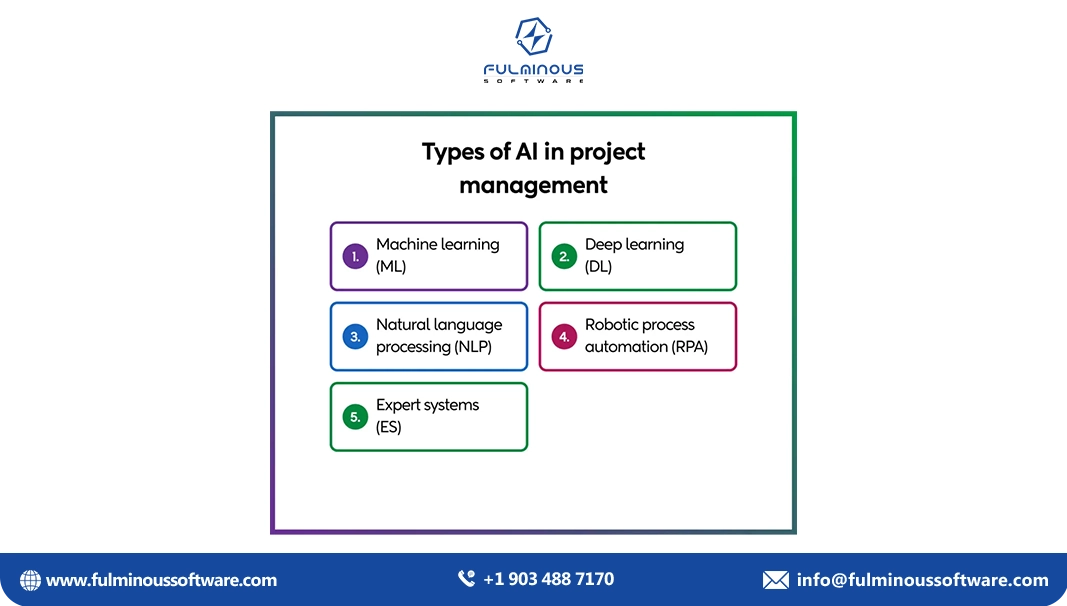
The pace of innovation in AI project management tools is accelerating. In 2026, several key trends are reshaping how project managers and organizations leverage artificial intelligence:
- Generative AI adoption at scale: Generative AI is moving from experimental use to mainstream adoption in project management workflows — most visibly in automated documentation, intelligent report generation, and AI-assisted project planning and execution.
- Agentic AI in project management: AI agents are evolving beyond simple task automation to function as true digital project managers — autonomously managing workflows, communicating with stakeholders, monitoring risks, and escalating issues without human intervention. Get AI agent development services.
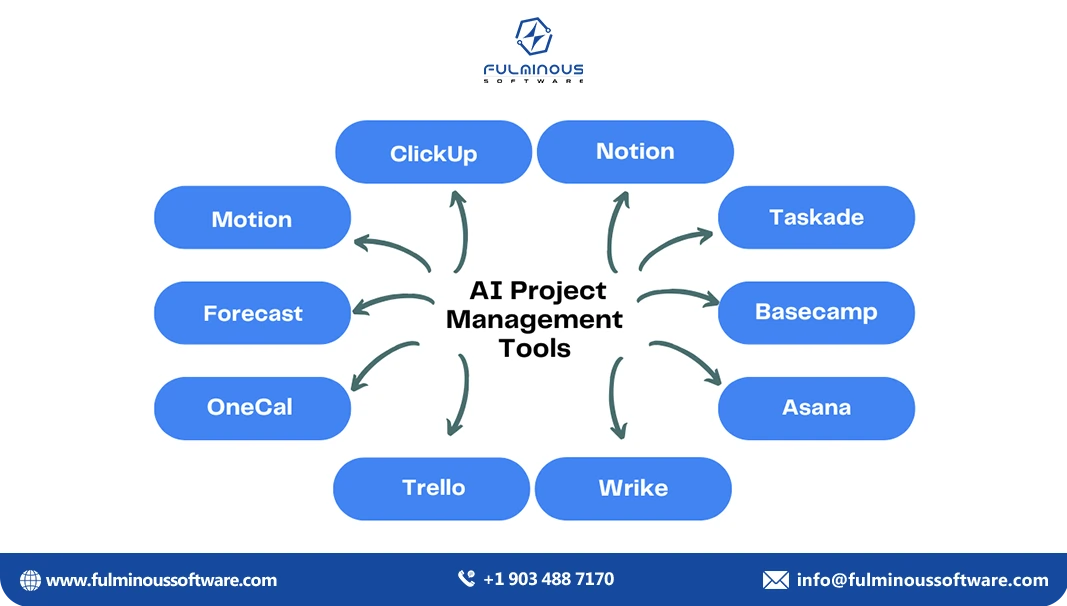
- Deep integration with popular tools: Leading project management platforms — Jira, Asana, Trello, MS Project, ClickUp, and Monday.com — are embedding AI capabilities directly into their interfaces, making AI-powered project management accessible without requiring separate tools or technical expertise.
- AI + IoT + Cloud synergy: The convergence of AI, Internet of Things (IoT), and cloud computing is creating powerful new capabilities for construction, manufacturing, and infrastructure projects — enabling real-time data collection from physical environments and AI-driven analysis in the cloud.
- AI-powered stakeholder management: New AI tools are emerging that specifically focus on stakeholder communication — analyzing stakeholder sentiment, predicting engagement risks, and suggesting communication strategies tailored to different stakeholder profiles.
Challenges and Limitations of AI in Project Management
While the benefits of AI in project management are substantial, a balanced view requires acknowledging the real challenges and limitations that organizations encounter during implementation. Understanding these upfront enables better planning and a smoother AI adoption journey. An experienced AI development and consulting partner like Fulminous Software can help navigate all of these challenges effectively.
| Challenge | Why It Occurs | Recommended Solution |
|---|---|---|
| Data Privacy & Security | AI systems process sensitive project and client data that may be vulnerable to breaches or unauthorized access. | Implement enterprise-grade secure AI tools with end-to-end encryption, role-based access controls, and compliance with GDPR/CCPA/ISO 27001. |
| Over-Dependence on AI | Teams may defer too heavily to AI recommendations, reducing critical human judgment and creativity in project decisions. | Establish clear human oversight protocols — position AI as a decision-support tool, not the final decision-maker. |
| Resistance to Change | Teams accustomed to existing workflows may resist adopting new AI-powered tools, slowing implementation and ROI. | Build an internal change management program: demonstrate clear benefits, involve teams in tool selection, and provide hands-on training. |
| Skill Gaps | Many project management professionals lack the technical skills to configure, manage, or fully leverage AI project management tools. | Invest in structured AI literacy training programs for project managers and team leads to bridge the skill gap progressively. |
| Data Quality Issues | AI systems are only as accurate as the data they're trained on — poor historical project data leads to inaccurate predictions and recommendations. | Conduct a data audit before AI implementation; establish data governance standards to ensure ongoing data quality. |
| Integration Complexity | Connecting AI tools with existing project management platforms and legacy systems can be technically complex and time-consuming. | Partner with an experienced AI integration specialist to design a phased, low-disruption integration roadmap. |
Future Outlook of AI in Project Management (2030 and Beyond)
Looking beyond 2026 to the 2030–2040 horizon, the role of AI in project management will expand dramatically. Here's what leading industry analysts and AI researchers anticipate for the future of AI-driven project management:
- Fully autonomous AI project assistants that can manage entire project phases with minimal human intervention
- Emotion-aware AI for team management — detecting team stress, disengagement, and conflict patterns before they affect project performance
- Personalized project management AI that adapts to each project manager's individual decision-making style and preferences
- Real-time, continuous risk prediction powered by live data streams from all project systems
- AI-driven strategic decision-making that evaluates complex trade-offs and recommends optimal project strategies
- Intelligent, self-optimizing resource allocation that continuously rebalances workloads based on emerging priorities
- Smart scheduling and forecasting using multi-variable machine learning models trained on global project datasets
- Voice-activated project controls enabling hands-free project management via natural language commands
- AI-powered stakeholder communication engines that auto-generate personalized updates for every stakeholder group
- Deep IoT integration for real-time physical project monitoring in construction, manufacturing, and infrastructure
- AI-enhanced cybersecurity protects sensitive project data and intellectual property at every touchpoint
- Predictive budget management that models multi-year project financial scenarios with near-perfect accuracy
The trajectory is clear: AI in project management is not a temporary trend but a fundamental, permanent transformation of the profession. Organizations that invest in AI project management capabilities now will be positioned to outperform competitors for decades to come.
Thinking about AI in project management for your own project? Let's talk - no pressure.
Start a ConversationGet the Best AI in Project Management Solutions from Fulminous Software
Fulminous Software is a leading provider of AI development and integration services, with deep expertise in building custom AI solutions for project management across industries. When you partner with Fulminous Software for AI in project management, you get:
Affordable, High-ROI AI Solutions
All our AI project management solutions are priced to deliver a strong return on investment for businesses of all sizes — from growing startups to large enterprises. Powerful AI in project management doesn't have to mean enterprise-level budgets.
Custom-Built for Your Specific Needs
Every project management environment is unique. Our AI solutions are custom-designed to address your specific workflows, team structure, industry requirements, and project complexity — not generic, off-the-shelf tools that require you to change how you work.
Experienced AI Development Team
Fulminous Software's AI development team has a proven track record of delivering AI solutions for project management organizations across IT, construction, healthcare, finance, and more — bringing both technical expertise and domain knowledge to every engagement.
Growth-Oriented Implementation Approach
Our primary focus is measurable business outcomes. Every AI in the project management solution we deliver is aligned to your growth objectives — whether that means faster delivery cycles, reduced project costs, higher client satisfaction, or scaled project capacity.
Proven Strategies + Continuous Innovation
We combine battle-tested AI implementation methodologies with cutting-edge innovations in generative AI, agentic AI, and predictive analytics — ensuring your AI project management capabilities remain state-of-the-art as the technology evolves.
Future-Ready AI Architecture
Our AI solutions are designed with scalability and future-readiness as foundational principles. As AI technology advances and your organization grows, your Fulminous-built AI project management system will grow and evolve with you.
Conclusion
The case for AI in project management has never been stronger. From AI-powered scheduling and predictive risk forecasting to generative AI documentation and agentic AI assistants, artificial intelligence is fundamentally transforming how projects are planned, executed, and delivered. The benefits — higher success rates, significant cost savings, improved collaboration, and superior decision-making — are well-documented and growing as AI capabilities continue to advance.
Whether you're a project manager looking to work smarter, a project management office (PMO) seeking better portfolio oversight, or an executive looking to improve project delivery ROI, now is the time to integrate AI into your project management practice. Organizations that delay adoption risk falling behind competitors who are already capturing the substantial advantages that AI in project management delivers.
If you're ready to explore how AI in project management can transform your team's performance and delivery outcomes, Fulminous Software is your trusted AI implementation partner. Our team of experienced AI developers and project management specialists will help you design and deploy a custom AI solution that delivers measurable results from day one. Contact us today to start your AI in project management journey.
Frequently Asked Questions (FAQs)
Q1. What is AI in project management?
AI in project management refers to the application of artificial intelligence technologies — including machine learning, natural language processing, predictive analytics, and generative AI — to automate tasks, forecast risks, optimize resources, and enhance decision-making across the entire project lifecycle. It acts as a comprehensive intelligent assistant for project managers, supporting everything from initial planning through final delivery and post-launch optimization.
Q2. What is the role of AI in project management?
AI in project management plays multiple interconnected roles: it automates repetitive administrative tasks, provides predictive insights on risks and budgets, optimizes resource allocation, enhances team collaboration, monitors project performance in real time, and generates reports and documentation automatically. In essence, AI amplifies the capabilities of human project managers at every stage of the project.
Q3. How can generative AI be used in project management?
Generative AI can assist project managers in drafting project documentation, writing progress reports, summarizing meetings, brainstorming "what-if" scenarios for strategic planning, creating customized project templates, generating stakeholder presentations, and providing intelligent decision support for resource, budget, and schedule challenges.
Q4. What are the key benefits of AI in project management?
The key benefits of AI in project management include dramatically improved efficiency and productivity, superior data-driven decision-making, significant cost savings and risk reduction, enhanced team collaboration, real-time monitoring and reporting, higher project success rates, and long-term scalability. Organizations using AI in project management consistently outperform those relying on manual methods across all major project performance metrics.
Q5. How is AI project management evolving in 2026?
In 2026, AI in project management is evolving rapidly across several fronts: generative AI is being adopted at scale for documentation and planning, AI agents are functioning as autonomous digital project managers, popular tools like Jira, Asana, and ClickUp are embedding AI features natively, and the convergence of AI, IoT, and cloud computing is creating powerful new capabilities for complex project environments.
Q6. Can AI replace project managers?
No — AI cannot and will not replace human project managers. While AI excels at data analysis, pattern recognition, automation, and optimization, human project managers are irreplaceable for leadership, stakeholder relationship management, ethical decision-making, creative problem-solving, and navigating the complex interpersonal dynamics that define real-world projects. AI augments and enhances the capabilities of human project managers rather than replacing them.
Q7. What are the best use cases for AI in project management?
The most impactful use cases for AI in project management include: predictive risk management and forecasting, automated cost estimation and budget tracking, AI-powered team performance analytics, remote team management and coordination, intelligent resource optimization, predictive scheduling with machine learning, and automated compliance monitoring. Each of these use cases delivers a measurable ROI that justifies AI investment.
Q8. What are the challenges of AI in project management?
Key challenges of AI in project management include data privacy and security risks, the risk of over-dependence on AI reducing human judgment, team resistance to adopting new tools, skill gaps in AI literacy among project management professionals, data quality issues affecting AI accuracy, and the technical complexity of integrating AI tools with existing project management platforms. All of these challenges are manageable with the right implementation strategy and a qualified AI partner.
Q9. How is AI used in agile project management specifically?
AI enhances agile project management by supporting sprint planning with capacity analysis and backlog suggestions, accelerating backlog refinement through intelligent user story prioritization, tracking velocity trends and detecting bottlenecks in real time, reviewing retrospective data to suggest process improvements, running automated QA testing, and forecasting accurate sprint completion and delivery dates based on current team performance.
Q10. How do I get started with AI in project management for my organization?
To get started with AI in project management: first, identify the highest-pain manual tasks in your current project workflows. Then, evaluate AI tools that integrate with your existing platforms (like Jira, Asana, or MS Project). Start with a focused pilot project to demonstrate value and build team confidence. Invest in AI literacy training for your project management team. Finally, partner with an experienced AI development company like Fulminous Software to build custom AI solutions tailored to your specific project management needs and growth objectives.
 Verified
Expert in Software & Web App Engineering
Verified
Expert in Software & Web App Engineering
I am Manish Kumawat, co-founder of Fulminous Software, a top leading customized software design and development company with a global presence in the USA, Australia, UK, and Europe. Over the last 10+ years, I am designing and developing web applications, e-commerce online stores, and software solutions custom tailored according to business industries needs. Being an experienced entrepreneur and research professional my main vision is to enlighten business owners, and worldwide audiences to provide in-depth IT sector knowledge with latest IT trends to grow businesses online.



Partner with Top-Notch Web Application Development Company!
Discuss your Custom Application Requirements on info@fulminoussoftware.com or call us on +91-935 141 8445.
15 Days Risk-Free Trial