
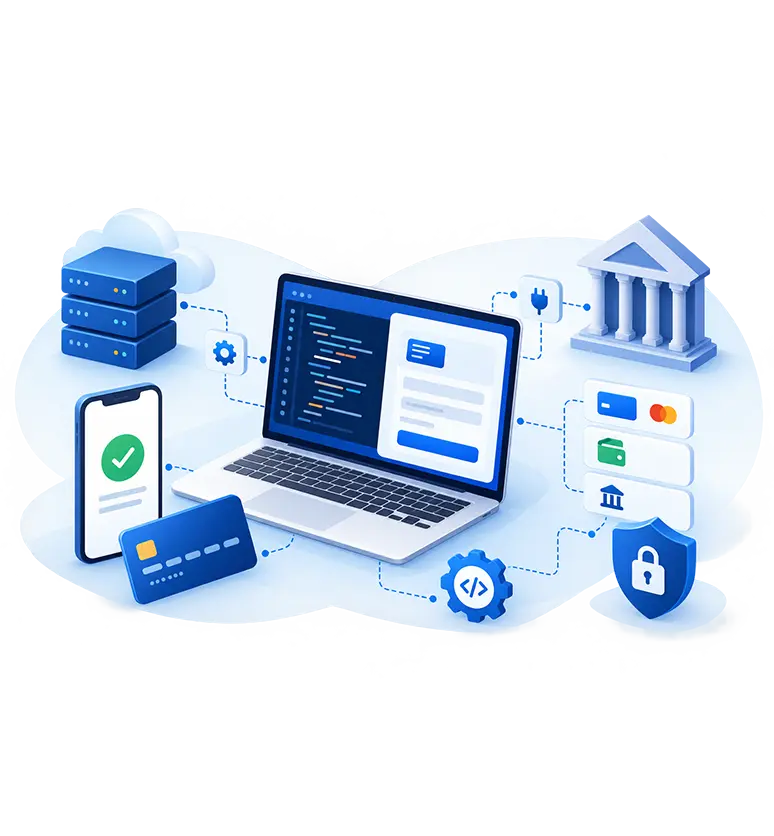
Payment Gateway API Integration Services

Secure, scalable payment integrations for web, mobile, and SaaS platforms

Are failed payments costing you sales? Struggling to connect your gateway to your site or app? Spending too long on manual refunds and tracking? Our payment gateway integration service links your payment system with your website, app, and business software. Payments, refunds, and transactions run with far less manual work.

Fulminous Software provides payment gateway API integration services for global businesses. Our 10+ backend developers work in Java, PHP, Python, Node.js and .NET, and we connect your product to Stripe, Razorpay, BillDesk, PayU, CCAvenue, PayPal, Adyen and most other gateways in common use. We build the payment gateway integration, test it against the gateway's sandbox, and stay on after launch.

If you want to launch a new checkout, add subscriptions, move to a different gateway, or run more than one gateway without the headaches, you can get in touch with Fulminous Software.

fulminous software Payment-Gateway-API-Integration-Services

Get the Best Payment Gateway API Integration Services

Fulminous Software is a payment gateway integration company with 30+ payment gateway API integration real projects in Java, PHP, Python, Node.js and .NET. Our payment gateway API integration services are built around your existing backend, so the code is easy for your own team to run and maintain. Our developers are strong in:

  • Payment Gateway API Integration Services
  • API Integration for Payment Gateway
  • API Integration Payment Gateway (web and mobile)
  • Java Payment Gateway Integration
  • Payment Gateway Integration in Java (Spring Boot)
  • Laravel Payment Gateway Integration
  • Django Payment Gateway Integration
  • BillDesk Payment Gateway Integration in PHP

You can hand over the whole payment gateway integration project or add our payment gateway integration developers to your own team at $20 to $60 per hour. If you haven't picked a gateway yet, we'll also help you choose one first. Contact us now!

What we build

Custom payment gateway API integration:

server-side code that creates orders, captures payments, handles callbacks and writes the result back to your database.

API integration payment gateway setup for web and mobile:

one backend that behaves the same on your website, your Android app and your iOS app.

Checkout and payment pages:

clear forms, readable error messages and saved payment methods.

Subscriptions and recurring billing:

plans, trials, retries for failed cards and auto-pay mandates.

Refunds, payouts and reconciliation:

full and partial refunds, vendor payouts and settlement reports that match your books.

Webhook handling:

verified, idempotent handlers that survive late, duplicate and out-of-order events.

Gateway migration:

moving from one provider to another without breaking live customers.

Multi-gateway routing:

sending transactions to the right gateway and switching when one goes down.

Monitoring and support:

dashboards, alerts and quick fixes when a gateway changes its API.

How Payment Gateway APIs Work

A gateway API is a set of endpoints your server calls over HTTPS. Most are REST-based, and many ship with SDKs that wrap the calls for you. Whatever the provider, a payment runs through the same loop:

  • Your server authenticates with its API credentials (a key and secret pair, or an OAuth token) and sends a request, such as create an order or authorize a card.
  • The gateway validates the request, runs its fraud checks and passes the transaction on to the card network or the bank.
  • The issuing bank approves or declines.
  • The gateway returns a response. Your server stores the result and updates the order.
  • A webhook arrives a few seconds later with the final status.

People tend to skip the last step. Don't. Responses time out and customers close the tab halfway through. The webhook is how you find out what really happened.

Taking a payment is only the start. The same APIs let you authorize now and capture later, void a transaction, refund all or part of it, save a card as a token, set up recurring payments, pull settlement files and run batch payouts. Some gateways also publish an event stream you can replay, which is handy when your own system was down for an hour.

Your side of the deal is simple to state and easy to get wrong: keep keys out of source code and front-end bundles, never log card data, and stay inside the PCI DSS scope that your chosen method allows. We handle API integration for payment gateway projects every week, and the approach doesn't change much. Keep the money path boring.

Payment Gateway Integration Methods

There's no single right way to connect to a gateway. The method you pick decides how much of the checkout you control, how much compliance work lands on you, and how long the build takes. This is how we usually explain the options:

MethodHow it worksFits best whenCompliance loadBuild effort
Hosted payment pageCustomer is redirected to the gateway's page to payYou need to launch fast or have a small teamLowestLow
Embedded iframe or hosted fieldsGateway-owned card fields sit inside your own pageYou want your branding without touching card dataLowLow to medium
SDKs and librariesOfficial packages for web, Android, iOS and server languagesYou want a native feel and faster developmentLow to mediumMedium
Direct API integrationYour server talks to the REST API itselfYou need custom flows, marketplaces or heavy back-office logicHigherMedium to high
Unified payment interfaceOne internal API with an abstraction layer over several gatewaysYou run more than one gateway or expect to switchDepends on the gatewaysHigh
Self-hosted custom gatewayYou build and run your own payment moduleVery high volume with a dedicated payments teamHighestVery high

For most clients we start with SDKs or hosted fields and move to direct API calls only where the product needs it. Going direct when you don't have to is the easiest way to inherit a much bigger PCI scope.

Benefits of Payment Gateway API Integration

A clean payment gateway integration earns its keep in places you might not expect. Here's what clients tell us changes first.

Customers get through checkout

Fewer redirects, clear error messages and the right payment options for each market mean fewer abandoned carts. Saved cards and auto-pay take care of repeat buyers.

Security becomes a smaller problem

With tokenization and hosted fields, card numbers never reach your servers. That shrinks your PCI scope, which means a shorter audit and less to defend. Cloud-hosted gateways add their own network and encryption layers on top.

Your growth isn't capped by the checkout

A well-built payment service handles sale-day traffic through queues and idempotent calls, so a spike doesn't turn into duplicate charges.

You can shape the experience

Direct API and SDK integrations let you customise the flow, the screens and the messages. Some gateways also offer white-label options if you want the payment step to look entirely like yours.

Online and offline work together

Omnichannel payment features let a website, a mobile app and a point-of-sale system share the same customer, order and refund records.

Money moves where it should

Refund processing, payouts and split settlements run from your own admin panel instead of the gateway dashboard.

You see what's happening

Reporting and analytics show success rates by method, bank and hour, so you can spot a failing route before customers complain.

You can lower your fees

With cost-smart transaction routing, payments can go to whichever gateway is cheapest or most reliable for that card type. This is where payment orchestration pays for itself, and we cover it in a later section.

Supported Payment Methods and Currencies

What you can accept depends on the gateway, the country you settle in and the licences the gateway holds there. Check this before you sign anything, because adding a method later is rarely a one-line change.

MethodWhat it coversWorth knowing
Credit and debit cardsVisa, Mastercard, RuPay, Amex and othersNeeds 3D Secure or equivalent authentication in most markets
Digital wallets and payment appsApple Pay, Google Pay, PayPal, Paytm and similarOften one-tap, and strong for mobile conversion
UPI and net bankingDirect bank payments, collect requests and QRThe default for many Indian customers
ACH and bank transfersUS ACH, SEPA, international bank account transfersCheaper per transaction, but slower to settle
Prepaid cardsPhysical and virtual prepaid cardsSupport varies by gateway
In-app paymentsNative SDK flows inside Android and iOS apps, with biometric authenticationNeeds the mobile SDK, not a web redirect
Recurring and subscription paymentsCard-on-file, e-mandates, auto-payRules differ by country and by bank

For cross-border sales, multi-currency support matters more than most teams expect. Decide early whether you want to price in the customer's currency, settle in your own, and who absorbs the currency conversion fee. A hosted payment page can cover many of these methods quickly. A direct integration gives you more control but means more testing for each one.

Language-Specific Payment Gateway Integration

Fulminous Software doesn't believe in one generic approach. A Spring Boot service and a Laravel monolith call for different habits, so Fulminous Software builds in the framework you already run and follows its conventions. That keeps the code familiar to your own developers after handover.

Java Payment Gateway Integration

Banks, insurers and large retailers tend to run Java, usually on Spring Boot. Our payment gateway integration in Java ranges from a single checkout call to a standalone payment microservice that several products share. On a typical project we:

  • write REST clients for the gateway's order, capture, refund and status endpoints
  • generate and verify request signatures, hashes and JWS tokens
  • add idempotency keys and safe retry logic, so a network blip never charges a customer twice
  • build webhook controllers that verify the signature before touching any data
  • keep a transaction ledger in JPA or Hibernate that finance can reconcile against
  • cover the flow with JUnit and Mockito tests that run against the gateway sandbox

Laravel Payment Gateway Integration

Laravel suits payments well because its structure keeps the messy parts out of your controllers. Our Laravel developers usually build a payment service class with a driver for each gateway, so adding a second gateway later means writing one new driver, not rewriting checkout.

  • Stripe, Razorpay, PayPal, PayU, Cashfree and other gateways
  • Laravel Cashier for subscriptions and invoices where it fits
  • Webhook routes with CSRF exclusion and signature checks
  • Queued jobs and events for order confirmation, emails and retries
  • An admin view for payment logs, refunds and failed transactions

Django Payment Gateway Integration

Python teams get the same care. Fulminous Software builds payments into Django and Django REST Framework so that web and mobile clients share one set of endpoints.

  • Payment models, serializers and API views for orders, attempts and refunds
  • Stripe, Razorpay, PayPal and other gateways through their official Python libraries or plain REST
  • Webhook views with signature checks that process each event once
  • Celery tasks for retries, delayed status checks and nightly reconciliation
  • Django signals that trigger fulfilment, invoices and customer emails
  • Tests that run against sandbox accounts, not mocks alone

BillDesk Payment Gateway Integration in PHP

BillDesk is a common choice for banks, utilities, insurers and government portals in India, and its onboarding has more steps than most gateways. Our BillDesk payment gateway integration in PHP covers core PHP, Laravel, CodeIgniter, WordPress and Magento projects. We take care of:

  • signed order creation and request generation
  • return URL handling and response verification
  • webhook processing so statuses stay correct when the customer never comes back
  • status checks, refunds and daily reconciliation
  • UAT testing and go-live, working with your BillDesk onboarding contact

Node.js, .NET and everything else

If your stack isn't listed, ask. Fulminous Software also integrates payment APIs with Node.js, .NET, Ruby, Go and headless commerce platforms. Tell us what you run and we'll tell you honestly whether we're the right fit.

Our Payment Gateway Integration Roadmap

Every payment gateway API integration we run follows the same six steps. Projects differ in size, not in order.

Requirements.

We ask what you sell, where, in which currencies, how often customers pay and what finance needs from the reports. We also read the gateway's API documentation before promising anything, because the docs often reveal limits the sales page doesn't.

Design.

We pick the integration method, whether that's a hosted page, SDK or direct API, and sketch the payment flow, the data model and the failure cases. What happens when the bank is slow? When the webhook never comes? These get answered on paper first.

Tech stack.

We match the build to your existing backend, so your own team can maintain it. Most of the time that means no new language and no new framework.

Build.

Developers work in short sprints against the gateway's sandbox. Error handling, idempotency and logging go in from the first commit, not as a clean-up task at the end.

Testing.

We test success, failure, pending, duplicate, timeout and refund paths, then run a small controlled launch with real money before opening it to everyone.

Support.

After go-live we monitor failed payments, handle gateway API version changes and keep the integration current. You can keep us on a retainer or take the code in-house.

Security and Compliance Requirements

Security isn't a phase you add before launch. It decides which integration method you choose, so we raise it in the first call. These are the areas we cover on every project.

PCI DSS

Any business that touches card payments falls under PCI DSS, but how much of it applies to you depends on your integration. Hosted pages and hosted fields keep card data away from your servers and keep you in the lightest self-assessment. Direct integrations carry heavier requirements. We help you work out where you sit and design to stay there.

Tokenization

Customers' cards are stored by the gateway as tokens. Your database holds the token, never the card number.

API key management

Keys live in a secrets manager or encrypted environment variables, never in the repository or in a mobile app build. Fulminous Software uses separate keys for test and live, and we rotate them on a schedule. Where a gateway supports OAuth tokens, we prefer short-lived ones.

Encryption and network controls

TLS everywhere, encrypted storage for anything sensitive, firewalls and IP allow-lists for gateway callbacks where the provider publishes them.

Idempotency and webhook safety

Idempotency keys stop duplicate charges. Webhook handlers check the signature before acting, and ignore anything they've already processed.

Regulated industries

Lending, wallets and marketplaces may need KYC checks and AML monitoring wired into the payment flow. Healthcare clients may need HIPAA-compliant data handling, and phone-based payments may need DTMF masking so card digits never appear in recordings. Fulminous Software builds these in from the start because adding them later usually means rework.

Common Integration Challenges and How We Handle Them

Any API integration for payment gateway projects hits a few predictable walls. None of them is hard to deal with if you plan for it. All of them are expensive if you meet them in production.

ChallengeWhy it happensWhat we do
Unreliable webhooksCallbacks arrive late, twice or out of orderVerify signatures, process each event once, and run a reconciliation job that checks the gateway's records
Duplicate or stuck paymentsTimeouts and retries on a slow networkIdempotency keys, status polling and clear pending states
Expanding to new countriesEach market has its own methods, rules and banksAdd local payment methods per region and check licence coverage before launch
Regulatory hurdlesKYC, data residency and card network rules differ by countryInvolve compliance early and keep regional logic separate in the code
Hidden costsSetup fees, currency conversion, chargebacks, failed-payment feesBuild a fee model before you pick a gateway, then check it against real transactions
Weak gateway supportSlow responses when something breaks on a live dayAsk about live customer support hours, escalation paths and SLAs before signing
Several gateways to maintainDifferent fields, errors and refund rulesOne internal payment interface with an adapter per gateway
Slipping timelinesGateway onboarding and approvals take longer than the codeStart merchant onboarding on day one, in parallel with development

Multi-Gateway Strategy and Vendor Lock-In

One gateway is fine until it isn't. It goes down on your biggest sales day, raises its rates, or doesn't support the market you're entering next quarter. By then, switching can mean months of work, because the gateway's field names and flows are scattered through your code.

The fix is an abstraction layer. Your application talks to one internal payment interface with its own simple methods: create payment, confirm, refund, check status. A small adapter for each gateway translates those calls into that gateway's API. Add or replace a gateway and you write a new adapter. Checkout, orders and reports don't change.

Once that layer exists, a few useful things become possible:

Failover.

If the primary gateway returns errors or times out, the payment retries through a second one without the customer noticing.

Intelligent routing.

Send each transaction where it's cheapest or most likely to succeed, by card type, bank, amount or country.

Better negotiating position.

You can move volume, and vendors know it.

Feature access.

Use one gateway for subscriptions and another for local methods, without rebuilding your product.

A few cautions. Bundled pricing from a merchant account provider can look attractive and still tie you to one vendor's features. If you're an ISV or MSP integrating payments on behalf of your own customers, you'll probably need a unified payment interface from the start, since each client may use a different gateway. And don't add a second gateway until you need one. The abstraction layer is worth building early, but running several accounts adds reconciliation work. We'll tell you plainly which side of that line you're on.

Team Roles and Technical Skills You'll Need

A payment project is small on paper and wide in practice. It touches your backend, your front end, your finance process and a third party's rules. These are the roles that usually matter:

RoleWhat they own
Solution architectIntegration method, payment flow, data model, gateway selection
Backend developerGateway API calls, error handling, idempotency, webhooks, ledger
Frontend or mobile developerCheckout screens, SDK setup, in-app and omnichannel payment features
DevOps engineerSecrets, environments, deployment, monitoring and alerts
QA engineerTest strategy, test plan and test cases for success, failure and refund paths
Security and compliance leadPCI DSS scope, KYC and AML requirements, audit evidence
Project manager or business analystRequirements, gateway onboarding, stakeholder sign-off

Beyond the job titles, the skills that count are practical ones: reading messy API documentation, designing for failure, writing retry logic that doesn't double-charge, and explaining payment states to a non-technical finance team.

You can fill these roles three ways. Build an in-house team if payments are central to your product. Outsource the whole project if they aren't. Or use staff augmentation to add a few specialists to your existing team for the length of the build. We work in all three models, and plenty of clients start with one and switch to another.

Integration Costs and Pricing Factors

Two different bills hide inside the word cost, and clients often only budget for one of them.

What the gateway charges you.

Transaction fees (usually a percentage plus a fixed amount), a monthly gateway fee on some plans, setup fees, currency conversion fees on international payments, and charges for chargebacks and failed payments. Ask for the full fee schedule, not the headline rate.

What building and running it costs you.

Developer time, any change to your infrastructure, security reviews and audits, compliance work, and ongoing maintenance when the gateway updates its API. The cost of our payment gateway API integration services depends mainly on the following:

  • how many gateways and payment methods you need
  • your backend language and framework
  • web only, or web and mobile
  • subscriptions, split payments or payouts
  • how much reconciliation and reporting finance expects
  • multi-currency and cross-border requirements
  • third-party systems to connect, such as ERP, CRM or accounting software
  • the testing and compliance effort

Payment Gateway API Integration Costs

Here are typical payment gateway API integration cost ranges. Your quote will depend on the scope, so treat these as a starting point.

ServiceEstimated cost
Gateway consulting and selection$1,500 – $5,000+
Single gateway integration (web)$2,500 – $8,000+
API integration payment gateway work (web and mobile)$4,000 – $12,000+
Java payment gateway integration$4,000 – $15,000+
Laravel payment gateway integration$2,500 – $8,000+
Django payment gateway integration$3,000 – $9,000+
BillDesk payment gateway integration in PHP$2,000 – $6,000+
Subscriptions and recurring billing$5,000 – $15,000+
Multi-gateway orchestration$10,000 – $30,000+
Marketplace split payments and payouts$8,000 – $25,000+

Future Trends in Payment Gateway Integration

Payment gateway API integration keeps changing, through new technology, shifting standards and different customer habits. Fulminous Software don’t try to predict all of it. These are the shifts we’re already building for in client projects.

Embedded payments

More software platforms now take payments inside their own product instead of sending users elsewhere. Sub-merchant onboarding, split settlement and payouts all run through APIs. Marketplaces and SaaS tools are ahead here, and the rest are catching up.

Local payment method support

Customers expect to pay the way they usually do, whether that’s UPI, wallets, bank transfers or buy-now-pay-later. Cards alone don’t cover it anymore. Gateways with strong regional acquiring relationships often get better approval rates in a market than a global brand does, so it’s worth checking who actually acquires for you locally.

Mobile payment integration

In-app payments, one-tap wallets and biometric authentication are replacing typed card numbers. A good mobile integration depends on the SDK, the backend and the webhook all agreeing on the state of every payment. Most mobile bugs we see come from those three disagreeing.

Recurring payments

Subscriptions, usage-based billing and auto-pay mandates are no longer limited to streaming and SaaS. Utilities, education and insurance are adopting them too, which means more teams need to handle mandates, retries and failed renewals properly.

Blockchain and cryptocurrency integration

Some gateways now accept stablecoins and other cryptocurrencies. Integration usually means generating a crypto wallet address for each order, watching the blockchain for confirmations, and settling in either crypto or fiat. It only makes sense if your customers are asking for it and your finance team can handle the accounting. We’ll build it when you need it, and we’ll tell you if you don’t.

Payment module architecture

Gateways are tightening their versioning, retiring old endpoints faster and improving their webhook management tools. If all gateway code lives in one isolated payment module, those changes turn into small updates instead of rewrites, and switching providers stays a contained job.

Integration speed and secure cloud connectivity

Better sandboxes and clearer documentation keep making integrations faster to build. At the same time, secure cloud connectivity, such as private links and allow-listed endpoints, is becoming standard between your systems and the gateway. The slow part is increasingly approvals, not code.

Why Teams Choose Fulminous Software

There are plenty of agencies that can paste a gateway's sample code into a project. What makes our payment gateway integration services different is what happens around that code.

We build for failure first.

Fulminous Software plans for late webhooks, retries and half-finished payments before we write the happy path.

We work in your stack.

Java, Laravel, Django, PHP, Node.js or .NET, using your framework's habits so your team can own the code.

We're upfront about the slow parts.

Gateway approvals, compliance reviews and bank testing take time. Fulminous Software tells you early and starts them in parallel.

You get clean handover.

Readable code, API documentation, a test suite and a short runbook for whoever is on call.

We stay after launch.

Gateways change their APIs. Fulminous Software monitors your integration and updates it, or we hand it over fully if you'd rather run it yourself.

Pricing is plain.

Hourly rates from $20 to $60, and fixed quotes when the scope is clear.

Engagement Models and Hiring

Pick the model that fits your project and change it later if you need to: dedicated team, fixed price, time and material, staff augmentation, project-based hiring, or a small trial project.

  • Hourly hiring: $20 to $60 per hour
  • Dedicated developer: $2,500 to $8,000 per month
  • Dedicated Java developer for payment gateway integration in Java: $3,000 to $8,000 per month
  • Dedicated API integration payment gateway specialist: $2,500 to $7,000 per month
  • Single gateway setup: from $2,000 per project
  • Gateway migration: from $3,000 per project
  • Support and maintenance: $300 to $2,000 per month
  • Payment Gateway Testing: Starts from $1,000 per project.

Case Studies

A second gateway for an online retailer

A growing e-commerce brand kept losing orders during sales because its only gateway slowed down under load. Fulminous Software added a second gateway behind an internal payment interface, rebuilt the webhook handling and made order updates idempotent. Checkout stayed the same for customers, and the work took six weeks.

What changed: fewer failed checkouts at peak traffic, no more duplicate charges or orphan orders, and reconciliation that finance could run without a spreadsheet.

Subscription billing for a SaaS product

A SaaS company needed monthly and annual plans, upgrades mid-cycle and a way to recover failed renewals. Our Django team connected the gateway's subscription APIs, wrote Celery jobs for retries and reminders, and added a small admin panel for refunds and invoices.

What changed: more failed renewals recovered, self-service plan changes for customers, and clean payment reports for the finance team.

Talk to a Payments Developer Today

Dealing with failed payments, a tricky gateway setup, or messy payment tracking? Tell us what you’re building, and we’ll suggest the right gateway, outline the work, and give you a quote. Connect to us for:

  • API integration for payment gateway projects on custom backends
  • API integration payment gateway setup for web and mobile apps
  • Java payment gateway integration
  • Payment gateway integration in Java with Spring Boot
  • Shopping cart integration Payment gateway API
  • Laravel payment gateway integration
  • Django payment gateway integration
  • BillDesk payment gateway integration in PHP
  • Stripe, Razorpay, PayU, CCAvenue and PayPal integrations
  • Subscriptions, refunds, payouts and reconciliation
  • Webhook development and gateway migration
  • Multi-gateway routing and payment orchestration
  • Payment security reviews and PCI DSS scoping

Contact the Fulminous Software team!

FAQs

It connects your website, app or backend to a gateway's APIs so you can take payments, track their status and issue refunds. The visible part is the checkout. Most of the work sits behind it, in webhooks, error handling and reconciliation.