
Dedicated Development Team Services: A Complete Guide for Businesses

Manish Kumawat
Last Updated on: 30 October 2026



Availability of an expert team for each development project is a concern for almost all businesses. Sometimes there will be more than one project going on at the same time. The roadmap is packed, the backlog keeps growing, and the engineers may feel overloaded.
Recruiting a full team in-house can consume up to six months before a single feature ships. Freelancers are quick to start but hard to rely on 100%. Agencies that bill by the development project often vanish the day you need a small change.
That's the gap dedicated development team services can cover up. Instead of buying a deliverable or setting up an in-house team, you get a committed group of engineers, testers and designers who work only on your product, for as long as you need them. It's a model that has quietly become the default for companies that see software as a long-term goal rather than a one-time purchase.
In this guide, we will see what a dedicated development team service really includes, how it compares with staff augmentation and fixed-price work, and when each option makes sense. We will also look at full-stack and app-focused teams, the rise of the self-managed model, offshore and remote setups, how to handle day-to-day management without time-consuming meetings, and what to check before you hire dedicated development team services.
Table of Contents
15 sectionsWhat Are Dedicated Development Team Services?
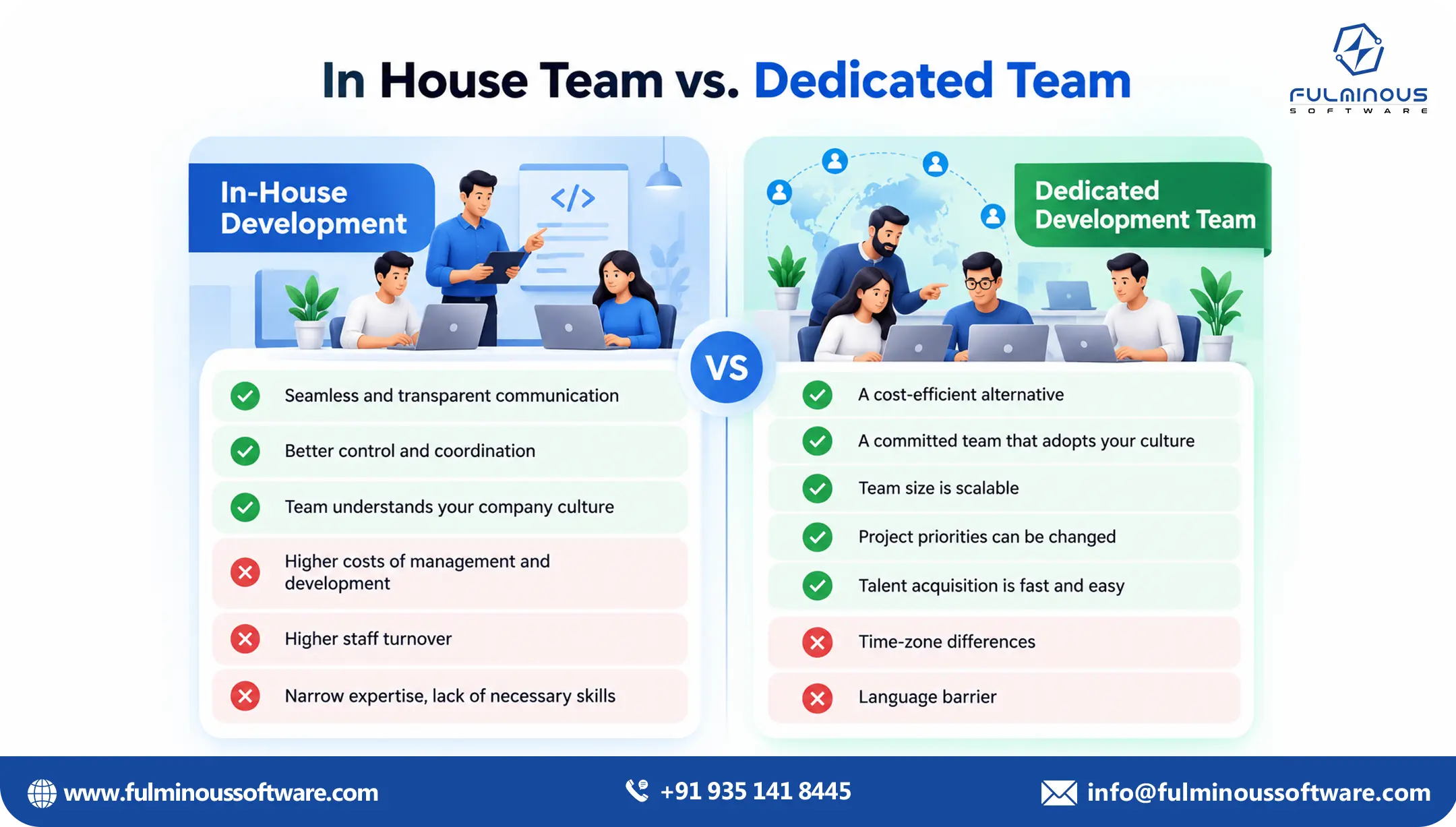
Dedicated development team services are an engagement model where a technology partner builds a team of engineers, QA specialists and designers who work exclusively on your specific project. You pay a predictable monthly fee. That fee covers salaries, equipment, management overhead and the partner's margin. You set the priorities and own everything with full control of what gets built. The partner takes care of recruiting, payroll, HR, workspace and retention.
You'll see the same idea of services sold under several labels: a dedicated software development services team, a dedicated team model, or an extended team. The wording may change, but the principle doesn't. The people are yours in every way except the payslip.
Providers of dedicated software development team services usually put together a mix like this:
- A project or delivery manager who keeps work moving
- A technical lead or architect who guards code quality
- Two to eight developers, split across frontend, backend and mobile as your product needs
- One or two QA engineers
- A UI/UX designer
- A DevOps engineer, often part-time at the start
What makes the development team "dedicated" is exclusivity and continuity. These people don't juggle five other clients or tie up with others when you hire them. They learn your codebase, your customers and your environment, and that context compounds month after month. So it's just like an extended version of your in-house team or business team.

How it differs from other engagement models
| Model | Best for | Your control | Commitment | Weak spot |
|---|---|---|---|---|
| Fixed-price project | Short, well-defined scope | Low | Per project | Change requests get painful |
| Time and materials | Evolving scope, short horizon | Medium | Flexible | Costs drift without tight tracking |
| Staff augmentation | Filling one skill gap on your own team | High | Individual hires | You manage everyone yourself |
| Dedicated team | Ongoing products, long roadmaps | High | Monthly, usually six months or more | Needs clear direction from you |
In simple words, staff augmentation gives you extra hands. A dedicated development team service gives you a unit that already works as a development team, with its own rhythm, its own standards and its own accountability.
Why More Businesses Are Choosing This Model
Did you know? 92% of top 2000 companies and 37% of small businesses prefer outsourcing projects to dedicated development teams. Demand for developers is rising more than five times faster than the job market as a whole.
Especially for a startup or a mid-sized company, assembling five or six engineers at a huge salary is a serious commitment, and finding them is slower still. That pressure is exactly why so many leadership teams now choose to hire dedicated development team services instead of building everything in-house.
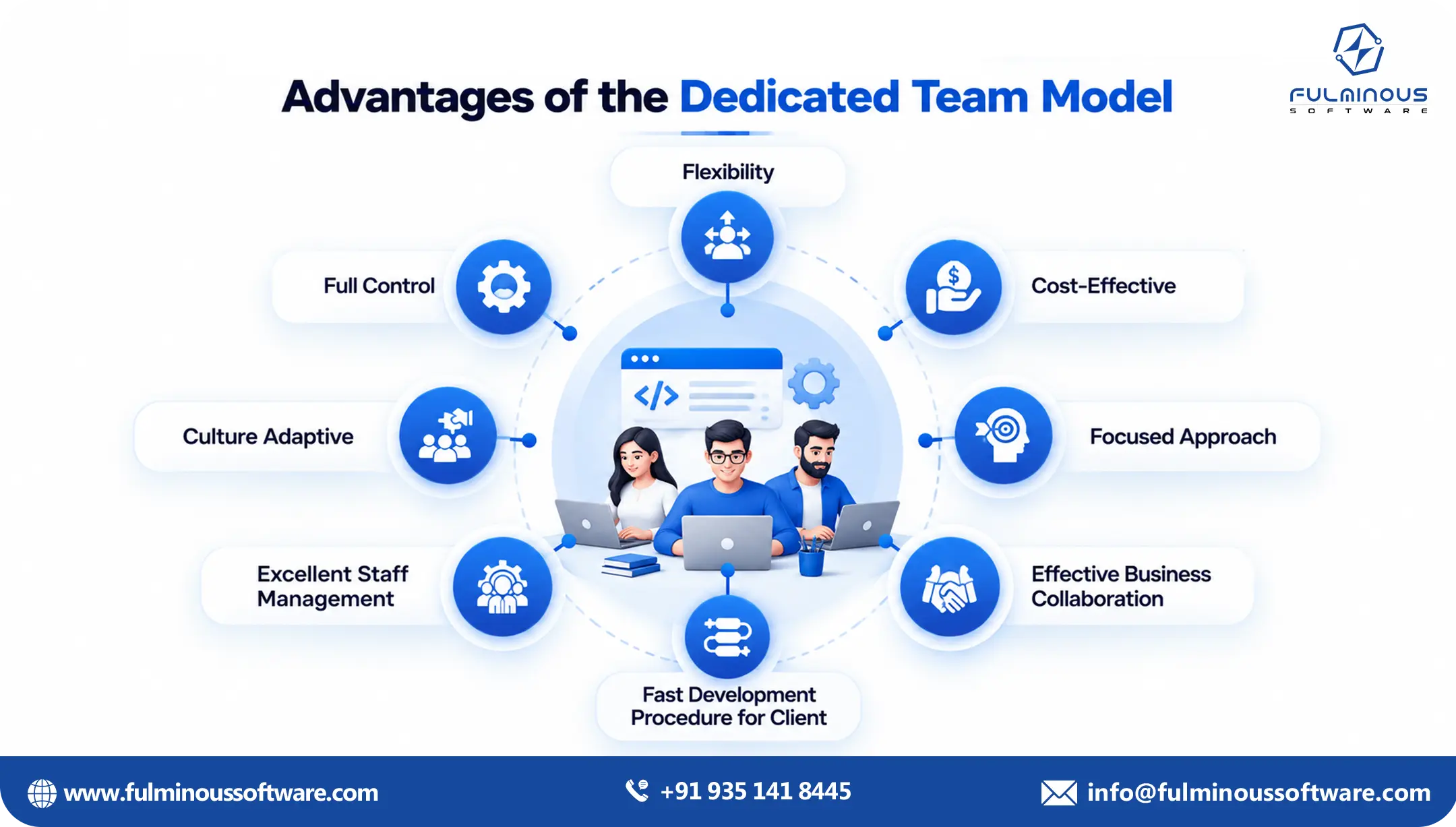
The model offers a handful of clear advantages:
Speed. A ready dedicated development team can often start within days, not delays.
Cost clarity. One monthly invoice replaces recruiter fees, benefits, laptops, licences and office space.
Focus. Your leadership talks to a team with direct communication.
Flexibility. You can scale up before a launch and scale down afterwards or at any time.
Knowledge retention. Because the team stays together, product knowledge will be maximized.
Lower hiring risk. If someone isn't the right fit for your projects, the agency replaces them, not you.
This is also why a dedicated development team for long-term projects is a hot topic. The longer the engagement runs, the more the shared context pays you back.
How Dedicated Development Team Services Work, Step by Step
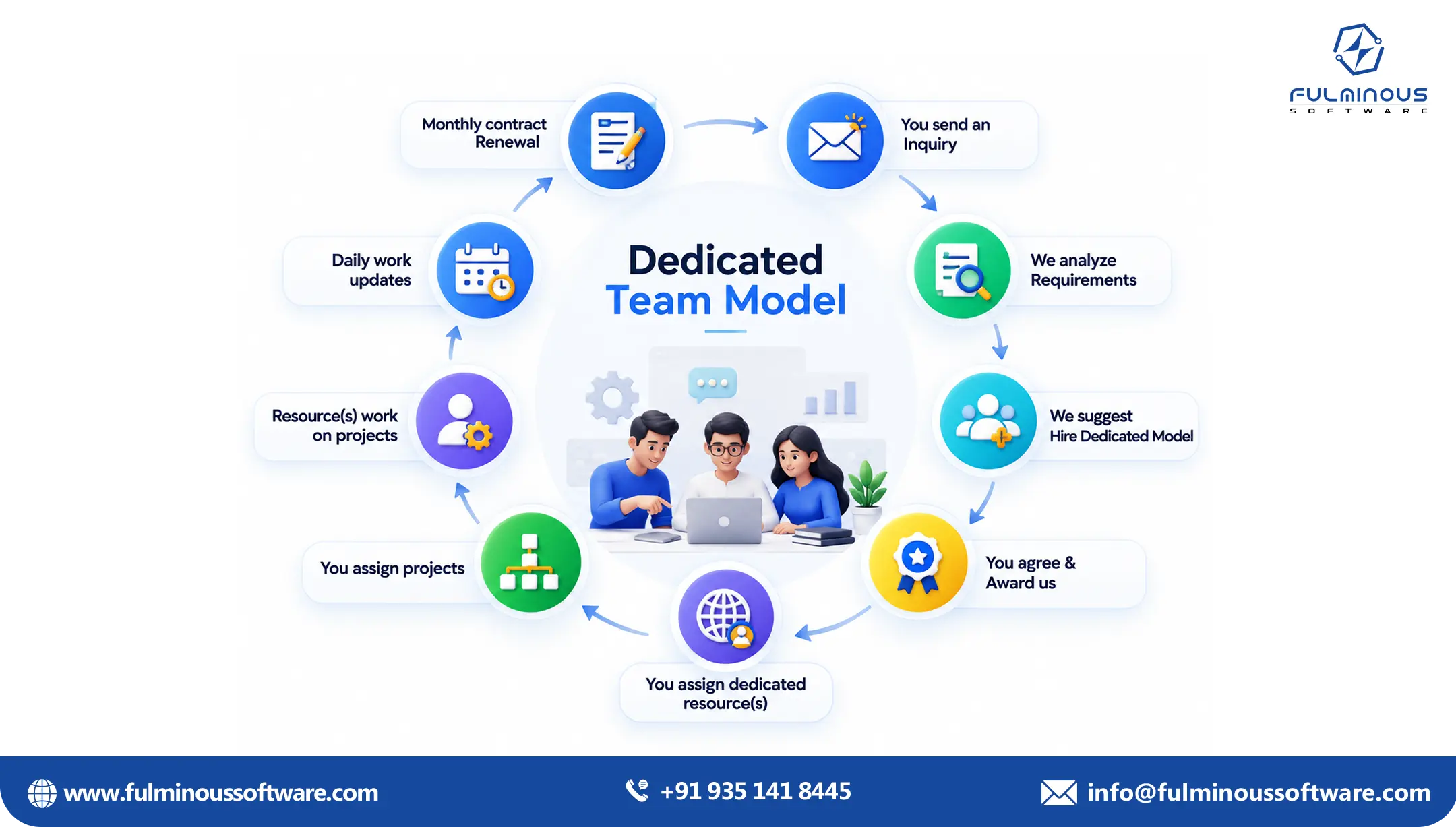
Every agency that provides dedicated development teams for hire has its own flavour, but the project journey usually looks like this:
1Discovery.
You explain the product, the stack, the goals and the budget. A good partner asks uncomfortable questions here, and that's a good sign.
2Team design.
The agency proposes roles, seniority levels and related plans. You interview key people, especially the tech lead.
3Onboarding.
Access to repositories, documentation, design files and communication tools. The first sprint is usually small, to build trust and test the workflow.
4Delivery cadence.
Sprints, demos and retrospectives start rolling. Dedicated development team management settles into a steady rhythm of planning, review and feedback.
5Review and scale.
Every quarter or so, you look at goal accomplishments, quality and costs together, then add, swap or reduce roles.
Notice what's missing: no long procurement process and no per-feature negotiation. Once the dedicated development team service is running, your energy goes into the product, not the paperwork.
Fullstack Dedicated Development Team Services
If your product needs to move from database to interface to deployment pipeline, fullstack dedicated development team services are usually the finest answer. Rather than coordinating separate frontend, backend and infrastructure agencies, you work with one fullstack dedicated development team that owns the whole flow.
A typical fullstack setup covers React, Angular or Vue on the front end; Node.js, Python, Java or .NET on the back end; PostgreSQL, MongoDB or something similar for data; and cloud tooling on AWS, Azure or Google Cloud. The stack matters less than the habits. You want full-stack dedicated development experts who can pick up a task, trace it through every layer and fix the real cause instead of patching symptoms.
Here are three situations where fullstack dedicated development team services really shine:
Building an MVP. Small, versatile teams move faster when nobody has to wait for another department.
Modernising a legacy platform. Someone has to understand the old database, the middle layer and the shiny new interface at the same time.
Running a SaaS product that ships weekly. Continuous delivery needs people who care about the entire pipeline.
Full-stack generalists are wonderful for minor issues, but a highly specialised problem, such as real-time video or machine-learning pipelines, may call for a specialist. Good providers of fullstack dedicated development team services let you add those people without rebuilding the team from scratch.
Dedicated App Development Team Services
Mobile products are in high demand. Users delete slow apps within days, store reviews are public, and every operating system update can change something that worked yesterday. That's why dedicated app development team services work so well for mobile-first businesses. Release cycles, platform updates and crash monitoring need people who stay with the app 24/7, not an agency that hands over a build and disappears till the next taks.
A strong mobile development team includes iOS and Android engineers (or React Native and Flutter developers when cross-platform is the right call), a backend developer for APIs, a QA engineer who tests on real devices, and a designer who respects each platform's guidelines. With dedicated app development team services, the same people who launched version 1.0 are still around for version 4.0, and they remember the foundation, each update and why that odd workaround exists.
When you evaluate dedicated app development team services, ask how the provider handles store submissions, analytics, push notifications, accessibility and performance budgets. Ask for examples of apps they've kept alive for years, not just apps they've launched.
The Rise of Self-Managed Teams
Here's another trend worth paying attention to. Many experienced product owners don't want a vendor project manager standing between them and the engineers. They want direct access, direct accountability and direct influence over priorities. That's the thinking behind self-managed dedicated development team services.
In this setup, the engineers organise their own sprints, estimate their own tasks and resolve blockers themselves. You, or your product owner, supply the vision and the backlog. The agency still handles the people side: contracts, hardware, payroll, wellbeing and performance conversations. But the daily tasks stay with the team.
Why a self-managed software development team works
A self-managed software development team removes layers. Decisions that once took three meetings take only a few minutes. Developers of your project feel real ownership, and ownership tends to raise quality. You also avoid paying for management costs you don't need. This approach tends to suit companies that:
- Already have a product owner or CTO who can set direction
- Value fast feedback loops over formal reporting
- Need engineers who can challenge ideas, not just execute them
When it doesn't fit
Be realistic. Self-managed software development teams need senior people. If your team is mostly juniors, or if nobody on your side can prioritise work, the model can drift. In those cases, a hybrid arrangement with a light-touch delivery lead is safer. A self-managed dedicated development team also needs transparency from you: clear goals, honest feedback and quick answers.
When you shortlist self-managed dedicated development team services, ask how the vendor picks senior engineers, how they handle conflicts, and what escalation looks like if things go sideways. Strong self-managed software development teams are built, not assembled at random, so the vetting process matters enormously. The best self-managed dedicated development team services give you autonomy without leaving you alone with problems.
Offshore and Remote Setups: What to Know
Geography is the other big decision in development projects. Many companies pair the dedicated model with offshore talent to get a huge hiring pool and keep budgets sensible. Done well, dedicated offshore development team services give you access to experienced engineers in regions with strong technical education, competitive rates and overlapping working hours with major markets.
An offshore self-managed development team is particularly interesting. You get complete control and cost efficiency in a single package. The engineers sit in another time zone, but they run their own process and report outcomes rather than hours.
What the best offshore dedicated development team services get right
The best offshore dedicated development team services aren't defined by price. They're defined by how well they close the distance. Look for:
Overlap hours. At least three or four shared working hours each day.
Communication discipline. Written summaries, recorded demos and a shared source of truth.
Retention. Low attrition keeps knowledge in the team. Ask for the number.
Security. NDAs, IP assignment, access controls and compliance with regulations that apply to your data.
Cultural fluency. Engineers who are comfortable pushing back politely and asking questions early.
And don't overlook the plain remote dedicated development team model, where people may be spread across several countries or even work from home offices. A remote dedicated development team can be just as productive as a co-located one, provided the tasks are right: daily check-ins, async documentation and a culture where raising a concern is welcomed. Similarly, the best offshore dedicated development team services treat a remote dedicated development team as a first-class unit, not a secondary option.
Remember: when people say dedicated offshore development team services, they are usually describing the same model, with the emphasis on location. Whichever phrase you search for, the questions to ask are the same. Where are the engineers? How long have they worked together? What happens when someone leaves?
Some buyers also prefer an offshore self-managed development team for 24/7 progress. While your in-house staff sleeps, the offshore group moves work forward, and you wake up to results instead of a question.
Dedicated Developer Team Services for Long-Term Product Development
If you're building digital products you expect to run for years, whether that's a marketplace, a healthcare platform, a fintech app or an internal system, you need dedicated developer team services for long-term product development, not a string of disconnected short-term projects.
Why? Because the real cost of software isn't the first release. It's everything after: bug fixes, security patches, new features, integrations, performance tuning and the quiet work of paying down technical debt. A regular change in contractors makes each of those projects slower and riskier. A stable dedicated development team makes them routine.
Here's what a dedicated development team for long-term projects typically offers:
Architectural consistency. The same people make decisions, so the codebase stays coherent.
Living documentation. Teams that stick around actually keep docs updated, because they're the ones who rely on them.
Predictable budgeting. A steady monthly cost is easier to forecast than a series of change orders.
Institutional memory. The team remembers why a feature was built, why another one was dropped, and what customers complained about last spring.
If your roadmap goes beyond a year, dedicated developer team services for long-term product development are almost always cheaper than the alternatives once you count rework, onboarding and handover. And a dedicated development team for long-term projects gives you something you can't buy per ticket: trust built over time.
Dedicated Development Team Management and Collaboration
A great development team can still struggle with weak habits. This is where dedicated development team management makes or breaks the engagement, and it's less complicated than most businesses think.
Set up the basics early
Effective dedicated development team management starts with clarity. Agree on a single backlog, a definition of "done", a release style and a way to escalate problems. Write them down. Revisit them quarterly.
Meet less, communicate better
Strong dedicated development team collaboration doesn't mean more meetings. It means better ones. A short daily stand-up, a weekly planning session, a demo at the end of each sprint and monthly meetings are usually enough. Everything else can happen asynchronously on a shared platform.
Here are habits that consistently improve dedicated development team collaboration:
- Treat the team as colleagues, not contractors. Invite them to product discussions and share customer feedback directly.
- Share the "why" behind each feature. Engineers make better plans when they understand the goal.
- Give feedback quickly and specifically, in public when it's praise and in private when it's critical.
- Use one project tool, one chat space and one documentation hub. Scattered tools cause scattered communication.
- Review work through demos rather than status reports.
Measure what matters
Skip simple metrics like lines of code or hours logged. Track cycle time, deployment frequency, defect rates and customer-visible outcomes. Good dedicated development team management ties those numbers to business goals, such as retention, conversion and support volume.
If you run a remote dedicated development team, add a few extras: rotate meeting times so one side isn't always inconvenienced, record sessions for anyone who can't attend, and plan an in-person visit once or twice a year. Face-to-face time still does wonders for dedicated development team collaboration, even when daily work is fully remote. And when dedicated development team management feels heavy, it's usually a sign that responsibilities are unclear, not that the model is flawed.
What Top Dedicated Software Development Team Services for US Companies Have in Common
If you're based in the United States, you face a specific mix of pressures: high salaries, fierce competition for engineers, compliance requirements and customers who expect fast solutions. That's why demand for top dedicated software development team services for US companies keeps growing.
What separates the top dedicated software development team services for US companies from the rest? In our experience, they share some qualities:
Transparent pricing. You see the team's structure and the monthly cost, with no hidden margins on tools or licences.
Time-zone planning. The best vendors arrange overlap with US business hours, whether you're on the East Coast or the West.
Security and compliance maturity. Think SOC 2-style practices, secure development lifecycles and willingness to sign HIPAA or GDPR-related agreements where relevant.
Clear IP ownership. Everything built belongs to you, in writing, from day one.
English fluency and written clarity. Documentation and communication should be excellent.
Proven references. Real customers who'll speak openly about what worked and what didn't.
When you compare top dedicated software development team services for US companies, don't just look at rates. Compare total delivery cost: how quickly the team ramps up, how often work comes back for rework and how many of your own managers' hours it consumes. Many dedicated software development team services look similar on a pricing page and very different in practice. Ask for a short paid pilot to see how the team really performs.
One more point: the strongest top dedicated software development team services for US companies don't try to be everything to everyone. They show a clear sweet spot, whether that's SaaS, healthcare, retail or logistics, and they can explain it.
How to Hire Dedicated Development Team Services Without Regret
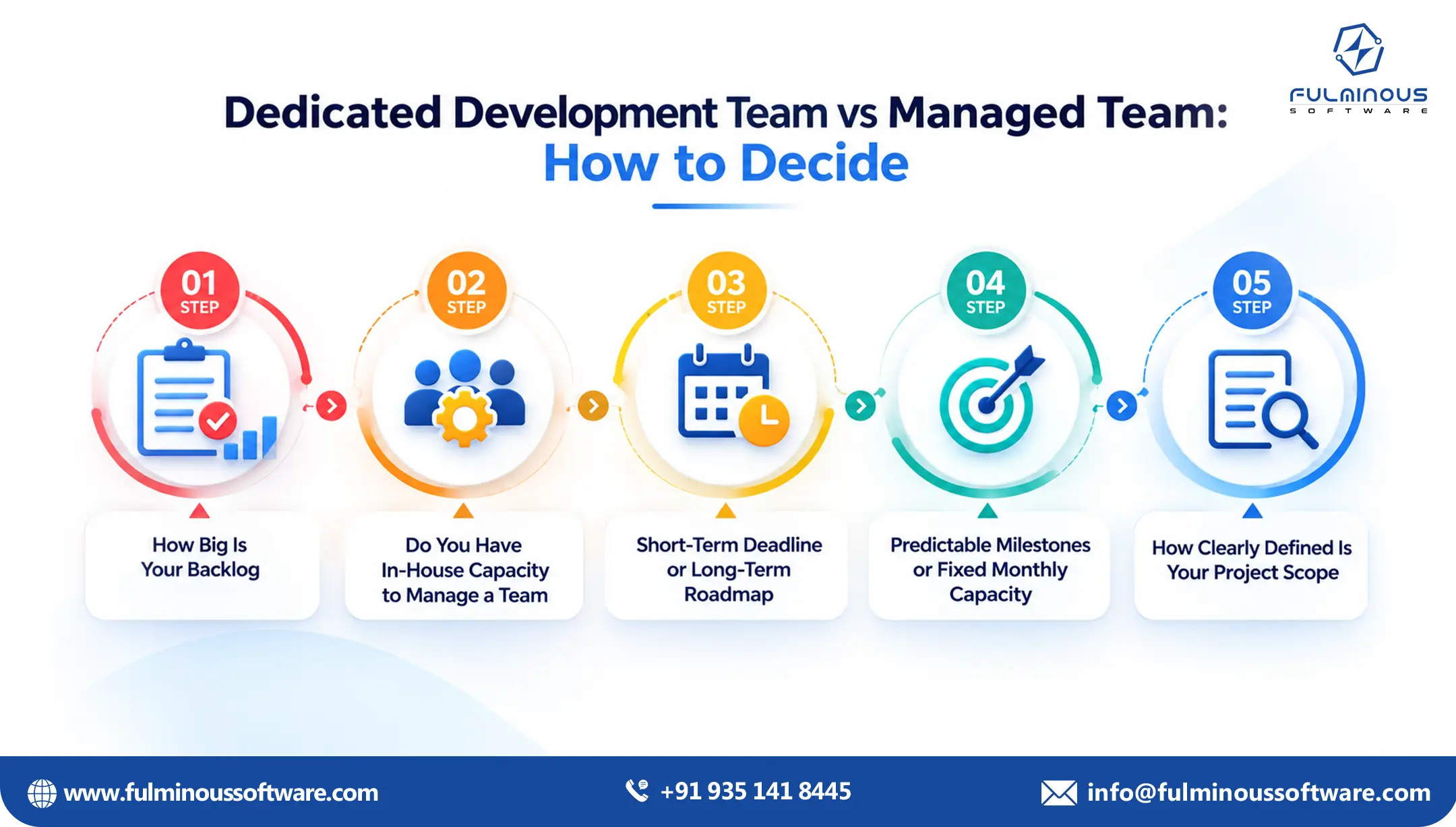
Ready to move? Here's a checklist for anyone planning to hire dedicated development team services for the first time.
1Define the outcome.
"Build our product" is no use. "Launch a customer portal in six months and support 50,000 users" is useful.
2Decide on the management style.
Do you want a vendor-managed team, a hybrid or a self-managed one? Be honest about how much time you can invest.
3Interview the actual people.
Don't settle for a sales team's promises. Speak to the tech lead and, if possible, the developers.
4Check retention and replacement policy.
Ask how quickly the vendor can replace a team member and how knowledge is transferred.
5Review the contract.
Look at notice periods, IP clauses, confidentiality, data handling and exit support.
6Start with a pilot.
Four to eight weeks is enough to test communication, code quality and cultural fit.
7Plan for growth.
Make sure the model lets you add or reduce capacity with reasonable notice.
When you hire dedicated development team services, trust your instincts about communication. If an agency is slow or defensive before you've signed, don't expect it to improve afterwards. And when you assess dedicated development team services, remember that the cheapest quote is rarely the lowest total cost.
Costs, Risks and How to Avoid Them
Pricing varies widely by region, seniority and team size, so it won't pretend there's one number that fits everyone. What we can say is that you should evaluate cost in three layers: the monthly rate, the period and the cost of change. A cheap development team that needs constant supervision is more expensive than a pricier one that delivers independently. The common risks are predictable:
Unclear requirements. A dedicated development team service amplifies good direction and bad direction equally. Invest in product thinking.
Weak communication. Fix it with fixed rituals and shared tools.
Over-reliance on one person. Insist on code reviews, documentation and pairing to spread knowledge.
Security gaps. Use least-privilege access, audit logs and regular reviews.
Treating the team as outsiders. Dedicated developer team services long-term product development that feel excluded produce exactly the work you'd expect.
How Fulminous Software Delivers Dedicated Development Team Services
If you are looking for a dedicated development team with all the above-discussed quality, then Fulminous Software is the choice. Here's how Fulminous Software puts it into practice.
Fulminous Software builds dedicated teams around your product, not around a template. After a discovery conversation about your goals, stack and budget, we propose a team structure, introduce you to the people who will work with you and agree on a plan before any long-term commitment is made.
A team shaped to your needs. Whether you want a dedicated software development services team to extend your in-house engineers or an independent unit that runs a whole product, we match skills and seniority to the work. Our dedicated software development team services cover web, mobile, cloud and DevOps, with QA and UI/UX built in rather than bolted on.
Fullstack coverage. Our fullstack dedicated development team services give you engineers who can work from the database to the interface and into deployment, so you're not stitching together several vendors.
Mobile expertise. Through our dedicated app development team services, we assign iOS, Android and cross-platform specialists who stay with your app after launch and handle updates, performance and store requirements.
Autonomy when you want it. Our self-managed dedicated development team services suit product owners who prefer direct access to engineers. The team organises its own sprints, and you keep full visibility through demos, shared boards and regular reviews. Where you'd rather have more structure, we can add a delivery lead.
Built for the long haul. We design dedicated developer team services for long-term product development with stability in mind: documented code, consistent architecture and a team that stays together, so knowledge compounds instead of leaking away.
Offshore strength, with real overlap. As one of the best offshore dedicated development team services options for growing businesses, we plan working hours to overlap with your day, communicate in writing as well as in meetings and handle security and IP clearly in the contract. Many of our clients value that dependable offshore delivery combined with the feel of a local team.
Suited to US businesses. For companies in America, we work to be among the top dedicated software development team services for US companies by offering transparent pricing, overlapping hours and straightforward agreements.
Flexible scaling. Need two more developers for a launch? Need to trim after release? We adjust the dedicated developer team services long-term product development with reasonable notice so you're never stuck with capacity you can't use.
If you'd like to see how this would look for your product, talk to Fulminous Software about a short discovery call and a pilot engagement.
Now Get The Best Dedicated Development Team Services
Development projects fail because the right people aren't available, aren't aligned or don't stay long enough to understand the product. Dedicated development team services solve that problem by giving you a stable, focused group that grows alongside your business.
Match the model to your situation. Choose self-managed dedicated development team services if you value autonomy and have strong product direction. Choose a fullstack setup for end-to-end ownership, a mobile-focused group for app-heavy roadmaps and an offshore or remote dedicated development team to widen the talent pool and keep costs under control. Whatever you pick, invest in dedicated development team collaboration, start with a pilot and judge the partner on communication as much as on code.
If you're ready to hire dedicated development team services that act like part of your company, Fulminous Software would be glad to start the conversation.
FAQs
Q1. What are dedicated development team services?
They are an engagement model where a vendor provides a full team of developers, testers and designers who work solely on your product. You direct the work and pay a monthly fee, while the vendor handles hiring, payroll, equipment and HR. It's closer to growing your own department than to buying a one-time project.
Q2. How is a dedicated development team different from staff augmentation?
Staff augmentation adds individual people to your existing team, and you manage them directly. A dedicated team arrives already organised, with its own lead, processes and shared knowledge. Staff augmentation suits small skill gaps. A dedicated team suits ongoing products that need a stable, cohesive group.
Q3. When should I hire dedicated development team services instead of building in-house?
Consider it when recruiting is taking too long, salaries stretch your budget, your roadmap runs beyond six months or you need to scale up and down with demand. If you have a strong internal engineering culture and plenty of hiring capacity, a hybrid approach can work well too.
Q4. What does a self-managed dedicated development team mean?
It means the engineers run their own planning, estimation and daily coordination, while you or your product owner set priorities. The vendor still manages contracts and people matters. This works best when you have clear goals and senior engineers who are comfortable with ownership.
Q5. Are offshore teams really as effective as local ones?
They can be, provided communication and overlap are handled properly. The best offshore dedicated development team services plan shared hours, document decisions, track retention and invest in cultural fit. Productivity usually depends more on process and people quality than on geography.
Q6. What do fullstack dedicated development team services include?
Typically frontend, backend, database, API and cloud deployment skills, plus QA and often design. Fullstack dedicated development team services let one group own the product from interface to infrastructure, which reduces handoffs and speeds up delivery, particularly for MVPs and fast-moving SaaS products.
Q7. How much does a dedicated team cost?
It depends on region, seniority, team size and technology. Most providers charge a monthly fee per team member, which covers salary, overhead and margin. When comparing quotes, look at total delivery cost, including ramp-up time, rework and the management hours you'll personally spend.
Q8. How do I protect my intellectual property?
Put it in the contract. Insist on a clear IP assignment clause, NDAs for every team member, access controls, secure repositories and defined data-handling rules. Reputable vendors expect these requests, and anyone hesitant about them is a warning sign.
Q9. How long should a dedicated team engagement last?
Most vendors recommend at least six months, because onboarding and context-building take time. For long-term products, engagements often run for years. Choose a contract with sensible notice periods so you can scale down without penalty if priorities change.
Q10. How do I manage a remote dedicated development team day to day?
Keep it simple: one backlog, one communication channel, a short daily check-in, weekly planning and a demo at the end of each sprint. Share the reasons behind decisions, give fast feedback and treat the team as colleagues. Good dedicated development team management is mostly about clarity and consistency.
 Verified
Expert in Software & Web App Engineering
I am Manish Kumawat, co-founder of Fulminous Software, a top leading customized software design and development company with a global presence in the USA, Australia, UK, and Europe. Over the last 10+ years, I am designing and developing web applications, e-commerce online stores, and software solutions custom tailored according to business industries needs. Being an experienced entrepreneur and research professional my main vision is to enlighten business owners, and worldwide audiences to provide in-depth IT sector knowledge with latest IT trends to grow businesses online.


Partner with Top-Notch Web Application Development Company!
Discuss your Custom Application Requirements on info@fulminoussoftware.com or call us on +91-935 141 8445.
15 Days Risk-Free TrialRecommended Articles