
Staff Augmentation vs Dedicated Team vs Project Outsourcing: Which Model Fits Your Project?

Manish Kumawat
Last Updated on: 13 November 2026



You may have a roadmap that keeps growing and a team that stays the same size. Maybe a big release is due next quarter and you need to speed up the project. Maybe your best engineers are stuck on maintenance while the new product sits half-built. Hiring in-house takes months, and you are not even sure the project will exist a year from now.
So you start looking at outside help, and the first thing you run into is a bundle of confusing terms: staff augmentation, dedicated team, managed team, project outsourcing, body shopping, offshore, nearshore. Every vendor explains them a little differently. Most of them quietly describe the model they happen to sell.
There are many ways to execute your development project. But the concern is always the cost, the quality and the control. Choosing an ideal hiring model for your software development projects is all about balancing these elements. Today, most businesses get confused at this stage. Are you one of them? Then this guide will help you to pick the ideal model for your project.
This guide helps those who want a straight answer on Staff Augmentation vs. dedicated teams vs. project outsourcing. Here we will explain how the main software outsourcing models actually work, where each one shines, where each one hurts, and how to pick the right one without giving up control of your project. Fulminous Software is an engineering partner that offers all three, so we have seen what happens when the wrong model is chosen. We will share that too.
Table of Contents
16 sectionsThe real question: how do I add capacity without losing control?
Most leaders who search for this topic are not really asking "which model is cheapest?" Yes, it's not always about the costs. Businesses look for a balance between cost, accountability, quality, control and the final results. They are asking something closer to this:
- Can I add people fast without slowing my own team down?
- Will the outside engineers follow our standards, or build things their own way?
- Who is responsible if something goes wrong?
- What happens to our code, our knowledge and our roadmap when the contract ends?
Every engagement model is basically a different answer to one question: who manages the work, and who is accountable for the result? With one model, you manage the people and you own the result. With another, the vendor manages the people but you still steer the product. With the third, the vendor manages almost everything and you are accountable for a defined outcome only. Once you see it this way, the choice gets much easier.
Staff Augmentation vs Dedicated Team vs Project Outsourcing: at a Glance
This is just a short version before we go deeper into all these engagement models:
| Staff augmentation | Dedicated team | Project outsourcing | |
|---|---|---|---|
| What you get | Individual engineers who join your team | A full team built around your product | A finished deliverable |
| Who manages the work day to day | You | You, with help from a team lead on the vendor side | The vendor |
| Who owns the outcome | You | Shared, leaning toward you | The vendor, against an agreed scope |
| Best for | Filling skill gaps or short-term capacity | Long-running products that keep evolving | Clearly defined work with a clear end |
| Control level | Very high | High | Moderate |
| Flexibility to change scope | High | High | Lower once scope is signed |
| Typical duration | Weeks to months | Many months to years | Weeks to months, ending at delivery |
Keep this table in mind. The rest of the article explains the reasoning behind each row.
What is staff augmentation?
If you have ever wondered, "What is staff augmentation, exactly?", here is the plain answer.
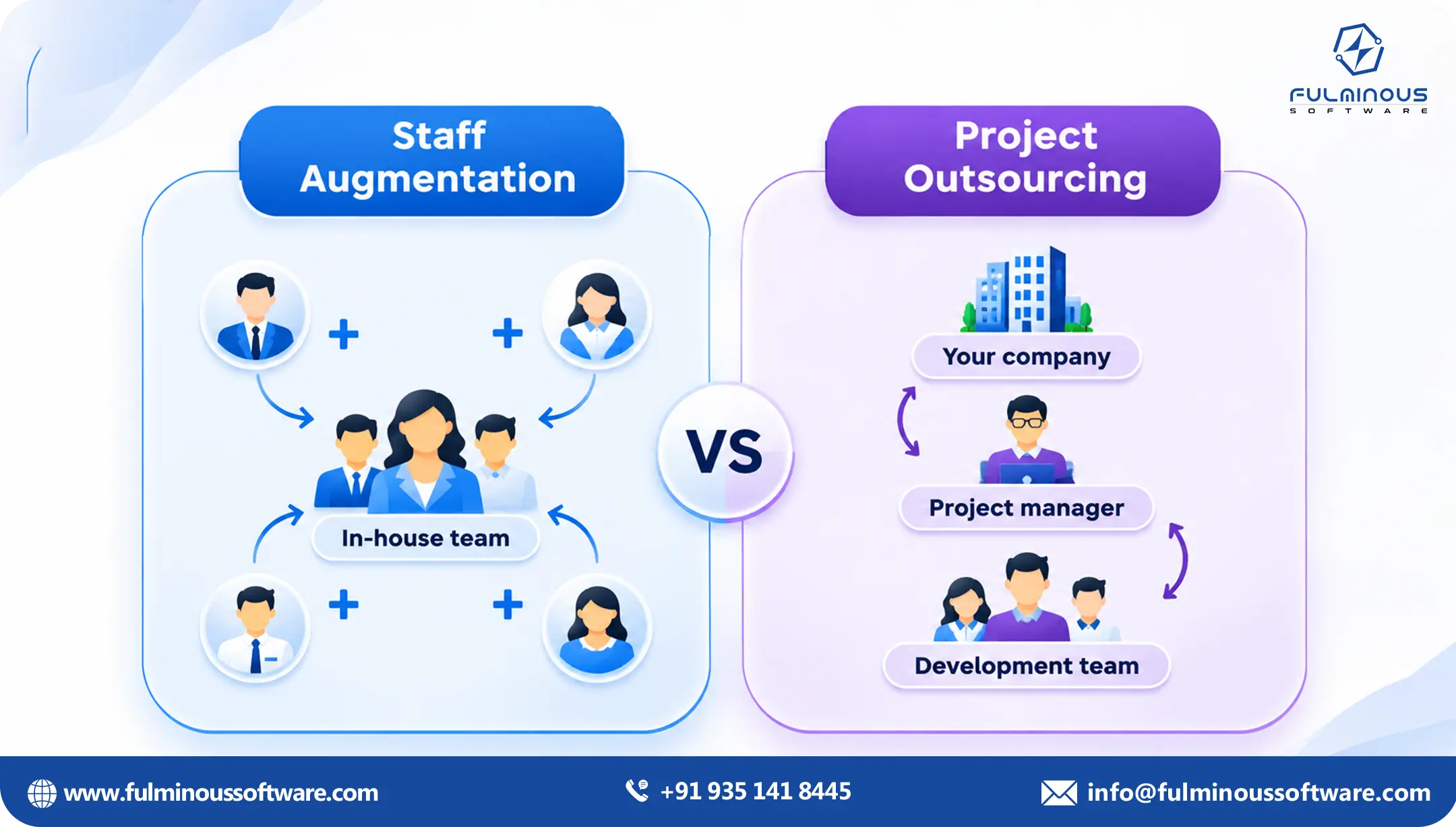
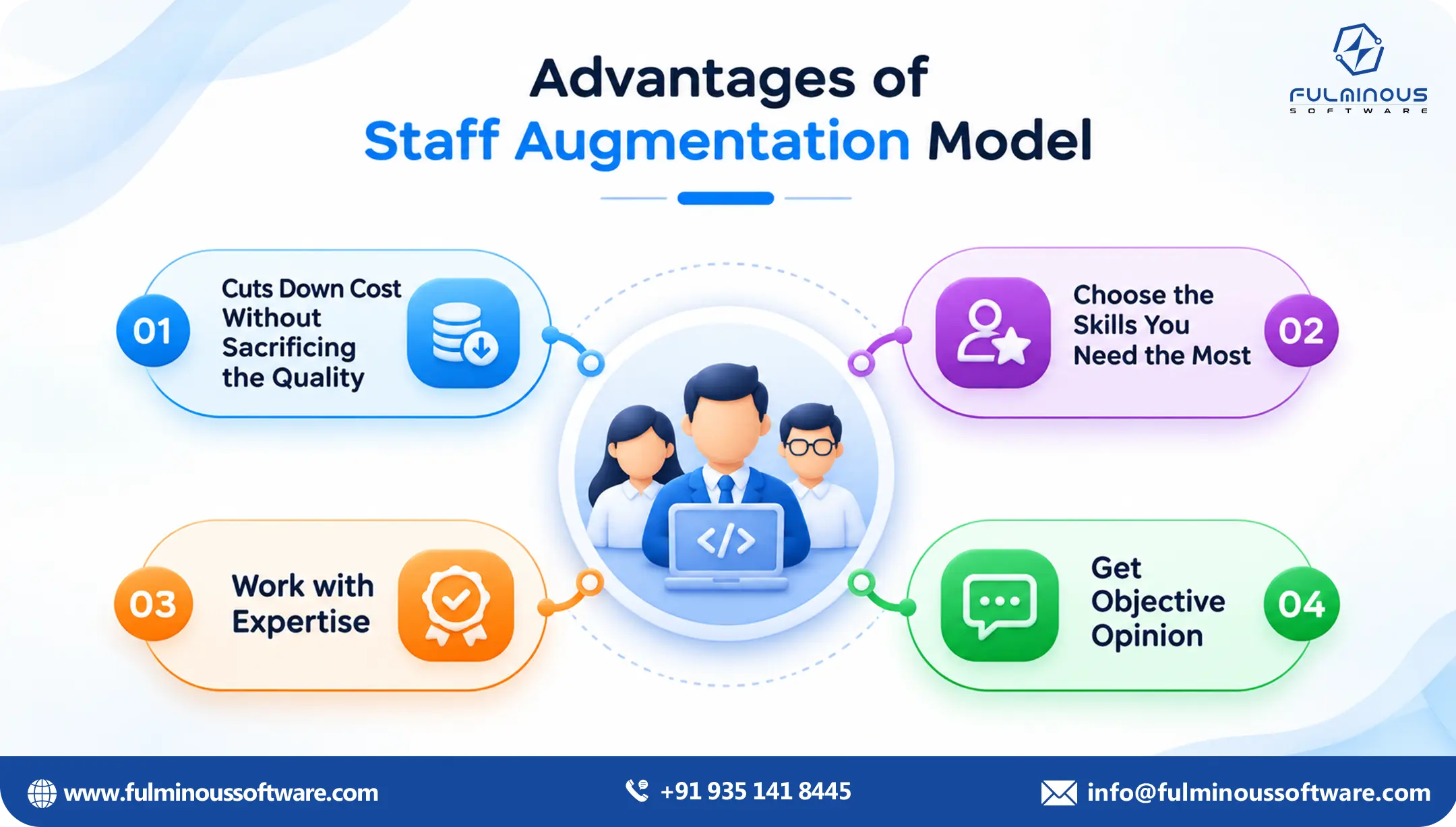
Staff augmentation means you bring in outside engineers to work as part of your own team. They join your stand-ups, use your tools, follow your coding standards and take tasks from your backlog. The vendor finds and employs them, handles payroll, equipment and HR matters, and you direct their work as if they were your own people.
Think of it as renting skills rather than renting a service. You decide the goals, plans, what gets built and how. The vendor's job is to supply good developers quickly and keep them happy and productive.
When it works well
- You have a strong in-house team and clear processes, but you are short on hands or on a specific skill, such as a Kubernetes expert, a mobile developer or a data engineer.
- You need people quickly, for example to hit a launch date.
- The extra work has a natural end date, or you are not sure how long you will need it.
- You want to test a person or a skill set before making a permanent hire.
Where it can go wrong
It needs management time. If your engineering managers are already stretched, adding five hired developers can make things worse before it makes them better. Someone has to assign work, review code and answer questions.
Knowledge can walk out the door. When an augmented engineer leaves, what they learned about your system may leave too, unless you insist on good documentation and pair work.
Culture mixing takes effort. Engineers who feel like outsiders tend to work like outsiders. You have to include them properly.
Staff augmentation is a fine choice when you have the management capacity to use it. It is a poor choice when you hoped the vendor would "just take care of it". If you want to see how this works in practice, our staff augmentation and dedicated teams page explains how we match engineers to your stack and your working hours.
What is the dedicated development team model?
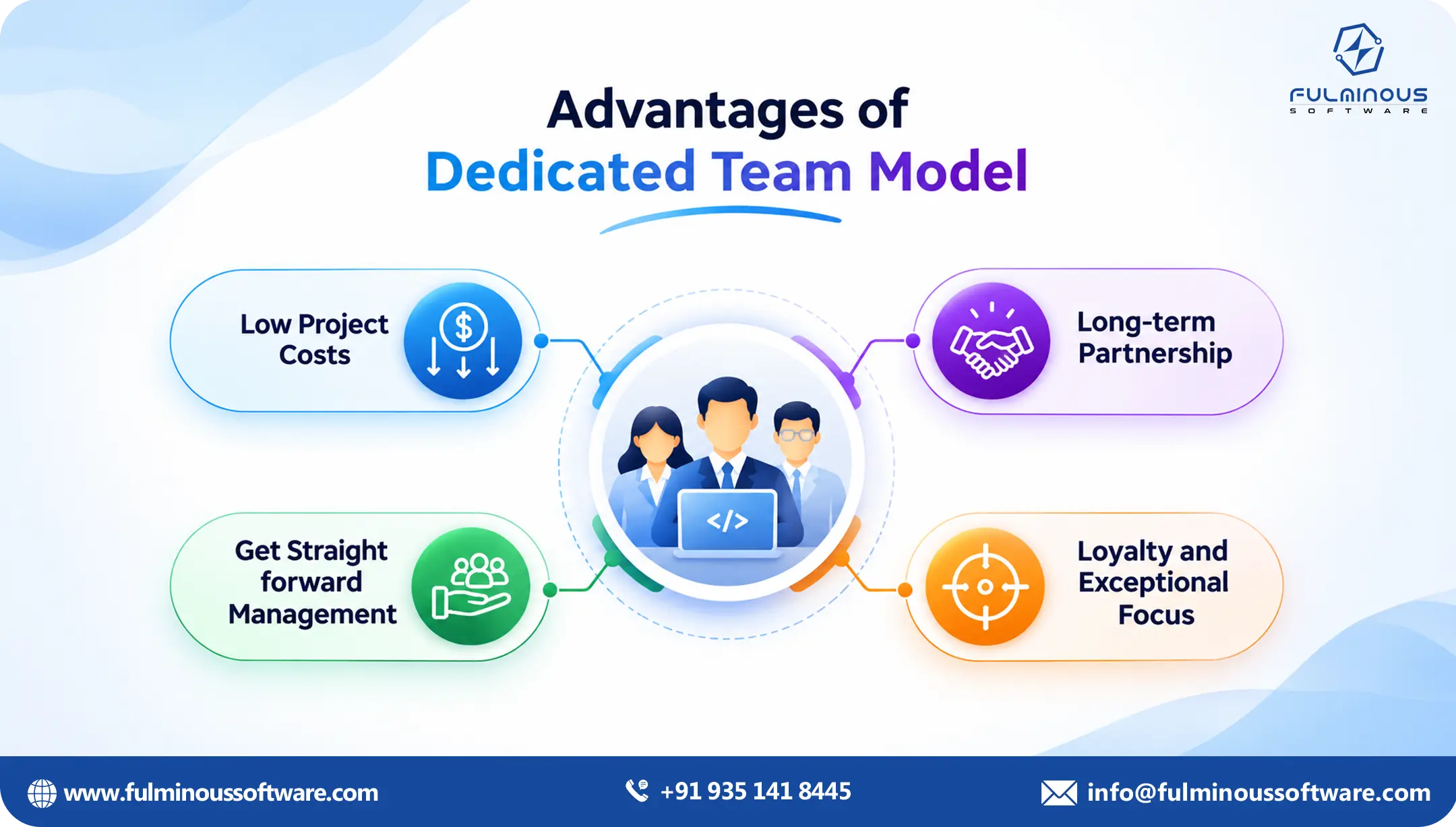
The dedicated development team model sits between augmentation and full outsourcing. Instead of borrowing a few individuals, you get a whole team that works only on your product: developers, QA engineers, often a designer, and usually a team lead or project manager from the vendor's side.
The key word is ‘dedicated’. These people do not split their time between clients or work for other clients while on contract with your project. They learn your product, your users and your way of working, and they stay with you for the long run.
You set the priorities and the roadmap. The vendor handles hiring, replacements, internal team management, equipment, office space and the human side of keeping a team motivated. You get a development team that feels like an extension of your company without the effort of building one from scratch.
When it works well
- You are building or running a product that will need steady development for a year or more.
- You want continuity. The same people know the codebase, so they get faster over time.
- You do not want to spend months hiring five or six people one at a time.
- You want to keep strategic control but hand off the daily people management.
Where it can go wrong
It is a commitment. A dedicated team makes the most sense when there is enough work to keep everyone busy. If your backlog is thin, you will be paying for idle time.
It needs a good onboarding. The first month matters. If the team does not understand your business goals, they will build what you ask for rather than what you need.
Weak communication hurts more here. Because the team is large and long-lived, small misunderstandings repeat themselves over many sprints.
A well-run dedicated team becomes one of the most reliable parts of an engineering organization. A badly run one becomes an expensive black box. The difference is almost always how clearly goals are shared and how often the two sides talk.
What is project outsourcing?
Project outsourcing means you hand a defined piece of work or project to a development agency and they deliver it. You agree on scope, timeline and cost up front. The agency assigns its own experts, manages them with its own processes and reports progress back to you. You review milestones and accept the final result.
It is the most hands-off of the common software outsourcing models. You describe the destination; the development agency chooses the route.
When it works well
- The scope is clear and unlikely to change much: a marketing website, a mobile app version one, an integration, a migration, a proof of concept.
- You do not have the internal skills or the time to manage the work yourself.
- You want a predictable budget and a defined end date.
- The work is not core to your competitive advantage, so deep internal knowledge matters less.
Where it can go wrong
Scope changes get expensive. Fixed-scope work is great until you realize halfway through that you need something different. Then you are negotiating change requests.
You see less of the work. If you are not careful, you only find out about problems at a milestone review, when they are already big.
Knowledge transfer at the end can be weak. If the project is something you will maintain later, you need to plan the handover from day one.
Project outsourcing is a strong choice for well-understood work. It is a risky choice for products where you are still discovering what users want.
Looking for this kind of arrangement? See how we run end-to-end delivery on our outsourcing services page.
Staff augmentation vs dedicated team: the real differences
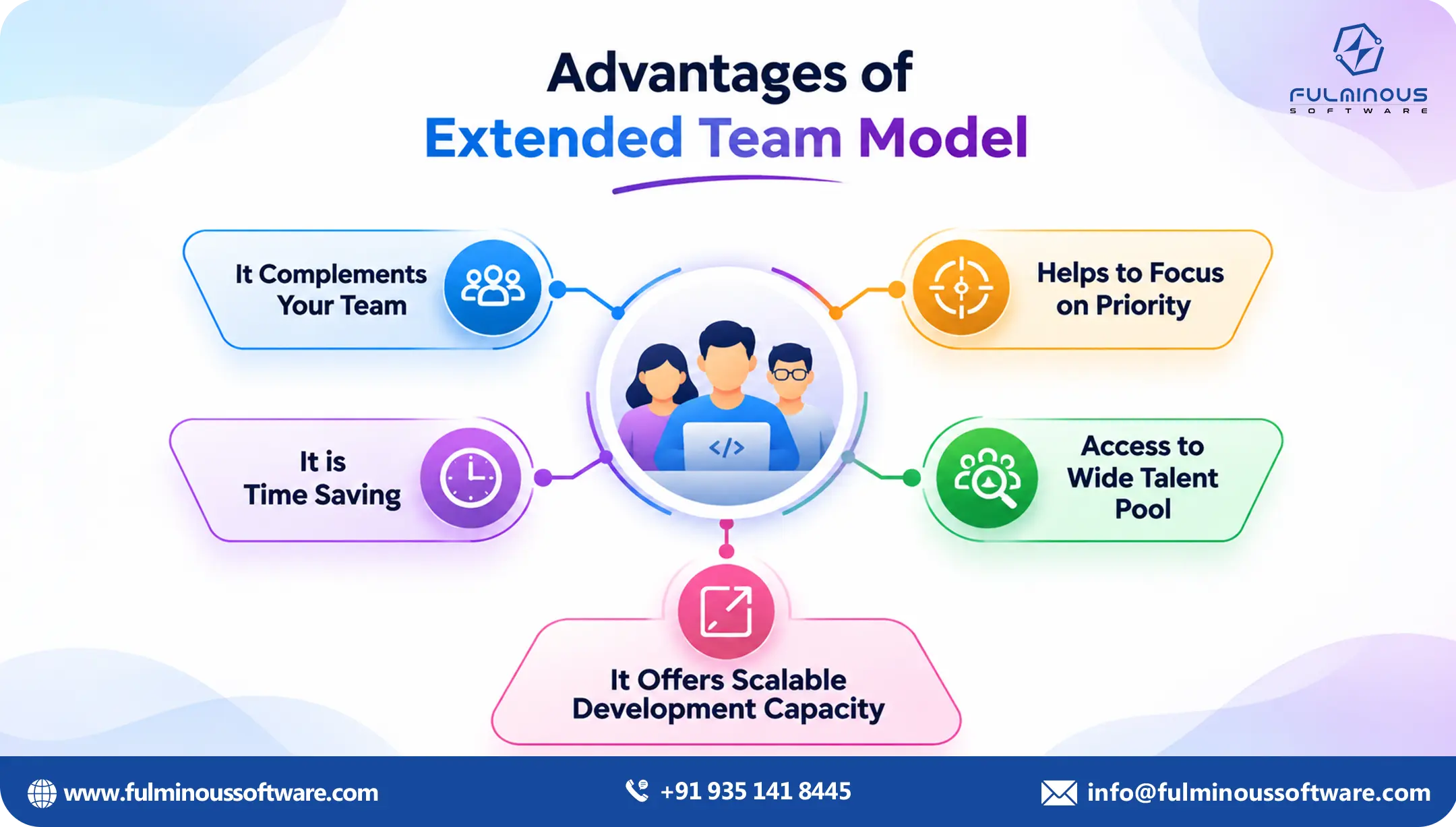
Staff augmentation vs dedicated team is the comparison most business leaders get stuck on, because both models put engineers close to your daily work. The staff augmentation vs dedicated team decision comes down to four things.
1. Who manages the people
With staff augmentation, you do. Your managers assign tasks, review performance and handle problems. With a dedicated team, the vendor shares that load. Their team lead deals with day-to-day coordination, workload balance and internal issues, while you focus on priorities and direction. If your managers have spare capacity, augmentation is fine. If they do not, a dedicated team will save them a lot of time.
2. How long you need help
Augmentation is always good for shorter or uncertain timelines. You can add one person this month and release them in three months. A dedicated team makes sense when you can see at least six to twelve months of steady work ahead, because the team's biggest value is the knowledge it builds over time.
3. How much structure you already have
Augmentation assumes your processes are in place. Your sprint rituals, code review rules, CI/CD pipeline and documentation are the framework the new engineers plug into. A dedicated team can bring some structure of its own, which helps if your processes are still maturing.
4. How you want to scale
With augmentation, you scale by adding individuals. With a dedicated team, you scale by adding units: another pod, another squad. If you expect to grow a product line quickly, the second approach is easier to coordinate.
A simple way to remember the staff augmentation vs dedicated team question: augmentation is for filling gaps in a team you already run; a dedicated team is for building a team you do not want to build yourself.
Staff augmentation vs outsourcing: where the line is
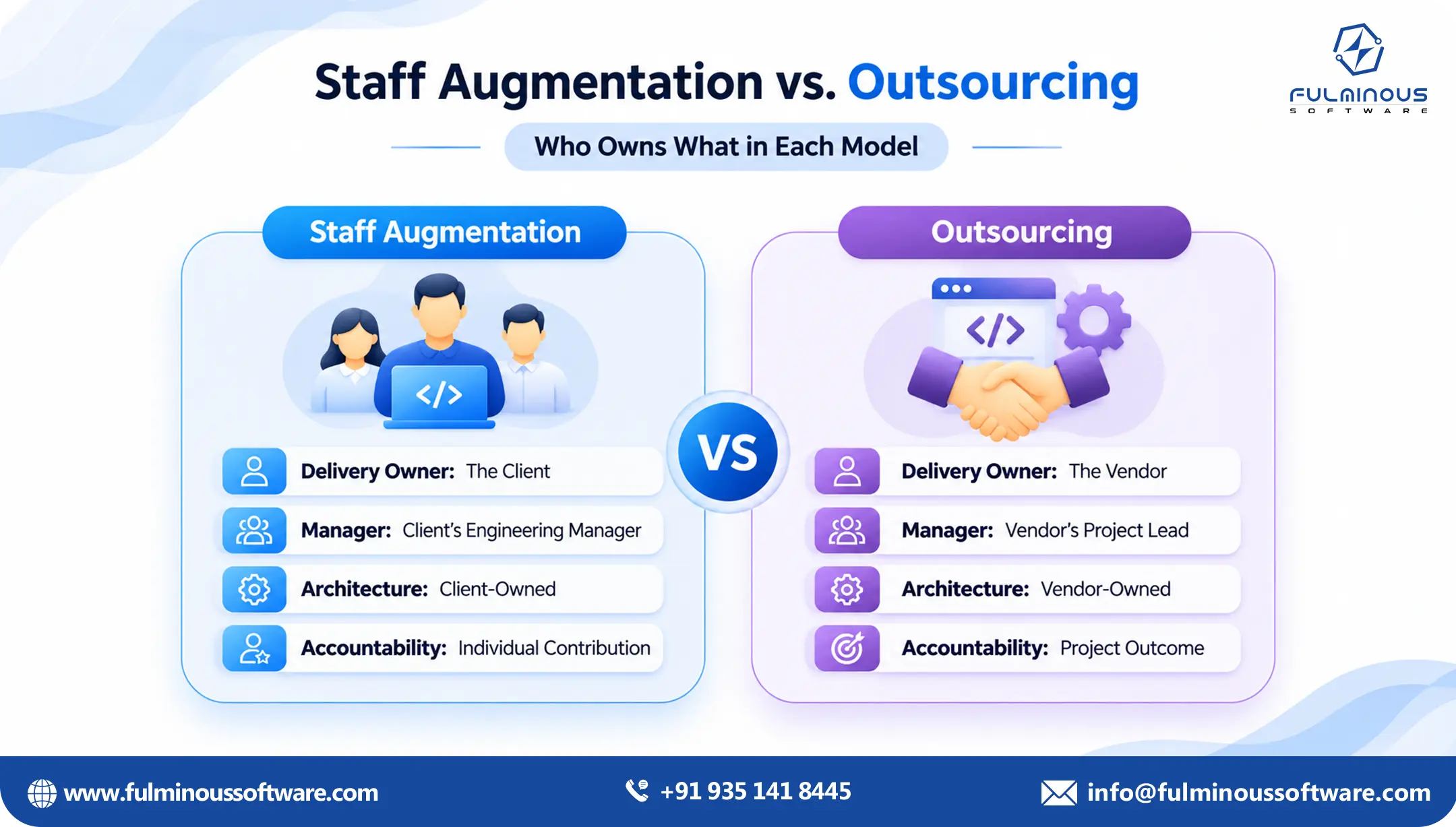
The staff augmentation vs outsourcing question is really about control and accountability.
Control. With augmentation, you control the "how" completely. With project outsourcing, you control the "what" and the "when", while the vendor controls the "how". If you have strong opinions about architecture, tools and quality standards, augmentation keeps them intact. If you would rather not have those opinions tested every day, outsourcing removes the burden.
Accountability. In staff augmentation, you are accountable for the result, because you directed the work. If a feature is late, that is a management problem on your side as well as a supply problem on theirs. In project outsourcing, the vendor is accountable for delivering the agreed scope. That is a real advantage when you need someone to carry the risk.
Flexibility. Augmentation lets you change direction every sprint. Outsourcing rewards stable scope. Changing the plan mid-project is possible, but it usually involves renegotiation.
Management effort. Augmentation takes more of your time. Outsourcing takes less, though never zero. Even outsourced projects need a product owner who answers questions quickly and reviews work honestly.
The cleanest way to think about staff augmentation vs outsourcing is this: if you want to keep steering the work, choose augmentation. If you want to hand over the work and check the result, choose outsourcing.
Dedicated team vs project outsourcing
This is the third pairing, and people often overlook it. Both models give you a vendor-managed team, but they behave very differently. A dedicated team works on a continuing stream of work. Priorities change as the product changes. You pay for the development team's time, and you are free to redirect that time.
Project outsourcing works toward a fixed outcome. Priorities are set at the start. You pay for the deliverable, and changes to it are handled as exceptions. If your product is still taking shape, a dedicated team will serve you better, because you can adjust each sprint. If the product is well defined and you just need it built, outsourcing is simpler.
A quick look at control in each model
Since control is the main worry for most technical leaders, here is how it plays out in practice.
Technical decisions. In augmentation, you make them. In a dedicated team, you make the big ones and the team lead makes the small ones, with you reviewing. In outsourcing, the vendor makes most of them, though you should approve anything that affects architecture.
Code quality. In augmentation, your own review process protects quality. In a dedicated team, you can require the same review standards and have access to the repositories at all times. In outsourcing, you rely on agreed standards, milestone reviews and acceptance testing, so those need to be written down clearly.
Intellectual property. In all three models, your contract should say that the code belongs to you. Insist on this regardless of model. Also insist that the code lives in repositories you own, not in the vendor's.
Visibility. Ask for the same transparency in any model: access to the repository, the task board, regular demos and a direct line to the people doing the work. If a vendor resists this, treat it as a warning.
Control is less about which model you choose and more about the habits you set up: shared tools, regular demos, open communication and clear ownership.
How to choose: six questions to ask yourself
You do not need a complicated framework. Answer these six questions honestly.
1. How clear is the scope? If you can write down what "done" looks like and expect it to stay the same, project outsourcing is a good candidate. If requirements will change as you learn, lean toward augmentation or a dedicated team.
2. How long will you need help? For a few weeks or months, augmentation is the most flexible. For a year or more, a dedicated team usually wins on continuity.
3. How much management time do you have? Be honest. If your managers are already overloaded, choose a model where the vendor carries more of the coordination.
4. How important is it that your own team learns the system? If this is the core of your business and you want deep internal knowledge, augmentation or a dedicated team keeps your people close to the work. For non-core work, outsourcing is fine.
5. How strong are your internal processes? Strong processes make augmentation easy. Weak ones make it painful. If you are still building your engineering practices, a dedicated team with its own team lead can add stability.
6. How do you want to handle risk? If you want a vendor to carry delivery risk for a defined result, choose outsourcing. If you are comfortable owning the risk in exchange for more control, choose augmentation or a dedicated team.
A quick rule of thumb
- Mostly "clear scope, short timeline, little management time" → project outsourcing.
- Mostly "specific skill gap, strong processes, flexible timeline" → staff augmentation.
- Mostly "ongoing product, long horizon, want continuity" → dedicated team.
Five real-world situations
Sometimes examples help more than frameworks. Here are five situations we see often.
Situation 1: The funded startup with an MVP to ship: A founder with a technical co-founder needs a first version in four months. The scope is fairly clear. A project-based approach gets the MVP out the door, and the team can later move into a dedicated model as the product grows.
Situation 2: The scale-up with a slow hiring pipeline: A company of 150 people has a solid engineering team but cannot hire fast enough to keep up with demand. They need three backend engineers and one DevOps specialist working inside the existing squads. Staff augmentation fits well: the processes are in place and the gaps are specific.
Situation 3: The enterprise modernizing a legacy platform: A large company is moving an old system to the cloud over two years. The work is long, complex and will change as surprises appear. A dedicated team works best here, because deep knowledge of the old system is valuable and will grow over time.
Situation 4: The product company that needs a mobile app: A company with a strong web team wants a mobile app but has no mobile engineers. They could hire, but the app is a single initiative. Project outsourcing delivers the app, and a small augmented team can maintain it afterwards if needed.
Situation 5: The company in transition: An engineering manager has just lost two senior developers and has a release in six weeks. Short-term augmentation fills the gap right away while the search for permanent hires continues.
Notice that none of these companies chose one model forever. Many of the best outcomes involve moving from one model to another as the product and the company mature.
Common mistakes to avoid
After working with many engineering leaders, we keep seeing the same mistakes.
Choosing on price alone. The cheapest option on paper is often the most expensive after rework, delays and turnover. Look at the total cost of getting the right result, not just the monthly figure.
Skipping onboarding. Whatever model you choose, give the new people a proper start: access, documentation, a walkthrough of the architecture and a buddy on your team. A week of good onboarding saves months of confusion.
Treating the vendor like a vending machine. Outside engineers do their best work when they understand why a feature matters, not only what it should do. Share context and they will make better decisions.
Forgetting the exit plan. Ask early what happens when the engagement ends. How is knowledge handed over? Who has access to what? A good vendor will have a ready answer.
Locking in too early. If you are not sure which model fits, start small. A short pilot or a small team lets you test the working relationship before you scale it.
Mixing up the models by accident. Some companies buy outsourcing but then try to manage the vendor's engineers directly, or buy augmentation and expect the vendor to take responsibility for the outcome. Be clear about which model you have and what each side is responsible for.
Can you combine models?
Yes, and many teams do. Common combinations include:
Outsource first, then move to a dedicated team. Build version one as a project, then keep the same people on as your dedicated team for future releases.
A dedicated team plus augmented specialists. Your core team stays steady, and you bring in specialists like a security engineer or data scientist when needed.
Augmentation to prove the fit. Start with one or two engineers. If it goes well, expand into a full dedicated team.
The point is to treat these software outsourcing models as tools, not as permanent labels. Pick the one that fits today's problem, and be ready to change as things evolve.
How Fulminous Software helps you choose the right model
At Fulminous Software, we do not start with a sales pitch for one model. We start with your situation, because the right answer depends on your product, your team and your goals. Here is how it usually works.
1. We listen first. We ask about your product stage, your current team, your deadlines and what has or has not worked before. We want to know where you feel the pain: speed, skills, management time or budget.
2. We give you an honest recommendation. Because we offer staff augmentation, dedicated teams and project outsourcing, we have no reason to push you toward the one that suits us. If augmentation will do the job, we will say so. If you need a full team, we will explain why. If a project-based approach fits best, we will tell you that too.
3. We match the people to your work. For augmentation and dedicated teams, we select engineers based on your stack, your time zone needs and your working style, not just a CV keyword match. You can meet and interview them before they start.
4. We protect your control. You get access to repositories, boards and communication channels from day one. The code is yours. Reporting is clear. You can talk directly to the engineers doing the work.
5. We make onboarding a priority. We help new team members get up to speed with a structured start, so they contribute sooner and with fewer mistakes.
6. We stay flexible. If your needs change, we change with you. You can scale a team up or down, switch from augmentation to a dedicated model, or move a finished project into ongoing support.
If you want to explore the options in more detail, you can read about our staff augmentation and dedicated team services or our outsourcing services. And if you are not sure which fits, that is exactly what a first conversation is for.
There is no single best answer in the staff augmentation vs dedicated team vs outsourcing debate. There is only the best answer for your product, your team and your stage.
- Choose staff augmentation when you need specific skills or extra hands and you have the management capacity to guide them.
- Choose a dedicated team when you have long-term work and want continuity without building a team yourself.
- Choose project outsourcing when the scope is clear and you want a vendor to carry delivery to the finish line.
Whichever you choose, protect your control with the basics: owned repositories, shared tools, regular demos and direct communication with the people doing the work.
Not sure which model fits? Let's work it out together
If you are weighing your options and want a second opinion from experts who have done this many times, Fulminous Software is happy to help. Tell us about your project, and we will walk you through the trade-offs honestly, whether that points to us or not.
- Compare engagement models with our team
- Explore our staff augmentation and dedicated teams services
- Learn about our outsourcing services
FAQs
Q1. What is staff augmentation in simple words?
It means adding outside engineers to your own team for a set period. They work the way your team works. They use your tools, follow your process and take direction from your managers. The only difference is that a vendor pays their salary. You get the extra skills and hands you need without hiring anyone permanently. It is one of the most common software outsourcing models.
Q2. What is the main difference between staff augmentation and a dedicated team?
It comes down to who manages the people and how long the work runs. With staff augmentation, you manage each engineer yourself, and the engagement is usually short or medium term. With a dedicated development team model, you get a full team with a lead from the vendor who handles daily coordination. That setup usually runs for a longer time.
Q3. What is the main difference between staff augmentation vs outsourcing?
With staff augmentation vs outsourcing, the question is who is in charge of the work. In staff augmentation, you direct the work and you are responsible for the result. In outsourcing, the vendor runs the work and is responsible for delivering what you agreed on. Augmentation gives you more control. Outsourcing lets you stay more hands-off.
Q4. How does the dedicated development team model work?
The vendor builds a team that works only on your product. You set the goals and priorities. The team plans the work and delivers it, usually with a team lead who looks after the daily activity. If your needs change, you can make the team bigger or smaller. This is why the dedicated development team model suits products that keep growing.
Q5. Which of the software outsourcing models gives me the most control?
Staff augmentation gives you the most control, because the engineers sit inside your process and report to your managers. A dedicated team comes next. Project outsourcing gives you the least day-to-day control, although you still decide the scope and approve the final result. When you compare software outsourcing models, control is often the first thing people look at.
Q6. Which model is best for a startup?
It depends on where you are. If you are building a first version and your requirements are clear, project outsourcing is often the quickest way. Once your product is live and growing, many startups move to a dedicated development team model or bring in specialists through staff augmentation.
Q7. Will my intellectual property be safe?
Yes, in any model, as long as your contract clearly says that all the code and related material belongs to you. Keep the code in repositories that you own. Make sure the agreement also covers confidentiality. A trustworthy vendor will be happy to confirm all of this in writing.
Q8. How quickly can I get started?
Staff augmentation is usually the fastest, because you are only adding people to a setup that already exists. A dedicated team takes a little longer, since more people need to be matched and onboarded. Project outsourcing needs time at the start to define the scope. The exact timing depends on your needs and the skills you are looking for. Speed is another point to weigh when choosing between software outsourcing models.
Q9. What if the engineers are not a good fit?
A good vendor will let you interview candidates before you commit, and will replace anyone quickly if the fit is poor. Ask about the replacement process before you sign, so you know what to expect. This applies whether you choose staff augmentation or a dedicated team.
Q10. Can I switch models later?
Yes. Many companies start with one model and move to another as their needs change. For example, you could outsource the first version of your product, then continue with a dedicated development team model, and add specialists through staff augmentation when needed. It helps to pick a vendor that offers all three, so switching does not mean starting over with someone new. That is the real value of understanding staff augmentation vs outsourcing before you begin.
 Verified
Expert in Software & Web App Engineering
I am Manish Kumawat, co-founder of Fulminous Software, a top leading customized software design and development company with a global presence in the USA, Australia, UK, and Europe. Over the last 10+ years, I am designing and developing web applications, e-commerce online stores, and software solutions custom tailored according to business industries needs. Being an experienced entrepreneur and research professional my main vision is to enlighten business owners, and worldwide audiences to provide in-depth IT sector knowledge with latest IT trends to grow businesses online.


Partner with Top-Notch Web Application Development Company!
Discuss your Custom Application Requirements on info@fulminoussoftware.com or call us on +91-935 141 8445.
15 Days Risk-Free TrialRecommended Articles