
What are the Benefits of Using Salesforce for the Banking, Financial Services, and Insurance Industry?

Manish Kumawat
Last Updated on: 28 September 2026



Salesforce can help banks, financial services firms and insurers centralise customer information, improve service, support relationship management, automate selected workflows and connect data across business systems. The advantages of Salesforce for banking, financial services and insurance are dependent on the products, processes, users, integrations and regulatory requirements of the organization.
Table of Contents
8 sectionsWhat BFSI Institutions Use Salesforce For
When we discuss the benefits of Salesforce for banking, financial services and insurance, Salesforce is used for customer relationship management, service, sales, client engagement, financial workflows and customer data management. It is contingent upon the organization. A retail bank could use it for Customer Relationship Management and service requests, while an insurer could take advantage of financial-services capabilities for policyholder engagement, claims-related service and insurance workflows.

Salesforce for BFSI can bring together customer and relationship information into one, easier-to-use working environment for BFSI organisations. Sales Cloud and Service Cloud support common sales and service activities and Salesforce Financial Services Cloud provides industry-specific functionality for banking, wealth management and insurance. Salesforce also has products like Data 360 and Agentforce for data management and automation.
1Customer relationship management
Salesforce CRM for banking allows teams to view customer profiles, interactions, financial relationships, service activity, and sales opportunities in a single location. Instead of separate spreadsheets, emails, or other applications, employees can access and manage customer information in a single, shared CRM environment.
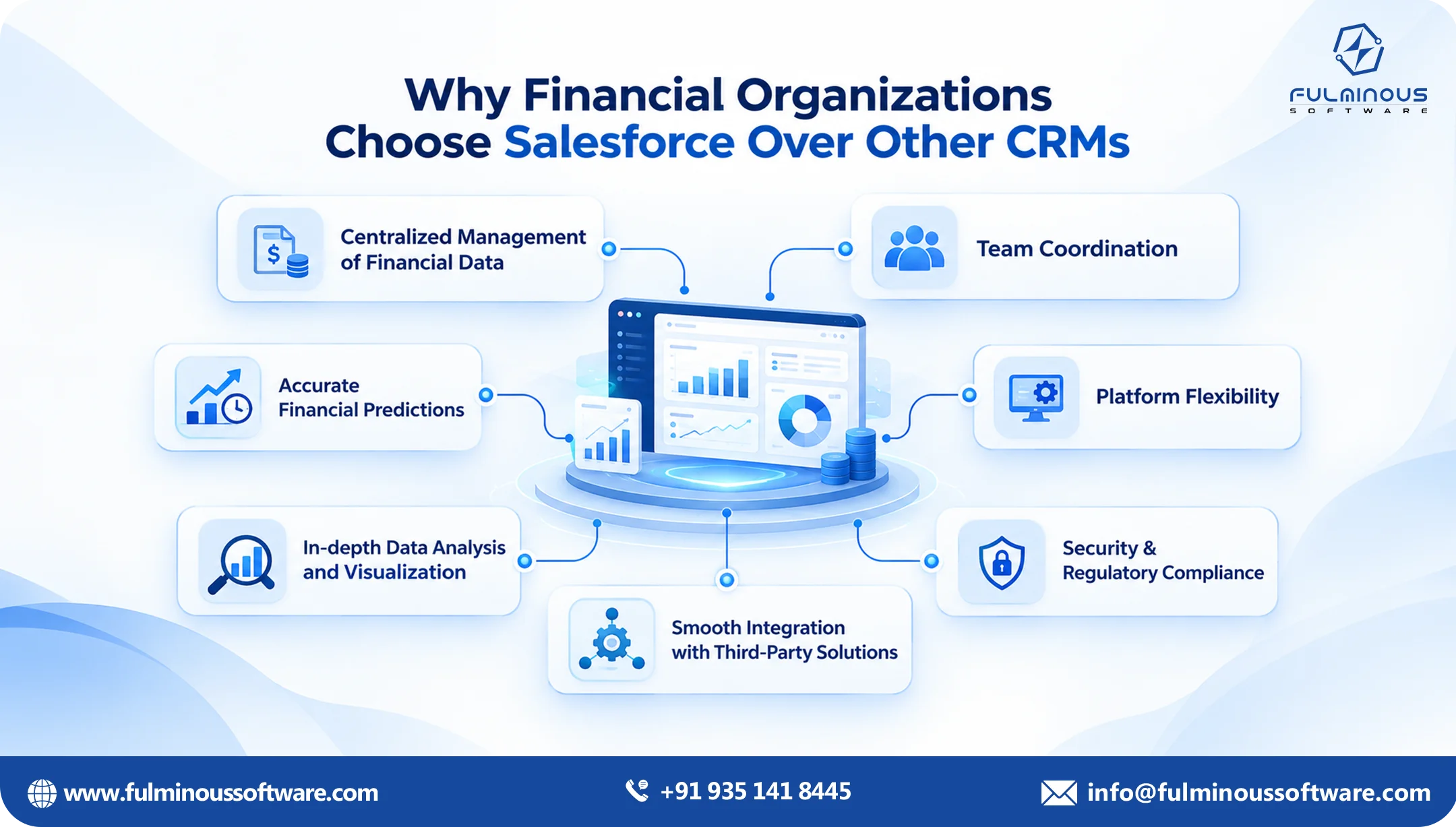
It can be a big help to relationship managers, customer service teams, sales reps, advisors and other customer-facing staff members. The information contained is based on the organization’s Salesforce products, integrations, data structure, and control of access.
2Customer service and engagement
Banks and insurers get all sorts of requests from their customers. These could be account questions, service requests, disputes, policy questions, claims related questions and follow-ups.
Salesforce for banks can help customer service by allowing employees to pull up relevant customer information and automate some tasks. Salesforce banking capabilities can connect customer data to core banking systems, enable service processes, and help employees provide more personalised customer interactions.
3Data, insights, and financial workflows
Financial institutions often work with information from multiple systems. Salesforce for BFSI can connect with external data sources and systems so that customer-facing teams can access information relevant to their work.
Data 360 is Salesforce's current name for the product previously called Data Cloud. Salesforce says Data 360 can ingest, harmonize, unify, and analyze data from different sources, including through data federation and data ingestion.
For organizations evaluating Salesforce for BFSI, the benefit is therefore not simply having another CRM. The practical value depends on how the organization connects Salesforce for BFSI with its existing customer, financial, service, and operational systems.
4Salesforce across BFSI sub-verticals
The benefits of Salesforce for banks vary by business model. Retail banks may focus on customer acquisition, onboarding, service, and relationship management. Commercial banking teams may need relationship visibility across businesses and stakeholders. Credit unions can use CRM capabilities for member relationships and service. Insurers have different needs around policies, claims, brokers, agents, and policyholder engagement. Wealth and asset management firms may prioritize advisor-client relationships, portfolios, financial goals, and service.
For a broader view of industry use cases, see our benefits of Salesforce for banking and insurance.
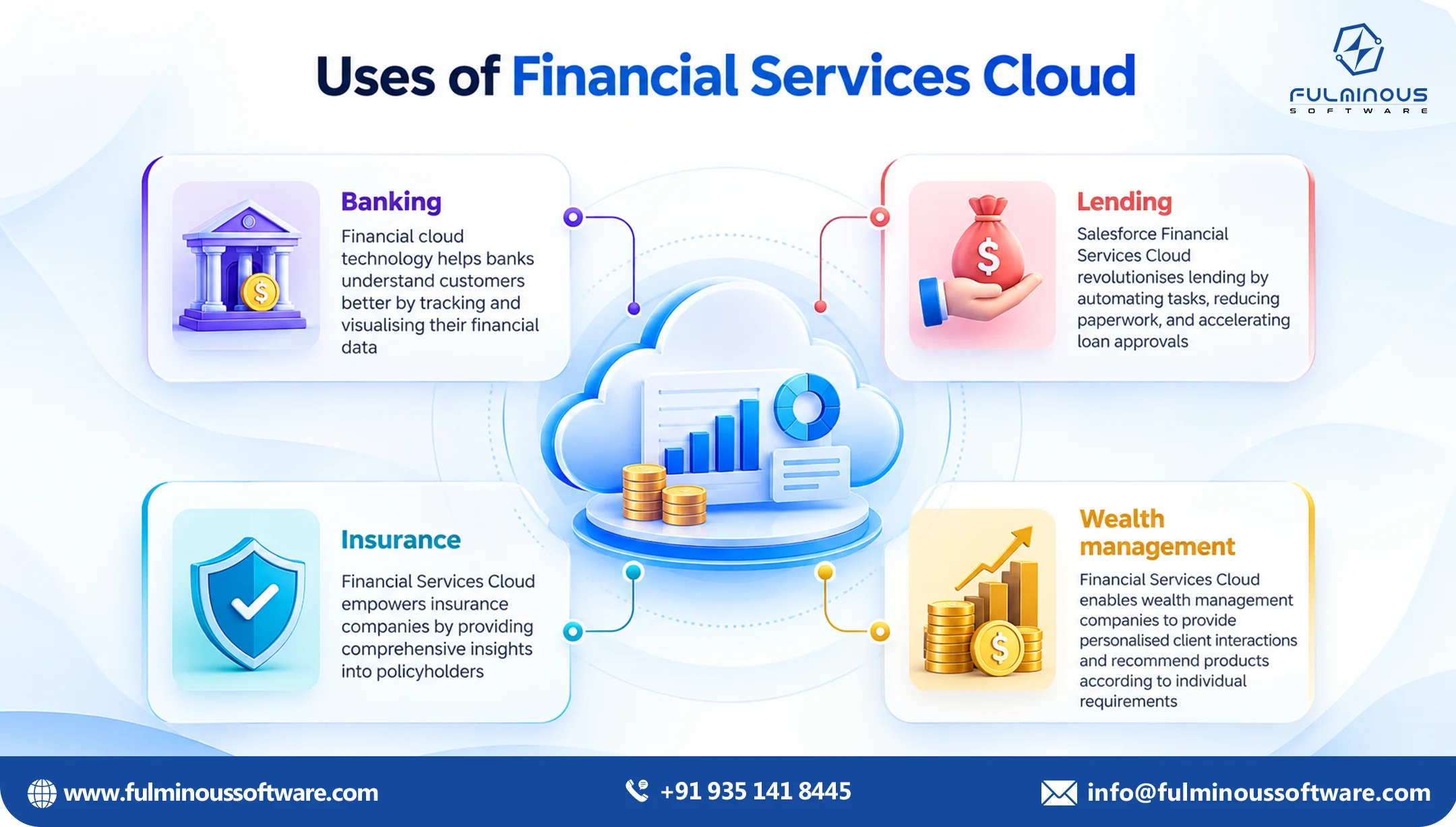
Benefits of Salesforce for Retail Banking
Retail banking involves many customer interactions, from account opening and onboarding to service, product enquiries, relationship management, and ongoing engagement. Salesforce can support these activities by bringing customer information, interactions, workflows, and selected financial-service processes into a connected working environment.
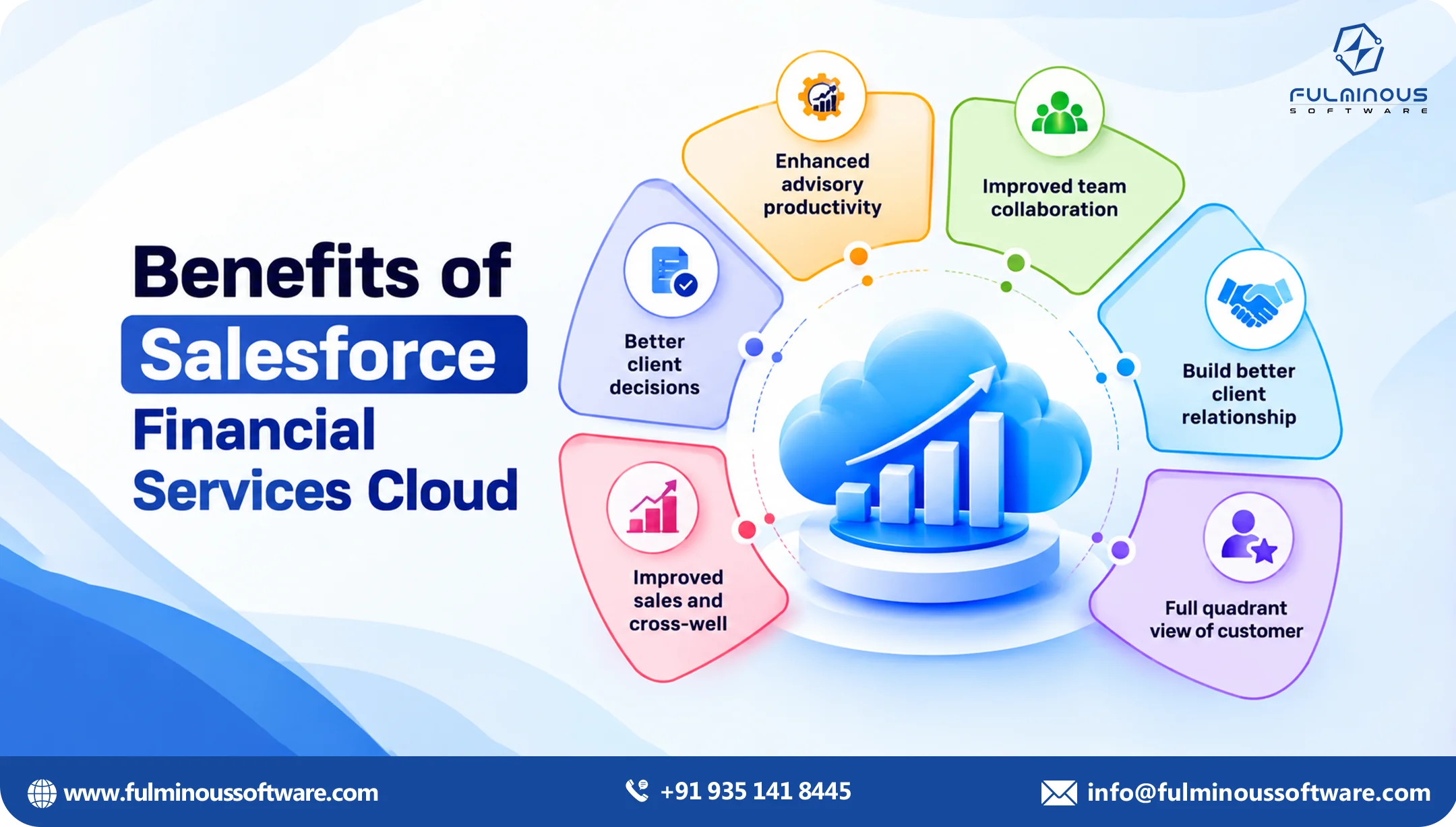
The benefits of Salesforce for banking depend on how the platform is configured and connected to existing systems. Salesforce should not be treated as a replacement for every banking application. Instead, it can provide a CRM and workflow layer that works with core banking and other systems.
1Unified customer information
A banking CRM from Salesforce can help employees see customer information and interactions more clearly. Salesforce banking capabilities are the ability to bring together data from core banking, internal and external systems to create a more complete customer profile.
For a bank, this can help authorised employees to understand past interactions, consumer tastes, products, relationships and service activity. The quality of this view depends on data integration, data quality, permissions and the organization’s Salesforce setup.
That can be useful when customers use different banking channels. A customer might use a mobile app, a contact center, a branch, email or another digital channel. With a connected CRM, teams can work from a single set of customer information rather than handling each interaction separately.
2Personalized engagement and service
It helps to bring together customer information, business processes, and engagement data to drive more relevant consumer engagement. Banking teams have access to customer profiles, interaction history, financial relationships and other available information to support service and sales activities.
Salesforce for banks can be utilised for banking use cases such as guided onboarding, collecting KYC information, document verification, risk screening, and connecting to core systems.
Automation can do away with repetitive work where suitable. Workflows can, for example, assign tasks, create follow-ups, guide employees through the necessary steps or even trigger actions based on certain business conditions.
These capabilities can also help realise the benefits of SFA integration in BFSI, particularly when sales-force automation is combined with customer information and existing monetary systems. The real value is in what processes you choose to automate and the quality of the underlying data.
Benefits of Salesforce for Insurance
Insurance companies must interact with policyholders, agents, brokers, employees and other participants throughout the policy lifecycle. This creates CRM and service needs that may be different than a general sales organization. Beyond Digital Insurance capabilities for policy and claims processes, Salesforce also has financial services capabilities for insurance.
Salesforce helps insurers connect client engagement with insurance specific information and workflows. This platform can be used to support customer and policyholder interactions, while other systems continue to support other insurance or business functions.
1Policy administration and customer engagement
Insurance teams may need to work with information on policyholders, policies, products, quotes, renewals, and other customer interactions. Salesforce’s Digital Insurance offering provides policy administration capabilities in the policy lifecycle, and its financial-services insurance capabilities enable policyholder information and customer relationships.
It can help insurers to offer a more connected customer service experience. Authorised employees can work with available customer and policy information, instead of working on each request without access to relevant history.
The Salesforce insurance documentation also describes customer profiles, relationships, policyholder life events, policies, claims, customer onboarding, customer service, and insurance-agent workflows.
2Claims, brokers, and agent relationships
Claims-related service is another important insurance use case. Salesforce currently describes Digital Insurance capabilities for claims management, including claims lifecycle activities. Its insurance materials also cover brokerages, producers, account managers, and agent-related workflows.
For an insurer, this can support several connected activities:
- maintaining policyholder information and interactions
- supporting claims-related customer service
- managing broker and agent relationships
- tracking customer and policy activities
- supporting insurance onboarding
- connecting policy and customer information with service processes
- providing digital engagement options
These capabilities do not mean that every insurer should move all policy administration or claims processing into Salesforce. Product selection depends on the insurer's existing architecture, business requirements, integration needs, data model, and compliance controls.
For organizations that need additional technical support, the relevant commercial option is to hire Salesforce Financial Services Cloud developers. Company-specific insurance experience should only be claimed where verified project evidence exists.
The current Salesforce product documentation also confirms that Financial Services Cloud supports banking, wealth, and insurance use cases, while Digital Insurance extends the platform into insurance-specific policy and claims processes.
Benefits for Wealth & Asset Management
Wealth management and asset management organizations often manage long-term client relationships involving advisors, portfolios, financial goals, service requests, and multiple stakeholders. Salesforce can help organize this relationship information and make relevant context available to authorized users.
Financial Services Cloud is designed for financial-services organizations including wealth managers. Salesforce describes capabilities for advisor and relationship-manager workflows, client information, financial relationships, and personalized engagement.
1Advisor and client relationship management
A CRM for wealth management can assist advisors and relationship managers in tracking information about clients, households, interactions, goals and business opportunities. It’s easier to gather relationship information when preparing for meetings, responding to requests or planning follow-up activities.
The value is getting customer information with the workflows that employees are already using. Otherwise, the Salesforce view may be partial if relevant information is still siloed in other systems. Thus, integration and data governance are key parts of the overall design.
2Personalized engagement and visibility
Wealth and asset management firms may require insight into client relationships beyond a single account or product. Salesforce financial-services capabilities can help provide relationship visibility and access to information from connected systems.
Salesforce also describes capabilities to identify client signals, manage complex relationships, support financial objectives and use data to inform relationship activities.
This can help teams organise follow ups and give more relevant client service. Salesforce does not give investment advice, nor does it guarantee the success of any investment. The processes, controls, policies and applicable regulations of the firm still apply to financial decisions.
Organisations can also connect Salesforce to other financial platforms and data sources. The right installation will depend on the firm’s existing technology environment, as well as the nature of client and portfolio information.
Financial Services Cloud vs. Sales Cloud
When considering benefits of Salesforce for banking, financial services and insurance, an organization should begin with its specific use cases and not assume that one cloud will suffice for all financial institutions. Sales Cloud provides general sales CRM functionality, while Financial Services Cloud has industry-specific data models, workflows and features for financial-services organisations.
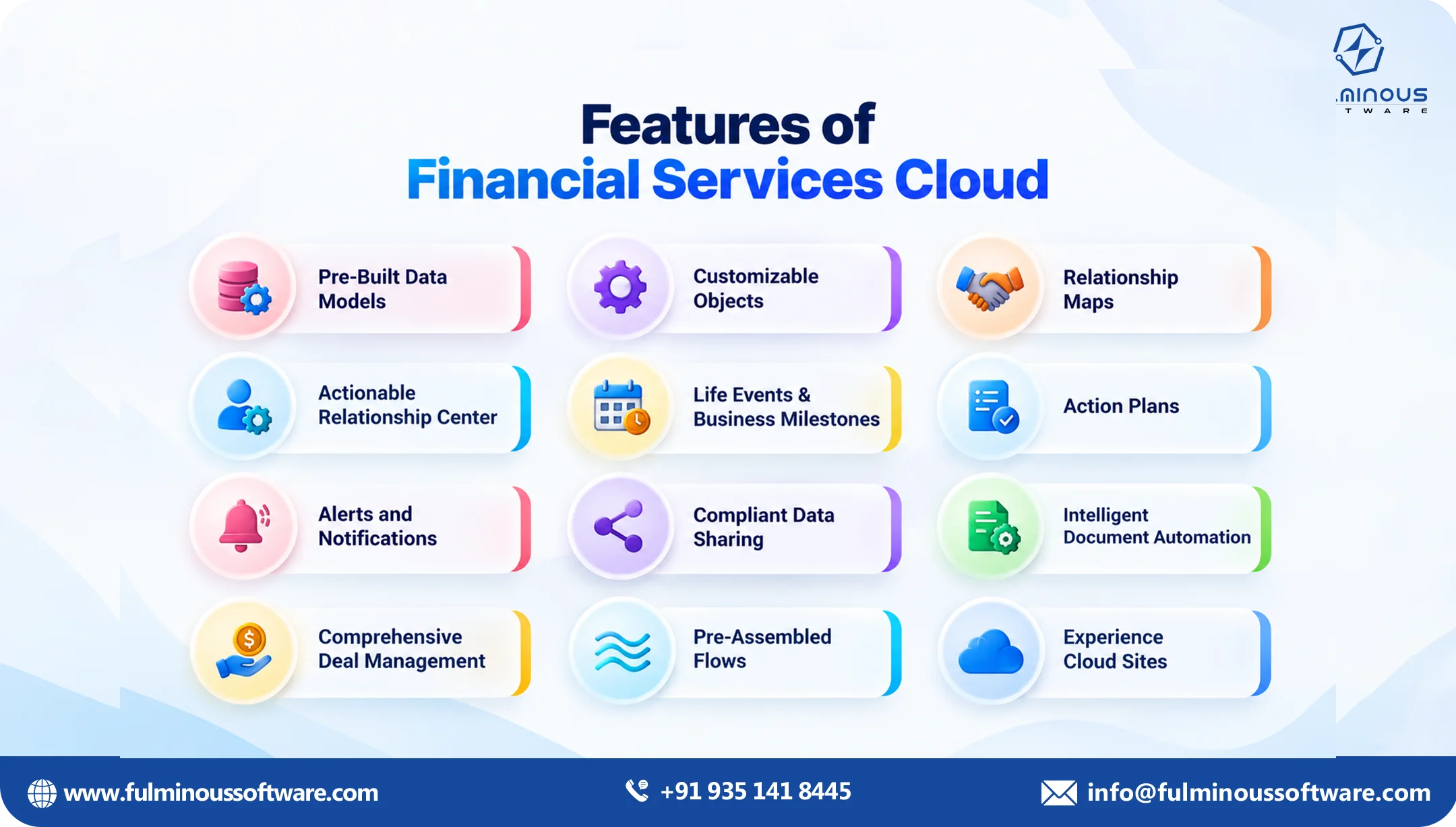
Salesforce currently describes Financial Services Cloud as a product designed for banks, wealth managers, and insurance companies. Its financial-services product pages also show Financial Services Cloud for Sales and Financial Services Cloud for Service, built around financial-services-specific requirements.
1Where Sales Cloud fits
Sales Cloud can support account, contact, lead, opportunity, sales-process, forecasting, reporting, and related sales activities. Its current product range includes different editions with different levels of customization, automation, analytics, and AI functionality.
A financial-services organization with relatively general sales requirements may therefore evaluate Sales Cloud alongside other Salesforce products. However, an organization that needs financial-services-specific data structures and workflows may need to evaluate Financial Services Cloud or the relevant financial-services products.
2When industry-specific functionality matters
Financial Services Cloud can be relevant when an organization needs capabilities designed around banking, wealth, or insurance relationships. Salesforce describes industry-specific data models and workflows for financial services, including customer onboarding, relationship management, service, and financial workflows.
Product selection should consider:
- business processes
- customer and relationship models
- required workflows
- existing systems
- integration requirements
- data structure and governance
- user roles
- compliance requirements
- automation requirements
- future product needs
Salesforce has been renaming various products over the last few years. Take Salesforce data cloud, for example, which says it rebranded Data Cloud as Data 360 on October 14, 2025. Agentforce Financial Services name is used on some newer materials, however Financial Services Cloud is still used on current Salesforce pages. Life Sciences Cloud is still a live Salesforce product, but newer pages use Agentforce Life Sciences terminology.
So, the goal is to match Salesforce capabilities with the organization's actual requirements rather than selecting a product based only on its name.
What It Costs and How Long It Takes
The cost and timeline of Salesforce for banks, financial services, and insurance vary substantially by project scope. A simple CRM deployment for a limited number of users is different from a multi-cloud BFSI program involving data migration, several integrations, custom development, security controls, and multiple business units.
1Factors that affect Salesforce cost
Common cost factors of salesforce crm for banking and insurance include:
- number and type of users
- Salesforce products and editions selected
- financial-services functionality required
- integrations with core banking or insurance systems
- data migration and cleansing
- custom objects, automation, and development
- portals and digital experiences
- reporting and analytics
- security and access requirements
- compliance requirements
- testing and user training
- ongoing administration and support
Salesforce publishes product-level pricing separately, and prices can change. For example, its current Sales Cloud pricing page lists different editions at different per-user rates, while Financial Services Cloud has its own pricing structure. These license prices should not be treated as the total cost of a BFSI project because implementation, integration, customization, data work, and other services can add to the overall project cost.
For company-specific Salesforce banking industry services, Fulminous Software offers $20-$60 per hour.
2Factors that affect implementation time
Timeline depends on the scope and complexity of the work. A salesforce crm for banking and insurance project involving a small number of standard processes can require less work than one involving multiple Salesforce products, legacy systems, large data sets, complex integrations, or extensive custom functionality.
Important timeline factors include:
- requirements and process complexity
- number of Salesforce users
- number of business units
- data volume and quality
- migration requirements
- API and integration work
- customization requirements
- security and compliance reviews
- testing requirements
- training and adoption
- stakeholder availability
A salesforce crm for banking and insurance project should therefore be estimated after reviewing the organization's requirements rather than using a fixed timeline for every BFSI organization.
Empower Your Banking, Financial Services, and Insurance with Our Salesforce Services
After understanding the valuable benefits of Salesforce for banking, financial services and insurance business, it is time to tie up with an ideal Salesforce partner. Fulminous Software has been providing top-class and premium Salesforce services at an affordable price for all kinds of industries since 2018. You can hire our team or individual Salesforce developers as per your requirements and explore the benefits of a bank using Salesforce.
FAQs
Q1. What are the benefits of Salesforce for banking, financial services and insurance?
Salesforce banking solutions can help banks centralize customer information, support relationship management, improve service workflows, guide customer onboarding, automate selected processes, and connect data from different systems, giving authorized employees more context for customer interactions and financial-service activities without requiring Salesforce to replace every existing banking application.
Financial Services Cloud is designed for financial-services organizations and can connect with external banking systems. Banks can use the Salesforce HCM solution for financial services to get capabilities for sales, service, customer engagement, data management, and selected financial workflows. The specific benefits of Salesforce for banking, financial services and insurance depend on the bank's processes, integrations, data quality, users, and security requirements.
Q2. Is Salesforce good for insurance companies?
Insurers may utilise Salesforce Insurance specific workflows, policy administration, claims management, customer and policyholder engagement, broker and agent relationships. Its Digital Insurance capabilities can also integrate policy and claims processes with customer-facing activities in the Salesforce platform.
Salesforce’s Digital Insurance Platform includes elements that support policy administration, claims, benefits and billing systems. These insurance capabilities can underpin activities throughout the life-cycle of the policy. But before settling on any particular Salesforce products, organisations should take stock of existing insurance systems, integrations, data needs and compliance processes.
Q3. What does SFDC mean in banking?
SFDC full form in banking is historically associated with Salesforce.com, and in banking it generally refers to Salesforce and its CRM capabilities rather than a separate banking technology, although current Salesforce in banking product terminology typically identifies specific products such as Financial Services Cloud, Sales Cloud, Service Cloud, Data 360, and Agentforce.
The SFDC full form in banking may appear in older technical documentation, system names, integrations, or discussions about Salesforce development. When reviewing current Salesforce documentation, organizations should use the specific product name because Salesforce's product portfolio and naming have evolved.
Q4. Which Salesforce cloud should a bank use?
Banks should not be choosing the same cloud for all scenarios. Instead, they should select Salesforce products according to their needs for customers, sales, service, data, integration, security and industry. Sales Cloud supports broader sales activities and business needs, whereas Financial Services Cloud provides specific capabilities for financial services.
Financial Services Cloud is purpose built for banking, wealth management and insurance use cases. Sales Cloud can provide support with general sales activity. Depending on the architecture of the system and business needs, a bank could also consider Service Cloud, Data 360, Agentforce or other Salesforce products.
Q5. Does Salesforce replace a core banking system?
Salesforce is not typically a substitute for a bank’s core banking system. Instead, it can deliver CRM, customer interaction, service, workflow and relationship-management capabilities at the same time as integrating with external banking systems through integrations based on the bank’s existing technology setup and business needs.
Financial-services documentation from Salesforce outlines how to integrate Financial Services Cloud with core banking and other outside systems. The benefits of SFA integration in BFSI are plenty, but the core banking platform can keep doing what it does now in terms of banking capabilities, and Salesforce can come in and help with the customer-facing actions, service processes, and relationship management.
Q6. How does Salesforce help with KYC and compliance?
Salesforce can support KYC and compliance workflows by managing customer compliance information, supporting identity checks and screening, organising risk information, controlling access to sensitive records and supporting onboarding activities. However, the financial institution still is responsible for applying and maintaining controls to meet its applicable regulatory requirements.
In Salesforce Financial Services, the cloud documentation describes a KYC data model that may include identity verification results, anti-money-laundering screening results, credit profiles, risk profiles and related information. These capabilities can be used by organisations as part of wider compliance processes and integrations.
Q7. What does Salesforce cost for a bank?
For a bank, Salesforce pricing will be determined by the products and editions chosen, the number of users, integrations, data migration, customisation, automation, security requirements, implementation services and ongoing support. These factors differ from one organization to another and thus there is no common project price that would represent the total cost of all banks.
Salesforce does publish pricing for individual products, but licensing is just one component of a banking Salesforce program. Financial Services Pricing Pricing is based on edition and use case. Add-on products and services can add to the price. Project pricing should be based on documented business and technical requirements.
 Verified
Expert in Software & Web App Engineering
Verified
Expert in Software & Web App Engineering
I am Manish Kumawat, co-founder of Fulminous Software, a top leading customized software design and development company with a global presence in the USA, Australia, UK, and Europe. Over the last 10+ years, I am designing and developing web applications, e-commerce online stores, and software solutions custom tailored according to business industries needs. Being an experienced entrepreneur and research professional my main vision is to enlighten business owners, and worldwide audiences to provide in-depth IT sector knowledge with latest IT trends to grow businesses online.



Partner with Top-Notch Web Application Development Company!
Discuss your Custom Application Requirements on info@fulminoussoftware.com or call us on +91-935 141 8445.
15 Days Risk-Free TrialRecommended Articles