
Offshore Software Development Rates by Country (2027): India vs Eastern Europe vs Latin America

Manish Kumawat
Last Updated on: 16 November 2026



The software development budget meetings on outsourcing start the same way. Someone asks, "What does a developer cost per hour?" Someone else shares a number of prices from online. Then the CFO asks why two offshore development agencies quoted $25 and $70 for the same project. Why are Indian offshore development agencies charging much less compared to the US?
The honest answer is that the hourly rate of offshore software development depends on various elements. The location you choose has the most relevant role in this pricing. Have you noticed that software developers from the US charge double the hourly rate available in India?
Then the other concern raises: is low cost offshore developers reliable? Do high offshore development rates mean premium quality results? Does it reduce the quality of the project? Does an offshore development team handle all the tasks like an in-house team?
So here we will discuss the offshore software development rates you can expect in 2027 across India, Eastern Europe and Latin America, explain why the numbers differ so much, and show how to compare cost against risk without getting fooled by a low headline price.
With this guidance, you can choose the best offshore software development company for your project at the best price and top quality!
Table of Contents
15 sectionsWhy companies choose offshore development
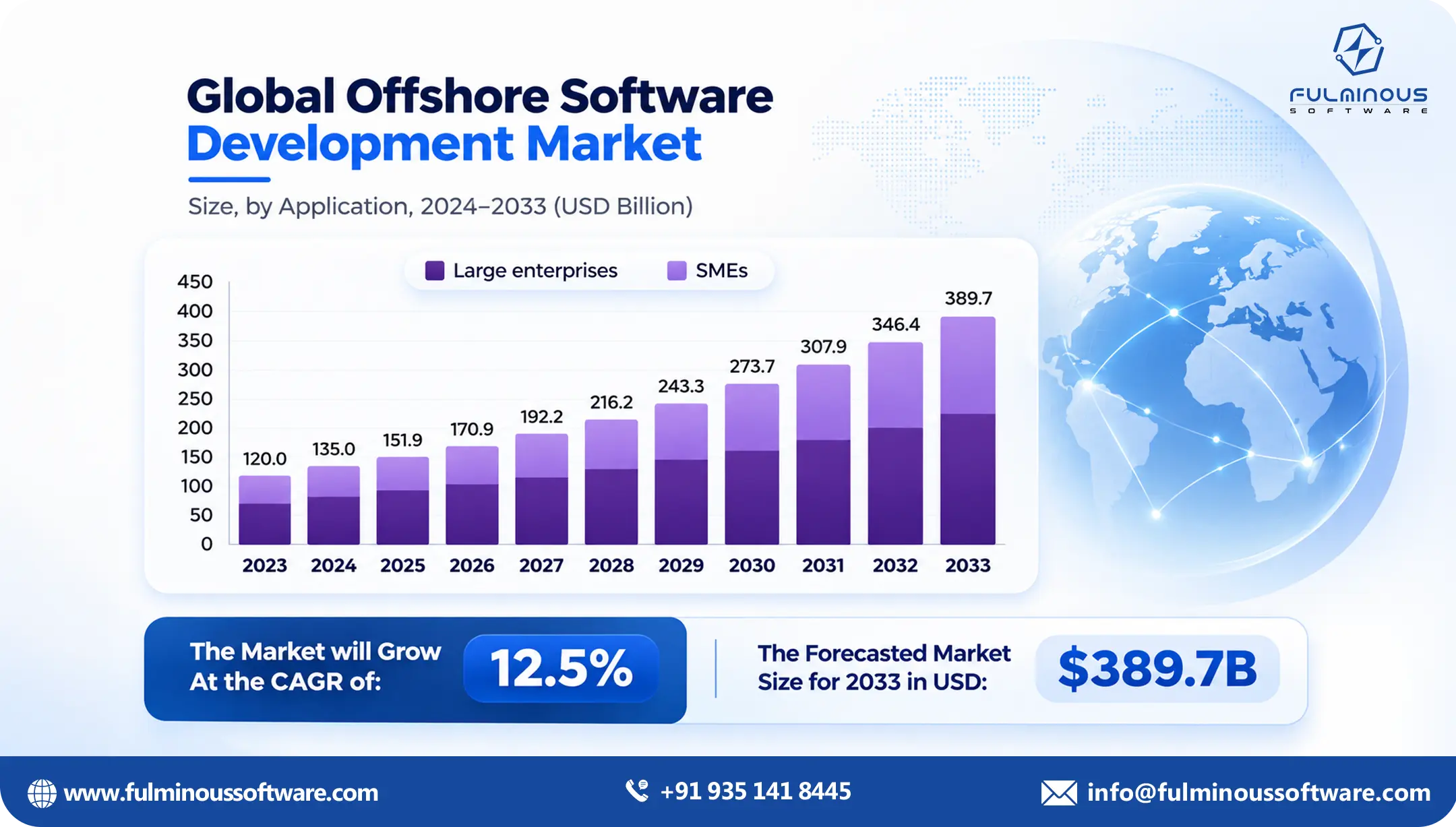
Every software development project faces these two concerns: offshore or onshore? If offshore, then which region? Do you know the offshore software development market globally is $204.32 billion this year? That shows the trend.
Before we get to the numbers of offshore development, it helps to ask a basic question: why go offshore at all? For most companies, it comes down to four things.
Lower cost. Hiring a full in-house team in the US or Western Europe means salary, benefits, recruiting fees, office space and equipment. An offshore team replaces most of that with one monthly invoice.
Access to more top talent. Good software developers are hard to find and slow to hire locally. Offshore markets give you a much bigger bunch of software developers, so you can fill roles in days instead of months.
Speed and flexibility. You can add three developers for a big launch and scale back when it ends. That is very hard to do with permanent local staff or in-house teams.
Focus. When a trusted partner handles the build, your own business or development team can spend its time on customers, sales and product decisions.
Definitely, offshore is not magic, and it does not suit every software development project. But when it is done well, it lets a small company build like a big one. Yes, your dream big projects can turn into reality easily.
Why the offshore location matters
Here is the part many buyers miss. "Offshore" is not one place. It just means another country or region away from your location. The country you pick changes your price, your risk and how smoothly the work runs day to day. Location affects at least five things:
Hourly rate. Pay levels differ a lot from country to country, which is why the same role can cost $30 in one place and $80 in another.
Time zone overlap. The more hours you share with your team, the faster questions get answered.
Talent pool size. Big markets like India can supply large teams quickly. Smaller markets may run out of senior people.
English and communication. Clear communication saves more money than a lower rate ever will.
Stability and legal risk. Currency changes, political events, data laws and IP protection all vary by country. Your finance and legal teams will care about these.
In short, choosing a location is a business decision, not just a price check or random pick. That is why the rest of this post compares India, Eastern Europe and Latin America on cost and risk together. Here we will make it clear for your decision-making.
Developer hourly rates by country and region (2027)
Here is a simple view of offshore software development rates in various countries. These developer hourly rates by country may give you a basic idea of the offshore costs and help you evaluate the price difference in each part of the world.
| Region | Junior | Mid-level | Senior |
|---|---|---|---|
| India | $18 – $30 | $20 – $45 | $40 – $70 |
| Eastern Europe (Poland, Romania, Ukraine, Czechia) | $25 – $40 | $40 – $60 | $60 – $90 |
| Latin America (Mexico, Brazil, Colombia, Argentina) | $25 – $40 | $40 – $65 | $55 – $90 |
| US onshore, | $60 – $90 | $85 – $135 | $120 – $200+ |
A few things stand out. India is usually the lowest in price at every level. Eastern Europe and Latin America sit close to each other, and both tend to cost 30 to 70 percent more than India for the same seniority. And all three cost far less than hiring in the US.
One more point. These are the developer hourly rates by country that agencies quote. Your real cost per hour of useful work is higher, and we will get to that below.
India software developer hourly rate: what is behind the affordability
Are you wondering why the India software developer hourly rate is lower than all other countries? Is there any hidden pitfall in these developer hourly rates by country? Actually, the India software developer hourly rate is lower mainly because of scale and local pay levels. India produces a very large number of engineering graduates every year, and the cost of living is lower than in Europe or the US.
As the pool of software engineers is vast in India, the clients get plenty of choices. That is why a mid-level developer there is commonly quoted around $20 to $45 an hour, while a senior engineer with strong English and years of experience with foreign clients can reach $40 to $70.
It is not only about cheap labor. India also gives you something the other two regions struggle to match: depth. If you need ten developers next month, or a mix of Java, .NET, mobile, cloud and QA under one roof, India has the bench for it. Smaller markets can run out of people fast.
The usual trade-off is the time zone of the developers. India is about 9.5 hours ahead of US Eastern time and 4.5 to 5.5 hours ahead of most of Europe. Good software development teams like ours solve this with a planned overlap window, clear written handovers, and a lead who stays online during your working hours.

Eastern Europe: higher rate, strong engineering culture
Poland, Romania, Ukraine and Czechia are popular for great technical skills, especially in backend, fintech and data work. The offshore software development rates run higher, roughly $40 to $60 for mid-level and up to $90 for top seniors, which is far higher than Asian prices.
The clients also get a big plus if their team is in Europe. The time difference is small, so calls and reviews are easy. For US companies, the overlap is partial, mostly in the morning. But the high rates make small businesses and startups choose tech developers from India rather than these European countries.
The things to watch: smaller talent pools in some countries, rising salaries each year, and in some cases, geopolitical risk that your board may want to discuss.
Latin America: time zone is the selling point
Mexico, Brazil, Colombia and Argentina are priced close to Eastern Europe. Definitely, there are some geographical benefits, but generally costs are double the rates compared to Asian countries. What you are mostly paying for is a full working day that overlaps with US teams.
You offshore developers from Latin American countries join the same stand-up, answer messages in minutes and can jump on a call when production breaks. As the expenses in these countries are high the costs and availability of developers is highly different than that of Asian countries.
The things to watch: currency swings in some countries, uneven English levels outside the main tech cities, and a smaller pool of very senior specialists compared with India.
Nearshore vs offshore cost: the real comparison
When people discuss nearshore vs offshore cost, they often compare two hourly rates and stop there. That misses the point. Nearshore (a nearby country in a similar time zone) costs more per hour. Offshore (a far-away country like India for a US client) costs less per hour but needs more planning around time zones.
The question is which one costs less per finished feature, not per hour. Here is a simple way to think about it. A software developer quotes you a rate. On top of that, you pay for hidden things:
- Management and coordination time. More time zone gap means more written specs and more waiting for answers.
- Rework. If requirements get misunderstood, you pay twice.
- Turnover. When a developer leaves, you pay to train the next one.
- Tools, security and compliance setup.
- Your own team's time spent in meetings and reviews.
Many buyers add 40 to 80 percent on top of the quoted rate to get a realistic number. Using that range:
| Region | Typical mid-level rate | Realistic cost per hour (1.4x – 1.8x) |
|---|---|---|
| India | ~$35 | ~$49 – $63 |
| Eastern Europe | ~$50 | ~$70 – $90 |
| Latin America | ~$52 | ~$73 – $94 |
Even after adding the hidden costs, India always stays more affordable. But the gap shrinks. And if a project needs daily live work with your team, a nearshore partner can finish faster, which can make the total bill lower even at a higher hourly price.
If you want to read more about nearshore vs offshore costs, see our page on offshore software development company services, or compare with nearshore software development companies.

A simple example: a team of five for one year
Numbers on a page feel boring and confusing, so let us make it real. Say you need five mid-level developers for 12 months. That is about 9,600 working hours in total (5 people, 160 hours a month, 12 months). Here is what the bill could look like. These are illustrative figures built from the mid-level rates earlier in this post, not a quote.
| Region | Quoted rate | Quoted yearly cost | Realistic yearly cost (1.4x – 1.8x) |
|---|---|---|---|
| India | $35/hr | ~$336,000 | ~$470,000 – $605,000 |
| Eastern Europe | $50/hr | ~$480,000 | ~$672,000 – $864,000 |
| Latin America | $52/hr | ~$499,000 | ~$699,000 – $899,000 |
On paper, India saves you around $144,000 a year compared with Eastern Europe. After hidden costs, the gap is still large, often well over $150,000. That is real money for a startup, and a big margin for a CFO.
Now the other side. Suppose the nearshore team is online with you all day and ships the same work 10 to 15 percent faster because questions get answered in minutes. That closes part of the gap, but rarely all of it.
Also, we can't ignore the well-dedicated offshore software development agencies like Fulminous Software that keep things live and work in the same working hours as the clients. So there will be no gaps and get results just like an in-house team. You get affordable software development services with the same qualities as an onshore or in-house team.
For many projects, the offshore team still comes out cheaper. For a few projects, mostly fast-moving products with daily decisions, the nearshore team wins. The lesson: do this calculation with your own numbers before you decide. A five-minute spreadsheet tells you more than any guess.
Cost vs risk: how to decide
A business CFO does not only ask "what is the cheapest way to build?" The better question is "what is the cheapest option I can still trust?" Here is a practical way to score each region and pick the best.
1. Project type: Long-running product build with clear specs? Offshore works well and saves the most. Fast-changing product with daily decisions? Nearshore may fit better.
2. Team size: Need 3 developers? Any region works. Need 15 or more within a quarter? India has the largest ready talent pool.
3. Time zone need: How many hours of live overlap do you really need each day? Two to three hours is enough for most teams. Full-day overlap is a nice extra, not always a must.
4. Risk tolerance: Look at staff turnover, contract terms, data security, IP ownership and local legal stability. These matter more than a $5 difference in rate.
5. Budget pressure: If cost per hire is the main concern, India usually wins. If speed and communication are the main concern, nearshore may justify its premium.
Many growing companies end up with a mix: a core team in India for the heavy build work, plus a small group near their own time zone for product decisions and client calls. But if you get a strong offshore software development company like Fulminous Software, there is no need for this mixup. Their single team is enough to cover all the tasks at the best price.

Why rates change inside the same country
You may also see two vendors in the same country , even from the same city can quote very different prices. Why does this happen? No need to think it's more tricky. Usually this comes down to:
Seniority and experience. A senior architect costs far more than a junior coder.
Tech stack. AI, cloud and niche skills can add 15 to 30 percent or more.
Engagement model. Dedicated team, fixed price and hourly billing each price risk differently.
Vendor size. A large firm carries more overhead than a small one, but also gives you backup when someone leaves.
Contract length. Longer commitments often earn better rates.
Also, the goals and focus of each software development company cause the pricing. For example, Fulminous Software focuses on bringing top-quality software development services at reasonable prices. That's why even small businesses and startups can launch their digital space with Fulminous Software.
If you are mainly hiring one skill set, such as full-stack, you can see how this plays out on our page to hire full-stack developers.
Common mistakes buyers make when comparing rates
We, as a leading software development agency, talk to a lot of founders and finance teams. The same mistakes come up again and again, so here they are and face several issues.
Choosing only the lowest rate. A very low quote often means junior developers, a thin team or hidden charges that show up later. If one vendor is 40 percent cheaper than everyone else, ask why.
Comparing different seniority levels. One vendor quotes a senior developer, another quotes a mid-level one, and you compare the two numbers as if they were the same job. They are not. Always line up the same role and the same experience.
Forgetting about turnover. In some markets, developers change jobs every year or two. Every exit costs you training time and delays. Ask each vendor how long their developers usually stay.
Starting without a small trial. Signing a 12-month deal on day one is risky. A paid pilot of four to six weeks shows you how the team communicates, how clean their code is and whether the time zone really works for you.
Writing vague requirements. Even the best team cannot read your mind. Unclear specs cause rework, and rework is the highest hidden cost in outsourcing. Spend a few days writing down what you need before you ask for quotes.
Skipping the contract details. Check who owns the code, how much notice either side must give, what happens if a developer leaves, and how disputes are handled. These clauses matter far more than a small difference in the hourly rate.
Ignoring time zones until it hurts. Teams that wait until week three to agree on overlap hours usually end up frustrated. Decide on it before you start, and write it into the plan.
Avoid these seven, and you are already ahead of most businesses.
Questions to ask any vendor about their rates
Before you compare quotes, ask each software development agency the same five things:
- Is this rate for a named developer or an average across the team?
- What is included: management, QA, tools, paid leave, equipment?
- What happens if the developer leaves mid-project?
- Are there extra charges for overtime, urgent fixes or scope changes?
- Can I see a written rate card by role and seniority?
If a vendor cannot answer the last one clearly, treat that as a warning sign. Transparent pricing usually reflects a transparent way of working
Why Fulminous Software is a strong choice for offshore development
Not exaggerating! Fulminous Software is the best offshore software development choice to hand over your project. As we have offices in India, the US, the UAE, the UK, and Australia, you can pick developers from any region at the best price and there will be no time gaps.
Especially if you decide that an India-based team fits your budget and risk level, the next question is who to pick. At Fulminous Software, we build our offshore services to resolve all the worries that finance and procurement teams actually have. Here is what makes Fulminous Software different:
Clear rate bands, shared up front. You get role-wise and seniority-wise rates before the first call ends. No "depends on the project" answers, and no surprise add-ons later.
Dedicated teams, not rotating names. The software developers you meet are the ones who work on your product. This keeps knowledge inside the team and cuts the rework that quietly inflates your real cost per hour.
Planned time zone overlap. Fulminous Software agrees on overlap hours with you at the start, so stand-ups, reviews and urgent fixes happen when you are online. Offshore pricing, with a working day that fits yours.
Senior-led delivery. Every team has an experienced lead who owns quality, reviews code and speaks to you in plain language. You do not have to manage developers one by one.
Security and IP protection built in. Contracts state clearly that the code is yours. Access control, NDAs and secure working practices are part of the setup, not an extra.
Easy to scale up or down. Start with two developers and grow to a full team as your product grows, or reduce when a phase ends. You pay for what you need, with simple notice terms.
Want to see how this works for your real project? Visit our offshore software development company page or ask us for a quote.
Now collaborate with the best offshore software development company!
In 2027, offshore software development rates are easy to understand. The India software developer hourly rate is very affordable, giving you the lowest price and a huge talent pool. Eastern Europe offers strong engineering and a closer time zone for European teams, but costs more. Latin America gives you full-day overlap with the US, but costs more too. The right choice depends on what you value most: price, speed, or control.
What matters is the full cost, not just the number on the quote or the developer hourly rates by country. Clients should never have to guess. That is why we share clear rate bands by role and experience level up front.
Want to see our offshore software development rates? Request our rate card and get role-wise rates, engagement options and a realistic cost estimate for your project.
FAQs
Q1. What are typical offshore software development rates in 2026?
Most software development agencies quote roughly $20 to $45 an hour in India, $40 to $65 in Eastern Europe and $40 to $65 in Latin America for mid-level developers. Senior software developers cost more in every region.
Q2. Is India still the cheapest option for offshore software development?
Yes, in most cases India software developer hourly rate is more affordable. Even after adding management and coordination costs, India usually stays below Eastern Europe and Latin America, though the gap is smaller than the headline rates suggest.
Q3. Is nearshore software development always better because of the time zone?
Not always. Nearshore helps when your team needs constant live contact. For well-defined work with clear specs, offshore teams with a planned overlap window can deliver the same quality at lower cost.
Q4. Do hourly rates of offshore software development include everything?
Not always. Ask whether management, QA, tools and equipment are included, and whether there are any extra charges.
Q5. How often do offshore software development rates change?
The offshore software development rates usually move up a few percent each year, faster for in-demand skills like AI and cloud. Check any figure against a current quote before you plan a budget.
Q6. Does a lower hourly rate mean lower quality?
No. The offshore software development rates mostly reflect local pay levels, not skill. A $35 developer in India can deliver the same work as a $90 developer in the US. What matters is the vendor's hiring process, code reviews and how senior the team lead is.
Q7. How much can I save compared with hiring in the US?
For mid-level roles, many companies save roughly 50 to 70 percent on the hourly rate. After you add management and coordination costs, real savings are usually lower, so ask for a full cost estimate, not just a rate.
Q8. Which engagement model is best: hourly, fixed price or dedicated team?
Hourly (time and materials) suits work where requirements change often. Fixed price suits small, clearly defined projects. A dedicated team suits long-term products because the same people stay on your work and the cost per hour usually drops.
Q9. How do I compare two vendor quotes fairly for offshore software development?
Ask both vendors to quote the same roles, the same seniority and the same hours, and to state what is included. Then add an estimate for management time, rework and turnover. The quote with the lowest rate is often not the cheapest in the end.
Q10. Is offshore or nearshore better for a startup on a tight budget?
If cash is tight and your specs are fairly clear, offshore usually gives you more developer hours for the same money. If you are still testing your idea and need daily back-and-forth, nearshore may save time even though it costs more per hour.
 Verified
Expert in Software & Web App Engineering
I am Manish Kumawat, co-founder of Fulminous Software, a top leading customized software design and development company with a global presence in the USA, Australia, UK, and Europe. Over the last 10+ years, I am designing and developing web applications, e-commerce online stores, and software solutions custom tailored according to business industries needs. Being an experienced entrepreneur and research professional my main vision is to enlighten business owners, and worldwide audiences to provide in-depth IT sector knowledge with latest IT trends to grow businesses online.



Partner with Top-Notch Web Application Development Company!
Discuss your Custom Application Requirements on info@fulminoussoftware.com or call us on +91-935 141 8445.
15 Days Risk-Free TrialRecommended Articles