Legacy Application Modernization Cost: Budget Ranges, Cost Drivers and ROI

Manish Kumawat
Last Updated on: 20 November 2026



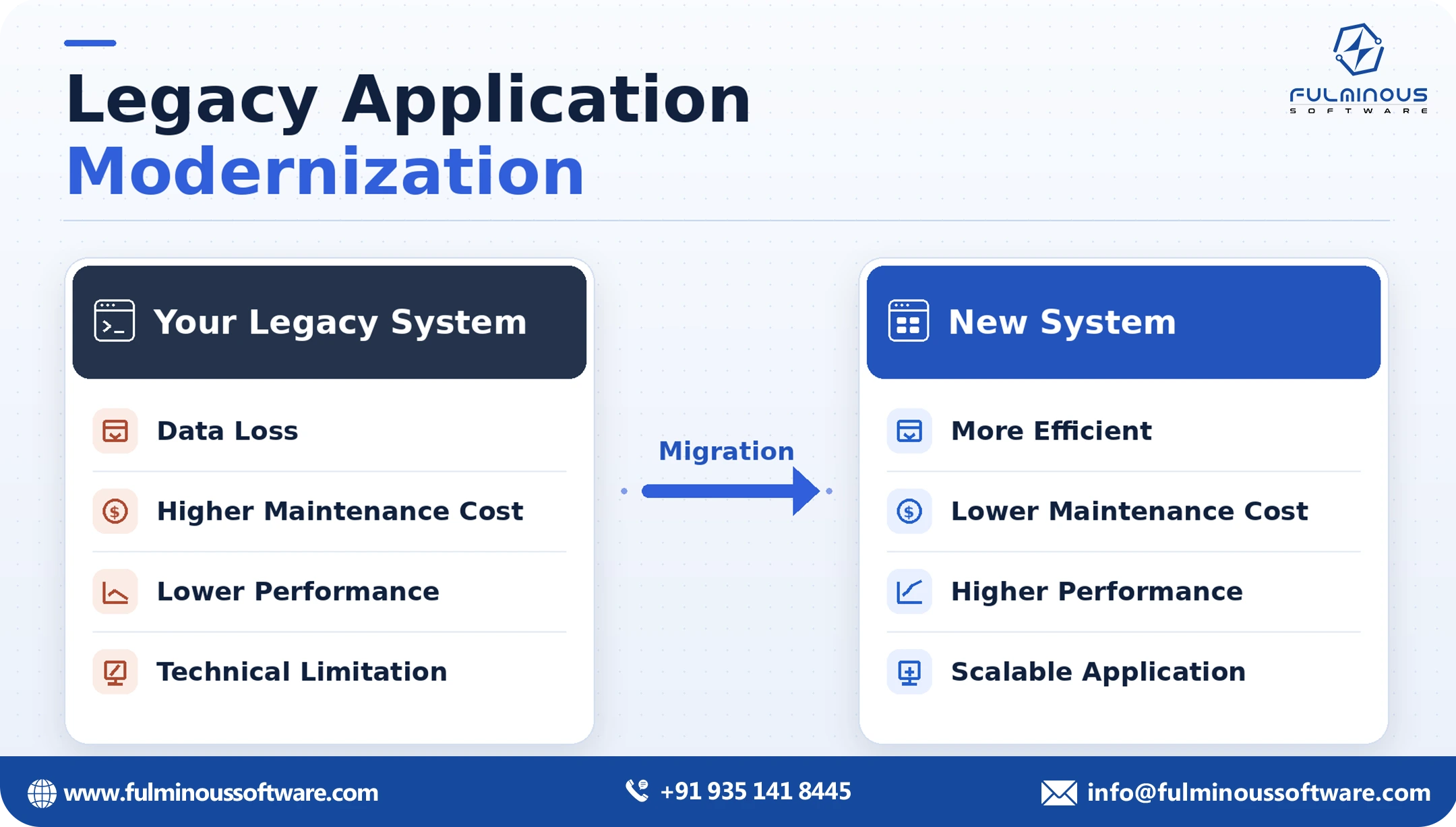
It's a fact that not a single business wants to continue using outdated business applications that cause business losses. The advancement of tech solutions and their benefits also inspires businesses to modernize their old business systems. But every business faces the same question: "What will it cost to fix this old system, and what do we get back?"
Whether it's for budgeting or fund allocation, it's relevant to have a clear answer to this question from the beginning. In general, legacy system modernization costs can be $5,000-$50,000+. But such an approximate cost is not enough for budgeting or budget allocation discussions.
Most teams cannot answer the exact cost with confidence because the real legacy application modernization cost depends on things nobody has measured yet: how complicated the code is, how many systems connect to it, and how much knowledge left the building when the original developers did.
Here we will give you straight answers about legacy system modernization costs. You will see realistic budget ranges for legacy system modernization costs, the factors that push the price up or down, the costs people forget, and a simple way to build an ROI case that finance will accept. The aim of the complete guide is to help you walk into the budget meeting with a realistic legacy system modernization cost you can defend.
Table of Contents
15 sectionsWhy the legacy application modernization cost question is so hard to answer
A new software project is just like a blank page. You can start development directly. Modernization of old software starts with a system that has been running for ten, fifteen, sometimes thirty years. It has patches on top of patches. Part of how things work is in the code, part is hidden in database triggers, and part exists only in some employee’s memory.
You need to evaluate the current situation, the necessary modernization method and implement it. That is why quotes for the same system can vary by factors. One modernization agency assumes the documentation is good. Another assumes it is missing. One plans to move the app as it is. Another plans to rebuild the business app from scratch. Both can be "right" and still be very far apart.
So the first thing to accept is that any number you read about legacy system modernization costs online is a starting point, not a realistic quote. Consider it as a way to frame your thinking. The real legacy system modernization cost only appears after someone looks inside your current system.
What does legacy application modernization cost? Typical budget ranges
Now we can see the general ranges of legacy system modernization costs based on what small, mid-size and large companies commonly spend. Your own figures will differ, but these give you a sensible frame for early planning and budgeting. The application modernization cost for one system usually falls into one of these bands.
| Application size and complexity | Typical budget range | Typical timeline |
|---|---|---|
| Small, self-contained app with few integrations | $5,000 – $15,000+ | 1– 3 months |
| Mid-size business app with several integrations | $15,000 – $30,000+ | 3 – 6 months |
| Large, business-critical system with heavy integrations | $30,000 – $50,000+ | 6– 10 months |
| Core platform or full portfolio (many linked systems) | $40,000+ | 10 months or more add |
A few things to keep in mind when you read this table about legacy application modernization cost.
These are project costs, not run costs. They cover the work of getting from the old system to the new one. Hosting, licences, support and monitoring come on top.
Size is not just lines of code. A small app that touches payments, customer data and three other systems can cost more than a larger app that stands alone.
Phased work usually costs more in total but less at any one time. Splitting a big legacy app modernization into stages adds some benefits, but it spreads the spend and lowers the risk of a single large failure.
Legacy application modernization cost by approach
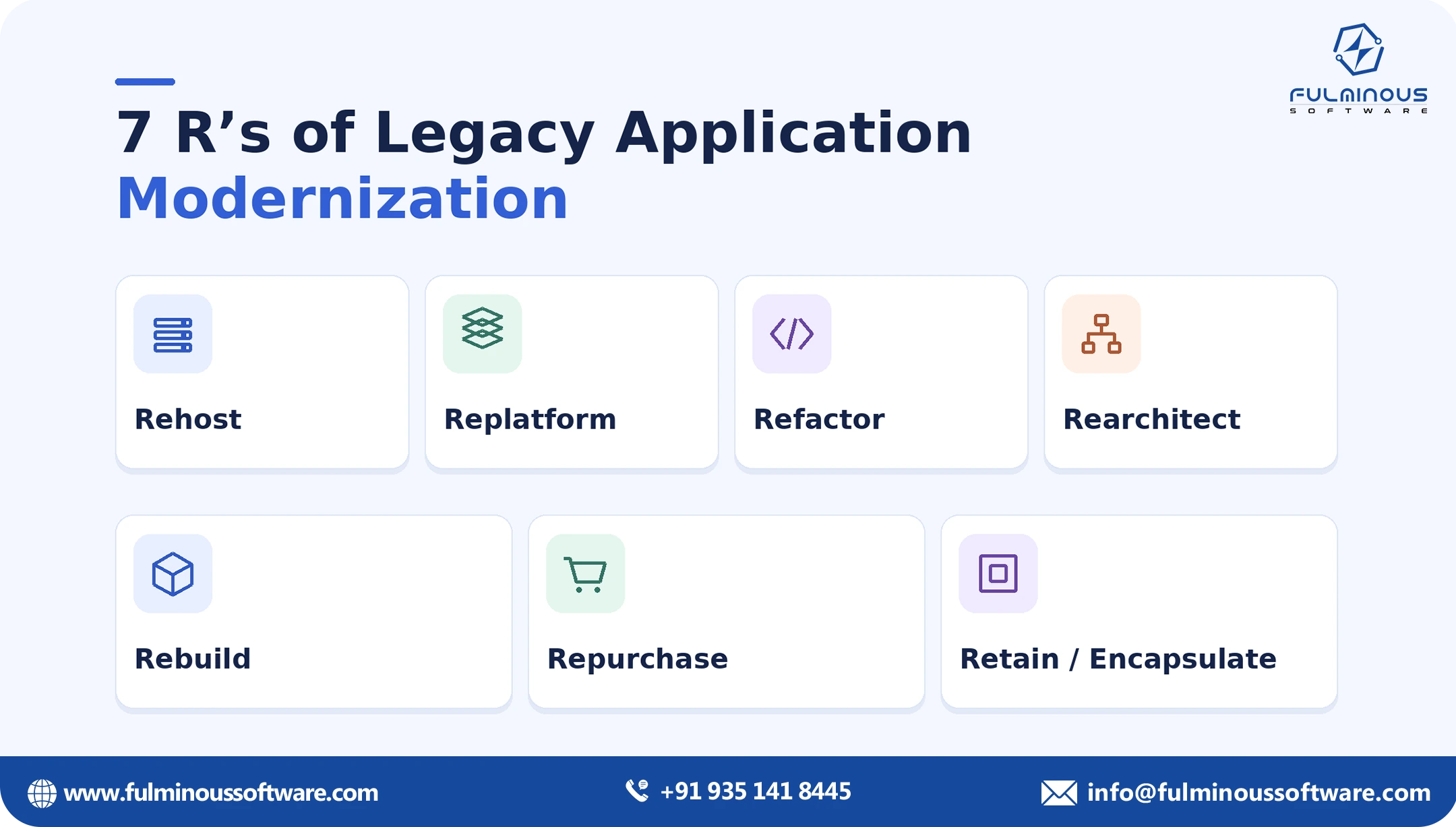
Some businesses want only a few additions or replacements. But some go for modernization including the core systems. Do you know there are more than 6 ways to modernize your legacy app?
The path you pick matters as much as the size of the system. Here is a rough guide to how the approach affects the price. If you want a full walk-through of each option and when to use it, see our guide on legacy application modernization strategies.
| Approach | What it means in plain words | Relative cost |
|---|---|---|
| Rehost | Move the app to new infrastructure with almost no change | Lowest |
| Replatform | Move it and make small changes so it works better on the new platform | Low to medium |
| Refactor | Clean up and restructure the code, often in pieces | Medium to high |
| Rearchitect | Redesign how the system is built, such as splitting it into services | High |
| Rebuild | Write a new application that does the same job | High to very high |
| Replace | Buy off-the-shelf software and retire the old app | Varies widely |
The cheapest option up front is not always the cheapest over five years. A rehost may cost little today but leave you with the same maintenance burden tomorrow. That's why you need to consult legacy app modernization experts to see the right option for your long-term benefits.
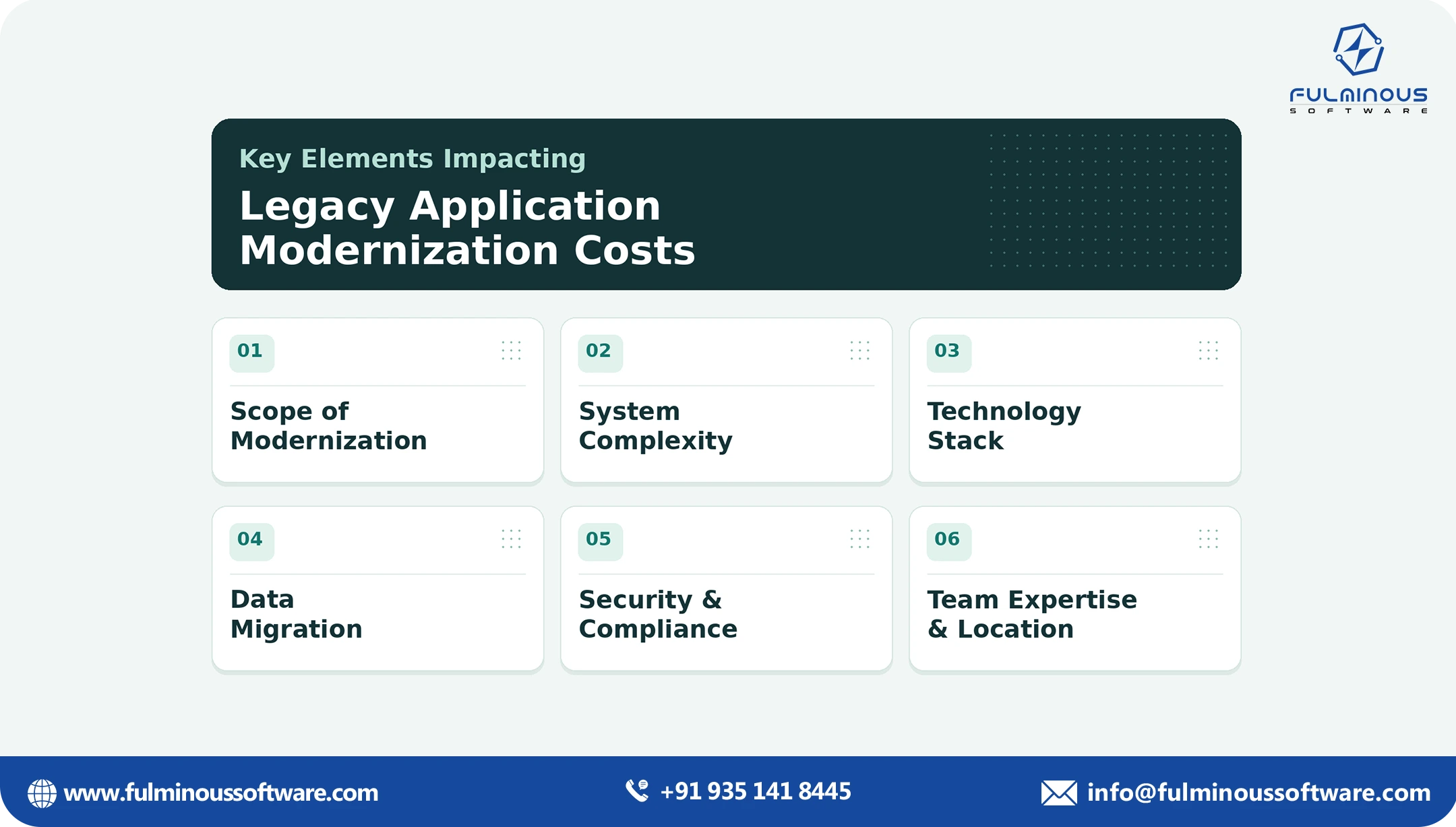
The legacy system modernization costs factors
Not only the approach or level of modernization, but there are more things that directly cause the legacy system modernization costs. When people ask us why one estimate is double another, the answer is nearly always found in this list.
Understanding these cost influencers is the fastest way to understand your own legacy system modernization cost.
1. Size and complexity of the codebase
More code means more to read, test and move. But complexity matters more than volume. Code with deep nesting, duplicated logic and years of quick fixes takes far longer to untangle than clean code of the same size.
2. Quality of documentation
Good documentation saves weeks. Missing documentation means developers spend a large part of the project simply working out what the system does. This is often the biggest hidden cost in the whole effort.
3. Number and type of integrations
Every connection to another system is a place where something can break. Old systems often talk to others through custom file transfers, database links or protocols that few people use today. Each one has to be understood, rebuilt or replaced.
4. Technology age and skills availability
If your system runs on a platform that few engineers know, the people who can work on it charge more and are harder to find. Old languages, old frameworks and unsupported databases all add to the price.
5. Data volume and data quality
Moving data is rarely a copy-and-paste job. Years of messy records, duplicates and odd formats need to be cleaned and mapped. Large databases also take careful planning to move without long downtime.
6. Testing needs
The more critical the system, the more testing it needs. If your app has no automated tests today, someone has to build them or run long manual checks. Testing often takes up a quarter to a third of the total effort.
7. Security and compliance
If you work in banking, healthcare, insurance or any regulated field, the new system has to meet strict rules. Audit trails, encryption, access controls and formal sign-offs all take time and add to the budget.
8. Business downtime tolerance
If the system can go offline for a weekend, the job is easier. If it must run around the clock, the team has to run old and new in parallel, which costs more. Near-zero downtime is possible, but you pay for the care it needs.
9. Scope changes and new features
This one is easy to underestimate. Once teams open up the system, stakeholders start asking for new features "while we are in there." Some of that is smart. Too much of it turns a modernization into a brand-new build with a modernization label.
10. Team model and location
Who does the work affects the rate. An in-house team, a local partner and a blended onshore-offshore team all have different cost profiles. Cheaper rates do not always mean a cheaper project, since rework from poor communication can cancel the savings.
Legacy application modernization costs that often get missed
A budget built only from the development estimate is almost always too low. This is the first mistake most of the businesses do. But a multidimensional evaluation of the legacy app modernization costs is the only way to get a realistic budget. Add these items before you take a modernization budget to your CFO.
Discovery and assessment. Before anyone can estimate properly, someone must review the code, data, integrations and risks. This is a real cost, but it is small compared to the cost of a wrong estimate.
Parallel running. For a period, you pay to run both the old and new systems.
Data migration and cleanup. Often treated as a footnote, it can be a significant slice of the budget.
Training and change management. A better system still fails if people do not use it properly. Plan for training, documentation and support in the first weeks.
New licences and tools. Cloud services, monitoring tools and security products may add recurring charges.
Internal staff time. Your own subject experts will spend many hours answering questions and testing. That time has a cost even if it does not show up on a vendor invoice.
Contingency. Set aside a buffer, often 15 to 25 percent for systems with many unknowns. It is better to plan for surprises than to be surprised by the plan.
When the finance team or management sees these items listed upfront, your budget looks more credible, not less. This gives you an extra cushion of budget for your legacy app modernization.
The cost of doing nothing
Most budget conversations focus on what modernization will cost. The better question is what staying put is costing you right now. Doing nothing is a spending decision too. It is just spread across many small line items that nobody adds up. Here is where the legacy system modernization cost quietly goes.
Maintenance eats the budget. It is common for companies to spend most of their IT budget keeping existing systems alive, which leaves little for new work. If 70 or 80 percent of your spend goes to "keep the lights on," you have very little room to grow.
Specialist skills cost more every year. As fewer engineers know the old technology, rates climb. If one or two people hold all the knowledge, you also carry a serious key-person risk.
Security gaps grow. Unsupported software stops getting patches. That leaves open doors for attackers, and the cost of a single breach can be far higher than a full modernization project.
Slow delivery hurts the business. When a simple change takes months because the code is fragile, your teams cannot respond to customers or the market. That is lost revenue, even if it never appears on a report.
Compliance risk builds. Old systems often cannot produce the audit trails or controls that newer rules expect. Fines and failed audits are expensive.
Outages cost real money. Ageing systems fail more often. Every hour of downtime in a customer-facing or revenue-critical system has a clear price.
When you put these numbers beside the project cost, the choice usually changes from "Can we afford to modernize?" to "Can we afford not to?"
How to calculate ROI for modernization
CIOs and CTOs often say the hardest part is not doing the work but explaining the return. The good news is that you do not need fancy models. You need a clear before-and-after comparison that finance can check.
To keep your legacy application modernization cost case simple, use this four-step method.
Step 1: Measure your current cost of ownership
Add up what the legacy system costs you today, per year:
- Infrastructure and hosting
- Licences and support contracts
- Developer and support staff time
- Cost of outages and incidents
- Cost of workarounds, such as manual processes built around the system's limits
Use real figures from your finance and IT teams. Round numbers are fine, but they must be honest.
Step 2: Estimate the future cost of ownership
Now estimate the same list for the modernized system. Expect savings in hosting, support effort and incidents. Be careful and conservative here. If you promise big savings and deliver small ones, you lose credibility for the next project.
Step 3: Add the business benefits
This is where modernization often pays back the most. Benefits can include:
- Faster release cycles, so features reach customers sooner
- Higher system availability and fewer lost sales
- Better customer experience and lower churn
- Productivity gains from removing manual work
- Lower risk of fines and security incidents
- Ability to connect with new tools, partners and data sources
Put a number on each one, even a modest one, and write down how you reached it. Finance teams respect an assumption they can see and challenge much more than a figure that appears from nowhere.
Step 4: Compare cost against return over three to five years
Subtract the total project cost from the total of savings and benefits over the same period. Then work out the payback time, which is how many months until the project has paid for itself.
A simple worked example
Let us take a mid-size company with an order management system.
- Current yearly cost to run and maintain: $900,000
- Estimated yearly cost after modernization: $500,000
- Yearly savings: $400,000
- Extra yearly benefit from faster releases, fewer outages and less manual work: $250,000
- Total yearly gain: $650,000
- One-time project cost, including contingency: $1.4 million
Simple payback time is $1.4 million divided by $650,000, which comes to a little over two years. Over five years, the gain is about $3.25 million against a $1.4 million spend. These numbers are only an illustration, but the shape of the argument is what matters: a clear cost, a clear yearly return, and a payback period that fits your planning cycle.
Things that make ROI look better
- Pick a system where the pain is already measurable
- Start with a phase that delivers value early, rather than waiting for a big-bang launch
- Include risk reduction as a real benefit, not an afterthought
- Track results after launch so you can prove the case and use it next time
How to justify the budget to your board
Numbers help, but boards also want a realistic story that makes sense. Here is a short structure that works to impress the fund allocation and management team for your legacy app modernization.
Start with the business problem, not the technology. Do not say "we need to move off an old framework." Say "our order system limits how fast we can launch new products, and it costs us more every year to keep running."
Show the cost of the status quo. Use the list from the section above. Make it concrete.
Offer options. Give three paths: do nothing, do a limited fix, and do a full modernization. Show cost, risk and return for each. Boards like to choose, and they trust a proposal that shows its alternatives.
Explain the risk of the project itself. Be honest that modernization carries risk, and show how you will control it through phasing, testing and clear checkpoints.
Ask for a staged commitment. Instead of asking for the full amount on day one, ask for funding for an assessment first. Then bring back a firm plan and number. This is easier to approve and leads to a much better final estimate.
Ways to keep the budget under control
Businesses always look for ways to cut down the application modernization cost. Reducing the quality or skipping necessary steps is not the way to get it. These habits make the biggest difference to your application modernization cost.
Do a proper assessment first. A few weeks of discovery can save months of rework later.
Fix the scope early. Agree on what is in and out, and keep a clear process for changes.
Modernize in phases. Release value in slices. Each phase teaches you something that makes the next one cheaper.
Retire what you do not need. Many legacy systems carry features nobody uses. Do not pay to move dead weight.
Automate testing from the start. It costs more at the beginning and saves a lot every time you release.
Use proven tools for code analysis and data migration. Good tooling cuts manual effort and lowers human error.
Keep your own experts close. Your people know the business rules. Give them time to work with the delivery team.
Review progress often. Short check-ins catch small problems before they become large invoices.
Plan for the people side. Training and communication prevent costly delays at go-live.
Common mistakes that inflate the budget
A few patterns show up again and again in projects that increase legacy system modernization costs. Avoid these and you remove a large share of the usual overruns before the project even starts.
Skipping discovery and starting with a guess
Treating the project as an IT-only task and leaving business teams out
Choosing the lowest bid without checking what it leaves out
Underestimating data work, which becomes a late and painful surprise
Trying to modernize everything at once instead of starting with the highest-value system
Letting scope grow with no change control
Forgetting the run costs after launch
Where cloud fits into the cost picture
Many modernization programs include a move to the cloud, and the choice of platform affects both the project cost and the running cost. Cloud can reduce hardware spend and make scaling easier, but only if the application is prepared for it. A badly prepared move can raise the monthly bill instead of lowering it. If cloud is part of your plan, our legacy to cloud modernization services page explains how we approach it so the savings are real.
Why an assessment is the smartest first spend
If you take only one idea from this article, let it be this: do not commit to a large number before you have looked inside the system. A good assessment usually covers:
- A review of the codebase, its structure and its risks
- A map of integrations and dependencies
- A look at data quality and volume
- A view of security and compliance gaps
- A comparison of modernization options with cost, timeline and risk for each
- A phased roadmap and a firm budget range you can take to your leadership
The output is not just a report. It is the proof you need to justify the budget and a basic document for the whole project. You walk in with facts instead of guesses, and your legacy system modernization cost estimate stops being an opinion.
Fulminous Software: Affordable legacy application modernization
If you are in search of a legacy app modernization services provider, Fulminous Software is an ideal choice. Fulminous Software helps companies modernize legacy applications without disrupting the business at very reasonable costs. More than 12 businesses across the globe are currently using legacy applications modernized by our experts. We work with businesses who have systems that are costly to maintain, hard to change and risky to leave alone.
Our approach is simple. We start with an assessment, so the numbers are based on your real system and not on guesswork. We then plan the work in phases, so you see value early and keep control of the spend. Throughout, we explain trade-offs in plain language, because a budget you do not understand is a budget you cannot defend.
What you can expect from us:
Honest estimates. We show what drives the price and what could change it.
Phased delivery. Smaller releases mean lower risk and earlier returns.
Business-first thinking. We tie every technical decision to a cost, a benefit or a risk.
Support through cloud and beyond. If your plan includes the cloud, we build it into the roadmap from day one.
If you want to see what a project like this could look like, you can read more about our legacy application modernization services. If you are weighing the cost of a legacy application modernization project and need numbers you can take to your board, we can help you get there.
Get Read for Legacy Application Modernization
The true cost of legacy app modernization is rarely a mystery until someone looks inside the system. It's not just a simple renovation, but sometimes it needs to be restructured from the core. The real question is whether you get the results from the costs you spend on legacy app modernization.
Start by measuring what your legacy system costs you today. Build a simple before-and-after case. Ask for a staged commitment. And choose a partner who will show you the numbers, not hide them behind jargon.
Request a modernization assessment. Our legacy app modernization team will review your system, map the risks and give you a clear budget range and roadmap you can take to your leadership. Request a modernization assessment with Fulminous Software.
FAQs
Q1. How much does legacy application modernization cost on average?
There is no single average legacy application modernization cost, but most projects fall between $50,000 for a small, simple app and well over $2 million for a large, business-critical platform. Most mid-size business applications land in the $150,000 to $500,000 range. The final figure depends on size, complexity, integrations, data and the approach you choose.
Q2. Why do modernization estimates vary so much between vendors?
Vendors make different assumptions. One may assume good documentation and a simple move, while another plans for a full rebuild. Some include testing, data cleanup and training, and others leave them out. Always ask what is included and what is not, and compare like with like.
Q3. What is the biggest factor that drives legacy application modernization cost?
It is usually a mix of code complexity, missing documentation and the number of integrations. Together they decide how much time engineers spend understanding the system before they can change it. Data migration and testing are close behind.
Q4. How long does it take to get ROI after legacy app modernization?
Many projects reach payback within two to four years, though it depends on how much the legacy system costs you today and how much value the new one unlocks. Phased projects often show early returns in the first year, because each release delivers benefits on its own.
Q5. Is it cheaper to modernize or to rebuild from scratch?
It depends on the state of the system. If the core logic is sound and the main problem is the platform, modernizing in stages is often cheaper and less risky. If the design is badly outdated and cannot support your future needs, a rebuild may cost less over the long run. An assessment helps you compare both with real figures.
Q6. What hidden costs should you prepare for?
The most common ones are data cleanup, parallel running of old and new systems, staff training, new tool licences, internal team time and a contingency buffer. Adding these to your budget early avoids unpleasant surprises later.
Q7. How much contingency should I include in the budget?
For most projects, 15 to 25 percent is a sensible range. Use the higher end when the documentation is weak, the system is very old or there are many integrations. A good assessment can reduce the number of unknowns and help you set a tighter buffer.
Q8. Can we modernize in phases to spread the legacy application modernization cost?
Yes, and it is often the best way. Starting with the highest-value or highest-risk part of the system lets you show results early, learn what works and adjust the plan. It also makes funding easier, since you are approving smaller steps.
Q9. How do I convince my CFO or board to approve the budget?
Lead with the business problem and the cost of doing nothing. Show clear options with cost, risk and return for each. Then ask for a small first step, such as an assessment, before the full commitment. Finance teams respond well to visible assumptions and staged spending.
Q10. What does a modernization assessment include, and is it worth the cost?
It typically covers a review of code, architecture, data, integrations, security and compliance, followed by options, a phased roadmap and a firm budget range. It is worth it because it replaces guesses with facts, which reduces the risk of overruns that can cost many times more than the assessment itself.
 Verified
Expert in Software & Web App Engineering
I am Manish Kumawat, co-founder of Fulminous Software, a top leading customized software design and development company with a global presence in the USA, Australia, UK, and Europe. Over the last 10+ years, I am designing and developing web applications, e-commerce online stores, and software solutions custom tailored according to business industries needs. Being an experienced entrepreneur and research professional my main vision is to enlighten business owners, and worldwide audiences to provide in-depth IT sector knowledge with latest IT trends to grow businesses online.



Partner with Top-Notch Web Application Development Company!
Discuss your Custom Application Requirements on info@fulminoussoftware.com or call us on +91-935 141 8445.
15 Days Risk-Free TrialRecommended Articles