How to Improve SEO for Manufacturers ?

Manish Kumawat
Last Updated on: 22 September 2026



Manufacturing companies face unique challenges in digital marketing — long B2B sales cycles, highly technical buyer audiences, and fierce competition for industry-specific search terms. A well-executed SEO strategy for manufacturers is no longer optional; it is the primary driver of inbound leads from procurement managers, engineers, and purchasing teams who start every supplier search on Google. Technical SEO gains hold only when the site itself is built for them, which is where a specialist manufacturing website development company makes the difference.
This guide covers everything manufacturers need to know: why manufacturing SEO differs from general SEO, how to build a step-by-step implementation plan, advanced manufacturing SEO techniques that drive rankings, and how to measure what actually matters for B2B lead generation.
Whether you are a discrete parts manufacturer, a food processing company, a CNC machining shop, or an industrial equipment supplier, the strategies here are built specifically for the manufacturing sector — not repurposed consumer SEO advice.
Understanding SEO for Manufacturers
Search engine optimisation (SEO) for manufacturers is the process of making your website rank higher in organic search results for the queries your buyers actually type. In manufacturing, those buyers are typically procurement officers, operations managers, and engineers — not everyday consumers. Their search behaviour is fundamentally different: longer queries, highly technical terms, process- and material-specific language, and strong intent to request a quote or evaluate a supplier.
Effective SEO for manufacturing companies starts by mapping these exact queries. Terms like "custom aluminium extrusion supplier USA", "ISO 9001 certified CNC machining", or "contract electronics manufacturer India" are far more valuable to a manufacturer than broad terms like "manufacturing company" — because they carry specific buyer intent.
Manufacturing SEO has two interconnected pillars: on-page optimisation (ensuring your content, headings, and metadata signal relevance to search engines) and off-page authority building (earning backlinks from industry directories, trade publications, and supplier networks that signal trustworthiness). Both are essential.
Need help with improving SEO for manufacturers? Get expert advice.
Get a Free ConsultationWhy is SEO Important for the Manufacturing Industry?
Today, over 70% of B2B buyers conduct extensive online research before ever contacting a supplier. If your manufacturing website does not appear in the first two pages of results for relevant search queries, you are invisible to the majority of your potential customers — who are instead finding and evaluating your competitors.
SEO for the manufacturing industry enables companies to capture this research-phase traffic with content that demonstrates technical expertise, builds trust, and drives RFQ (Request for Quote) submissions. Unlike paid ads that stop generating leads the moment you stop paying, SEO compounds over time — a well-ranked page continues attracting leads for months or years.
For B2B manufacturers, the stakes are high. A single manufacturing contract won through an inbound SEO lead can be worth tens or hundreds of thousands of dollars. The importance of search engine optimisation for manufacturing is growing as more procurement processes move entirely online, post-pandemic.
Key Differences Between General SEO and Advanced Manufacturing SEO
The fundamentals of SEO — keyword research, on-page optimisation, backlinks — apply across all industries. But advanced manufacturing SEO differs from general SEO in three critical ways:
1. Technical buyer intent: Manufacturing searches are driven by procurement intent, not informational curiosity. A buyer searching "precision injection moulding tolerances ±0.005mm" knows exactly what they need. Content must match this level of specificity — generic descriptions do not convert.
2. Longer sales cycles: B2B manufacturing sales take weeks or months. Your SEO content must serve multiple stages — awareness (educational articles), consideration (case studies, technical specs), and decision (service pages with RFQ forms).
3. Qualified lead focus: Volume of traffic means little in manufacturing. A page that drives 500 visits from unqualified visitors is worth less than a page that drives 50 visits from procurement managers actively sourcing a supplier. A manufacturing SEO strategy must prioritise the quality of intent over the quantity of impressions.
Preparing for SEO Success in Manufacturing
Before implementing any SEO tactics, manufacturers must lay the right groundwork. Three preparation steps matter most:
Define your target audience precisely. Who searches for what you make? Are they domestic buyers, international procurement teams, distributors, or OEMs? Understanding their job titles, industry jargon, and purchase triggers informs every keyword and content decision. A manufacturing SEO agency with sector experience can accelerate this audience mapping significantly.
Establish your baseline with analytics tools. Connect Google Search Console and Google Analytics before anything else. Search Console shows which queries already trigger your pages — even if you rank poorly. Analytics reveals which pages have the highest engagement and lowest bounce rates. Together they create the data foundation for every decision.
Align SEO strategy with revenue goals. Decide which products, services, or markets matter most. Then build your SEO roadmap — which pages to create, which to optimise, which keywords to target first — in order of commercial priority rather than technical convenience.
Essential Tools and Resources for Getting Started
Manufacturers do not need to invest in dozens of tools to run effective SEO. These six cover the full workflow:
Google Search Console — Free. Shows every query your site appears for, average position, click-through rate, and crawl/indexing status. The most important SEO tool for any manufacturer.
Google Analytics 4 — Free. Tracks website traffic, user behaviour, session duration, and goal conversions (RFQ submissions, phone call clicks, quote form fills). Connects traffic sources to business outcomes.
Ahrefs or SEMrush — Paid. Industry-standard tools for keyword research, competitor analysis, backlink monitoring, and rank tracking. Essential for identifying which keywords your competitors rank for that you don't.
Screaming Frog SEO Spider — Free up to 500 pages. Crawls your entire website and identifies technical issues: broken links, duplicate title tags, missing meta descriptions, slow pages, and redirect chains.
Google Business Profile — Free. Critical for manufacturers targeting local or regional buyers. A complete, optimised profile significantly improves visibility in "near me" and location-specific searches.
PageSpeed Insights — Free. Google's tool for measuring how fast your pages load on mobile and desktop. Slow pages hurt both rankings and conversion rates.
Identifying Target Audience and Search Behaviour
Effective SEO solutions for manufacturing companies begin with a precise understanding of how your buyers search. Conduct interviews with your sales team — ask them what questions prospects ask most often, what objections come up repeatedly, and what specifications buyers always request. These conversations surface the exact language your audience uses, which is often more valuable than keyword tool data alone.
Map search intent across the buyer journey. Top-of-funnel queries are broad and educational ("what is precision CNC machining"). Mid-funnel queries are comparative ("CNC machining vs injection moulding for small parts"). Bottom-funnel queries are transactional ("CNC machining company USA get quote"). Each stage needs different content — informational articles, comparison guides, and optimised service pages respectively.
Want to talk through improving SEO for manufacturers for your business?
Talk to Our TeamStep-by-Step Guide to Implementing Advanced SEO for Manufacturers
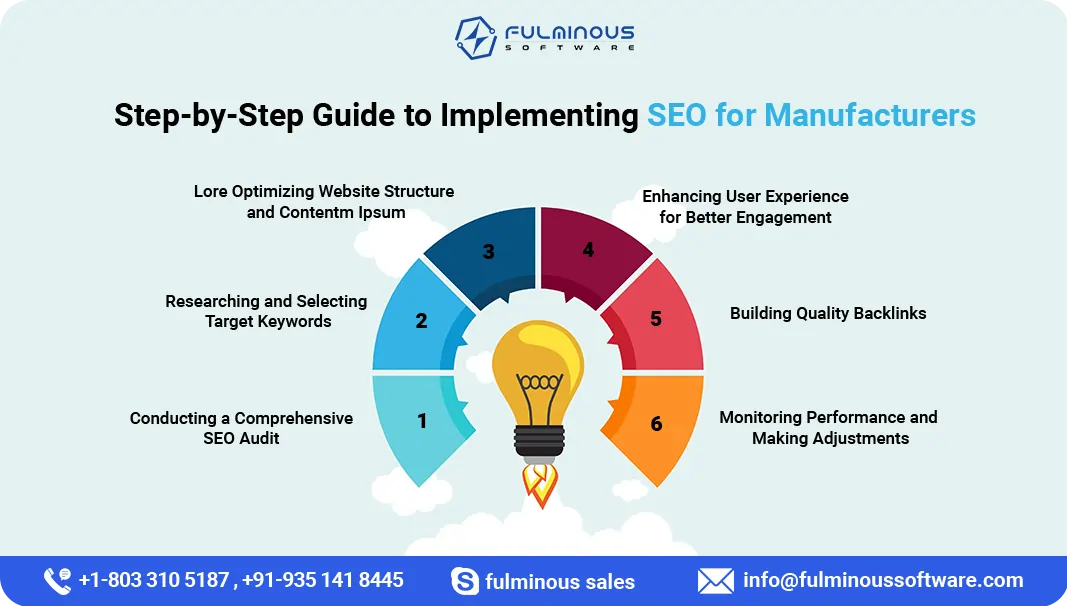
Follow these six steps in sequence. Skipping steps — especially the audit — leads to wasted effort optimising pages that have deeper structural problems.
Step 1: Conducting a Comprehensive SEO Audit
A thorough SEO audit reveals the true starting point. Use Screaming Frog to crawl your site and export a list of all pages with their title tags, meta descriptions, H1s, response codes, and word counts. Identify: pages with duplicate titles, missing meta descriptions, thin content (under 300 words), broken internal links, redirect chains, and slow load times (over 3 seconds on mobile). Prioritise fixing issues on your highest-traffic and highest-value pages first.
Step 2: Researching and Selecting Target Keywords
Use Ahrefs or SEMrush to export all keywords your site already ranks for (positions 4–30 are quick-win opportunities). Then research competitor keyword gaps — queries your competitors rank for that you don't. For each target keyword, evaluate: monthly search volume, keyword difficulty, and commercial intent. Prioritise long-tail, buyer-intent keywords with lower competition. For example, "custom stainless steel fabrication UK" will drive more qualified leads than "manufacturing company" despite lower search volume.
Step 3: Optimising Website Structure and Content
Ensure your site architecture follows a clear hierarchy: Homepage → Category pages (by product type or process) → Individual product/service pages → Supporting blog content. Every page that targets a specific keyword needs: a unique title tag containing the primary keyword, a compelling meta description (150–160 characters), an H1 matching the target keyword, and body content that comprehensively answers the searcher's intent. Compress images, enable browser caching, and use a CDN to improve load times.
Step 4: Enhancing User Experience for Better Engagement and Lead Generation
Manufacturing buyers spend time evaluating suppliers carefully. Give them reasons to stay on your site: detailed product specifications with downloadable data sheets, case studies showing the problem, process, and outcome for past clients, video walkthroughs of your production facility and quality control process, and clear calls to action (Request a Quote, Download Specs, Call Now) above the fold on every service page. High engagement signals — time on page, pages per session, low bounce rate — directly influence search rankings.
Step 5: Building Quality Backlinks
Backlinks from authoritative manufacturing and industrial sources are among the strongest ranking signals Google uses. Target: industry association directories (Thomas Net, Maker's Row, IndustryNet), trade publication guest posts (Manufacturing Engineering, Industry Week), supplier networks and OEM partner pages, and local business directories (chamber of commerce, regional trade bodies). Each backlink from a relevant, authoritative source raises your domain's credibility and directly improves rankings for target keywords.
Step 6: Monitoring Performance and Making Adjustments
SEO is not set-and-forget. Review Google Search Console monthly: check which queries gained or lost impressions, which pages improved or dropped in ranking, and what new queries are appearing. Track your core KPIs — organic traffic, keyword rankings for target terms, RFQ conversion rate from organic visitors, and cost-per-lead compared to paid channels. Adjust content and targeting based on data, not assumptions.
Core Components of SEO Management for Manufacturers
Sustainable manufacturing search engine optimisation rests on three integrated components working together:
On-page SEO ensures every page clearly signals its topic to search engines through optimised title tags, meta descriptions, heading structure, keyword usage, and internal linking.
Technical SEO ensures search engines can efficiently crawl, index, and render your site — covering site speed, mobile responsiveness, XML sitemaps, structured data, canonical tags, and HTTPS security.
Content strategy builds topical authority by systematically covering every relevant question a buyer might have, from educational overviews to detailed technical guides and case studies.
Advanced On-Page SEO Tactics for Manufacturers
On-page SEO for manufacturing goes beyond inserting keywords into titles. High-performing manufacturing pages share these characteristics:
Specificity over generality. A title like "Precision CNC Machining Services — Tolerances to ±0.001mm | Fulminous Software" outperforms "CNC Machining" because it matches the exact language a knowledgeable buyer uses. Include materials, processes, certifications, and tolerance ranges in product page copy.
Comprehensive coverage of buyer questions. Google's Helpful Content system rewards pages that fully satisfy a searcher's intent. For each service page, answer: What is it? Who is it for? What materials/processes are used? What are the specifications? What does it cost? How do I get a quote?
Strong calls to action aligned to buying stage. Product pages need prominent RFQ buttons. Educational articles need email capture or related service links. Every page should have a next step.
Technical SEO Best Practices
Technical SEO issues silently kill manufacturing websites. The most common — and most impactful — issues to fix:
Page speed: Google's Core Web Vitals directly influence rankings. Manufacturing sites with large product images, legacy codebases, or shared hosting often load slowly. Target under 2.5 seconds for Largest Contentful Paint (LCP). Compress images, minify CSS/JS, and use server-side caching.
Mobile responsiveness: Over 50% of B2B research now starts on mobile, even for industrial products. Google's mobile-first indexing means your mobile experience directly determines your desktop rankings.
XML sitemap and robots.txt: Ensure all important pages are included in your sitemap and submitted to Google Search Console. Ensure the robots.txt does not accidentally block key pages from crawling.
Structured data: Implement schema markup (Product, Service, Organization, FAQPage) to enable rich results — star ratings, price ranges, FAQ dropdowns — that increase click-through rates in search results.
Looking for expert help with improving SEO for manufacturers?
Get Expert AdviceContent Marketing Strategies for Manufacturing Sites
Content marketing for manufacturers is not about volume — it is about depth and specificity. A single 3,000-word technical guide that genuinely answers "how to choose the right injection moulding material for your application" will outrank 10 shallow 300-word articles every time.
Content types that perform best in manufacturing SEO: technical guides (process explainers, material comparisons, tolerance guides), case studies (problem → process → outcome with measurable results), buyer's guides (how to evaluate suppliers, what certifications to require), and product specification pages (detailed, downloadable technical data). Each type serves a different stage of the buying journey and builds topical authority collectively.
Common SEO Challenges for Manufacturers and How to Overcome Them
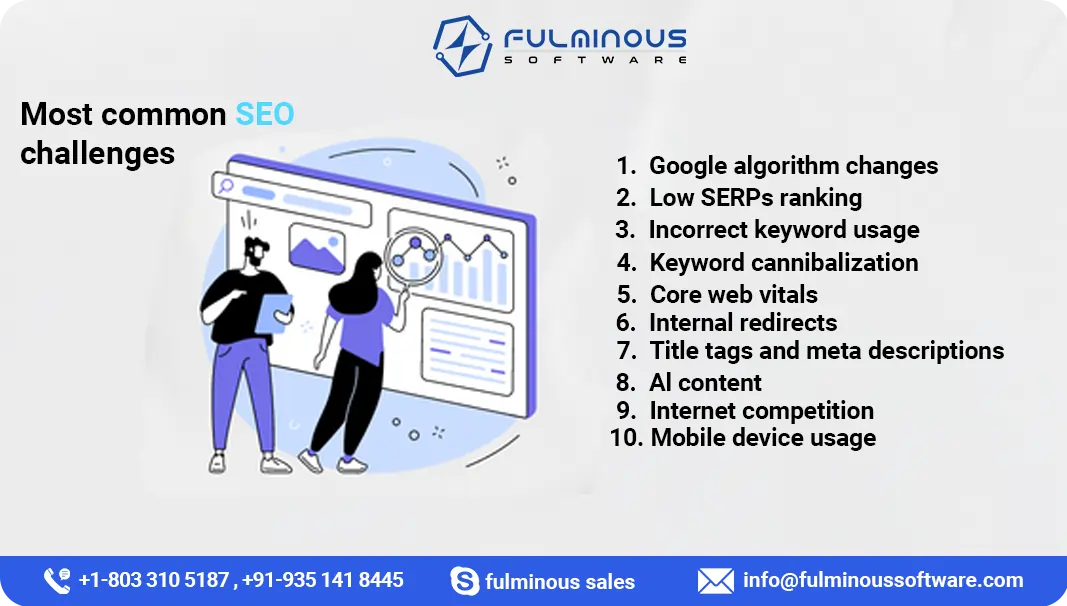
Manufacturing companies consistently face the same set of SEO obstacles. Here is how to overcome the most common:
Highly competitive head keywords: Terms like "SEO for manufacturers" and "manufacturing company" are dominated by large agencies and directories with years of domain authority. The solution is not to compete head-on — it is to build a strong long-tail keyword portfolio first (hundreds of specific, lower-competition queries that collectively drive significant qualified traffic) while gradually earning the authority to compete for broader terms.
Thin or duplicate product content: Many manufacturing sites list products with minimal description — just a part number and one sentence. Search engines cannot rank thin pages. Write comprehensive product pages covering specifications, applications, compatible materials, lead times, and quality certifications.
Complex website architecture: Large manufacturers often have hundreds of product SKUs across multiple categories. Implement a clear category → subcategory → product hierarchy, use faceted navigation correctly (with canonical tags or noindex on filter combinations), and ensure internal linking guides both users and search engines through the site logically.
Navigating Highly Competitive Keywords
The most searched manufacturing SEO terms — "seo for manufacturers", "manufacturing seo", "seo for manufacturing companies" — are dominated by established agencies. Rather than targeting these immediately, build authority through a keyword clustering strategy:
Start with specific, long-tail queries your competitors have not covered thoroughly. "SEO for fabrication companies", "advanced manufacturing SEO strategy", "SEO for food manufacturing companies", "technical SEO for industrial websites" — these are lower competition, still highly relevant, and each page built around them grows your domain's topical authority. After 6–12 months of this cluster-building approach, the broader head terms become winnable.
Addressing Technical Issues on Complex Websites
Complex manufacturing websites — those with hundreds of product pages, multi-language support, or legacy CMS platforms — require structured technical SEO maintenance. Run a full Screaming Frog crawl monthly. Prioritise fixing: 404 errors on pages that receive external links (fix with 301 redirects), duplicate content across similar product variants (fix with canonical tags), pages blocked by robots.txt that should be indexed, and images without descriptive alt text (missed keyword opportunity and accessibility issue).
Use Google Search Console's Coverage report to identify pages Google cannot index and resolve each issue systematically. SEO agencies specialising in industrial businesses can audit and remediate technical issues faster than an in-house team without dedicated SEO expertise.
Thinking about improving SEO for manufacturers for your own project? Let's talk - no pressure.
Start a ConversationLeveraging Local SEO for Manufacturing Companies
Many manufacturers underestimate local SEO. Even if you supply nationally or internationally, local searches like "precision machining company [city]" or "manufacturing supplier near me" drive highly qualified leads from buyers who prefer proximity for quality control, facility visits, and logistics efficiency.
Claim and fully complete your Google Business Profile: add all product/service categories, upload facility photos, keep NAP (Name, Address, Phone) consistent across all directories, and actively request reviews from satisfied customers. A complete profile with positive reviews significantly improves placement in the local 3-pack results — the three map listings shown above organic results for location-based queries.
Optimising for Local Search Results
To rank for local manufacturing searches: include city and region names in title tags and headings of location-specific pages, build citations in regional business directories and chamber of commerce listings, create location-specific service pages if you operate in multiple facilities or serve distinct geographic markets, and embed a Google Map on your contact page. Use LocalBusiness schema markup with your exact address, phone, and hours.
Managing Local Listings and Reviews
Maintain consistent NAP information across Google Business Profile, Yelp, ThomasNet, IndustryNet, Maker's Row, and any sector-specific directories. Inconsistent information across directories confuses both search engines and buyers. Respond to all reviews — positive and negative — professionally and promptly. A pattern of responded-to reviews signals an active, trustworthy business to both Google and prospective customers.
Advanced SEO Techniques for Manufacturers
Beyond foundational SEO, these advanced manufacturing SEO strategies provide competitive differentiation:
Structured Data and Schema Markup
Schema markup tells Google exactly what your content means, enabling rich results that stand out in search. Implement the following schema types across your manufacturing site:
Product schema on product pages — includes name, description, specifications, price range, and availability. Can trigger rich product snippets in search results. Organization schema on your homepage — includes company name, address, founding date, and contact details. FAQPage schema on educational articles and service pages — FAQ rich results appear as expandable dropdowns directly in search results, increasing visibility without requiring a higher ranking. HowTo schema on step-by-step guides — can trigger rich results with step previews in mobile search.
Rich results consistently generate higher click-through rates than standard blue links for the same ranking position — making schema markup one of the highest-ROI on-page improvements a manufacturer can make.
Mobile Optimisation Strategies
Google uses mobile-first indexing — it crawls and ranks your site based on its mobile version, not desktop. Manufacturing sites built years ago often fail mobile usability tests: small text, buttons too close together, horizontal scrolling, or images that overflow the viewport. Run Google's Mobile-Friendly Test on your key product and service pages. Fix every failure before investing further in content or backlinks.
Key mobile optimisation priorities: responsive design that adapts to all screen sizes, font size minimum 16px for body text, tap targets (buttons, links) minimum 48×48px, Core Web Vitals passing scores (LCP under 2.5s, FID under 100ms, CLS under 0.1), and no intrusive interstitials blocking content on mobile.
Measuring SEO for the Manufacturing Industry
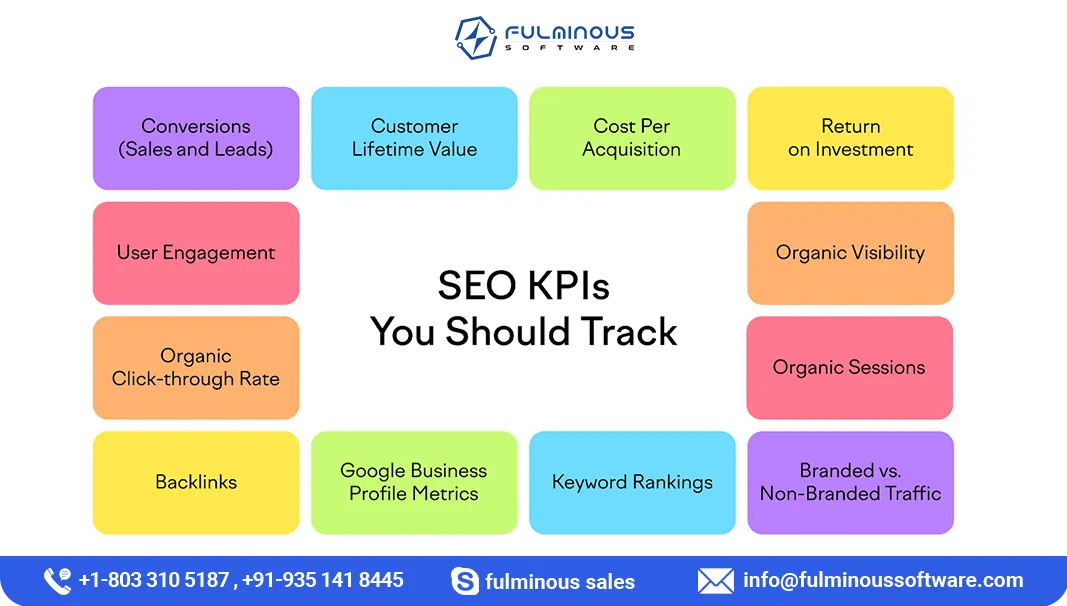
Measuring SEO success in manufacturing requires going beyond vanity metrics (total traffic) to focus on metrics tied to revenue:
Key Performance Indicators (KPIs) for Manufacturing SEO
Organic traffic to service/product pages — not the blog. Blog traffic can be high but if it doesn't convert to RFQ submissions, it has no commercial value. Track service page organic sessions separately.
Keyword ranking positions for target terms — monitor your top 20–30 target keywords weekly. Track position movement, not just absolute rank. A keyword moving from position 28 to position 15 is meaningful progress even if it's not yet page 1.
Organic lead conversion rate — what percentage of organic visitors submit a quote request, download a spec sheet, or call? This is the ultimate SEO KPI for manufacturers. A 1% improvement in conversion rate doubles the value of all your SEO traffic.
Organic-sourced RFQ submissions — the direct revenue metric. Track how many quote requests or qualified enquiries originated from organic search each month.
Bounce rate by page type — a high bounce rate on a product page signals a mismatch between searcher intent and page content. Investigate and fix.
Conclusion
Effective SEO for manufacturers requires a sustained, structured approach — not a one-off campaign. The manufacturers who win in organic search are those who consistently publish technically authoritative content, maintain a fast and crawlable website, earn backlinks from relevant industry sources, and measure their results against revenue metrics rather than traffic volume.
Local SEO, structured data, and mobile optimisation are no longer optional — they are baseline requirements. Advanced manufacturing SEO strategies that combine all of these create compounding returns: each improvement reinforces the others, building a digital presence that consistently outperforms competitors across every stage of the buyer journey.
As a specialist provider of SEO services for the manufacturing industry, Fulminous Software brings deep sector knowledge and a team of 50+ digital marketing experts to every engagement. If you want to increase organic traffic, generate more qualified RFQ leads, and build lasting search visibility for your manufacturing business, contact us today for a free SEO audit.
FAQs
Q1: Why is SEO important for manufacturing companies?
A: SEO helps manufacturing companies rank higher in search results, attract qualified B2B leads, and increase organic traffic without paid ads. In a competitive industry where buyers research suppliers online before contacting anyone, strong SEO ensures manufacturers are found at the right moment in the buying cycle.
Q2: What are the key differences between general SEO and manufacturing-specific SEO?
A: Manufacturing SEO targets longer, technical B2B search queries tied to specific processes, materials, and certifications. Unlike consumer SEO, it focuses on ranking for RFQ (Request-for-Quote) intent, reaching procurement managers and engineers, and building trust through technical content and case studies.
Q3: What are the essential tools and resources for starting an SEO strategy in manufacturing?
A: Key tools include Google Search Console, Google Analytics 4, Ahrefs or SEMrush for keyword research, Screaming Frog for technical auditing, Google Business Profile for local search, and PageSpeed Insights for performance monitoring.
Q4: What advanced SEO techniques should manufacturers consider?
A: Advanced techniques include HowTo and FAQPage structured data markup, Core Web Vitals optimisation, building backlinks from ThomasNet and trade publications, optimising Google Business Profile for local searches, and creating content mapped to each stage of the B2B buying journey.
Q5: How to improve SEO on a manufacturing website?
A: Conduct a technical SEO audit, target buyer-intent keywords specific to your manufacturing niche, optimise title tags and meta descriptions on service pages, create comprehensive product content with technical specifications, build backlinks from manufacturing directories and trade journals, set up Google Business Profile, and track performance monthly via Google Search Console.
Q6: How long does SEO take to show results for manufacturing companies?
A: Most manufacturing companies see measurable improvements within 3–6 months. Competitive head terms may take 6–12 months to reach page 1, while long-tail and local keywords can show results in 4–8 weeks with consistent effort.
HIRE A TOP SOFTWARE DEVELOPMENT COMPANY
 Verified
Expert in Software & Web App Engineering
Verified
Expert in Software & Web App Engineering
I am Manish Kumawat, co-founder of Fulminous Software, a top leading customized software design and development company with a global presence in the USA, Australia, UK, and Europe. Over the last 10+ years, I am designing and developing web applications, e-commerce online stores, and software solutions custom tailored according to business industries needs. Being an experienced entrepreneur and research professional my main vision is to enlighten business owners, and worldwide audiences to provide in-depth IT sector knowledge with latest IT trends to grow businesses online.



Partner with Top-Notch Web Application Development Company!
Discuss your Custom Application Requirements on info@fulminoussoftware.com or call us on +91-935 141 8445.
15 Days Risk-Free TrialRecommended Articles