AI in Clinical Trials: How Pharma Uses AI for Drug Discovery

Johnson Mathew
Last Updated on: 21 September 2026



Have you noticed that pharmaceutical organisations are shifting manual tasks to AI solutions? Organisations that run manual clinical trials and traditional drug discovery are facing challenges like high cost, time-consuming processes, and risks. It's a fact that the days of manual clinical trials and drug discovery are gone.
AI in clinical trials has been conquering the scenario with plenty of benefits. On average, a single successful drug can take more than 10 years and cost billions of dollars. But today, AI is changing the whole scenario. Even for simple documentation to find promising drug candidates, AI is useful for all clinical trials and pharmaceutical tasks.
But today, many pharmaceutical businesses want to adopt AI in clinical trials but are confused about the cost and ways to implement AI in clinical trials. Are you one among them? Are you planning to add custom AI solutions to your clinical trial tasks? Need assistance to implement AI solutions in drug discovery? Want cost-effective AI solutions for pharmaceutical tasks? Then this guide will help you!
Here we will discuss all the aspects of AI in clinical trials. Beyond basic information on AI in clinical trials, we will reveal the various use cases, its benefits, and the best way to adopt them in your pharmaceutical organisations. So this guide will be useful for your AI implementation in the pharmaceutical business.
Table of Contents
14 sectionsWhat Is AI in Clinical Trials?
AI in clinical trials is all about using various AI solutions in the phases of clinical trials and drug discovery in pharmaceutical tasks. Earlier, pharmaceutical organisations were running on completely manual tasks. Manual clinical trials, drug discovery, medicine analysis, and traditional statistical methods all cause huge costs and more time in clinical trials.
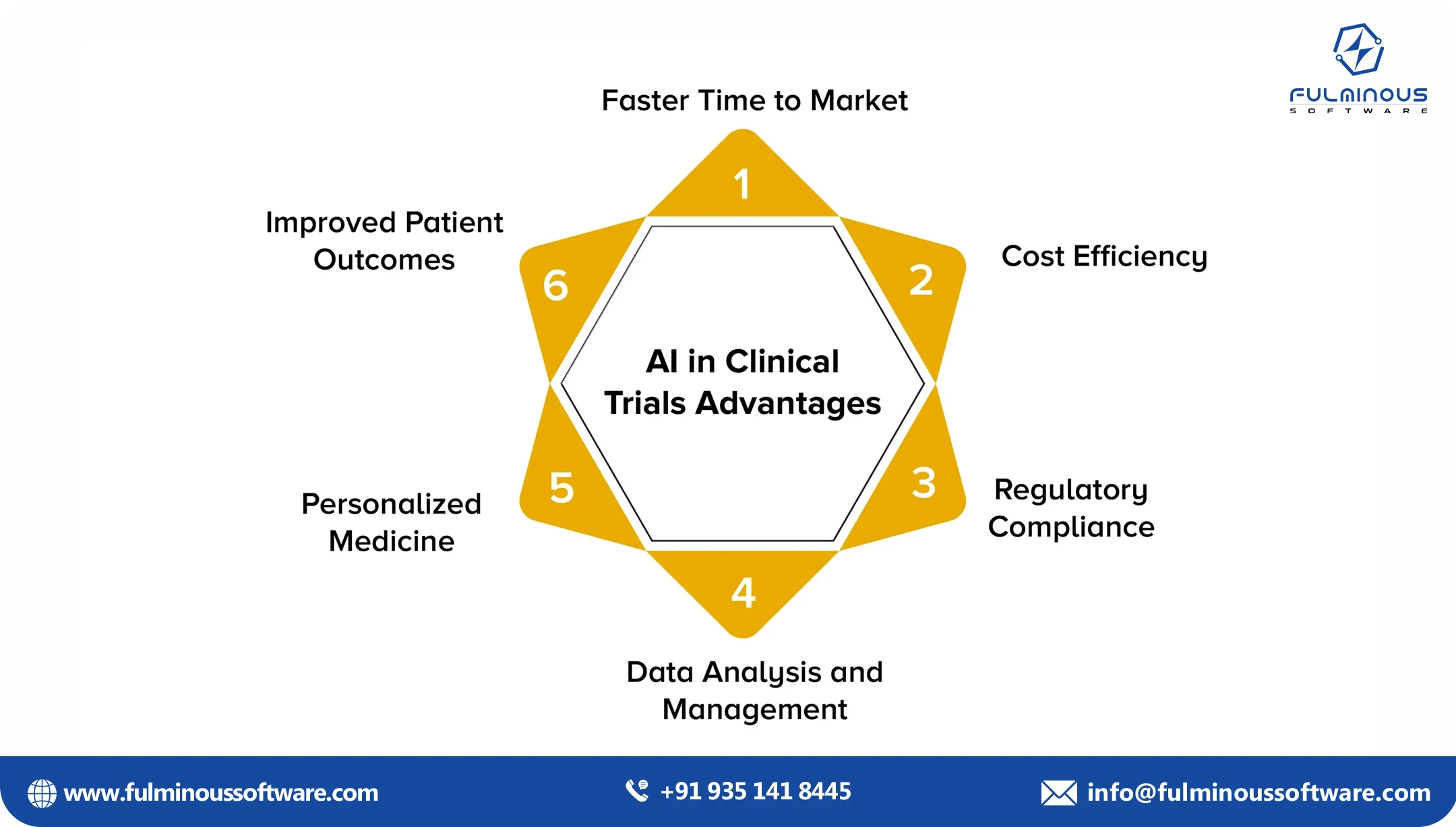
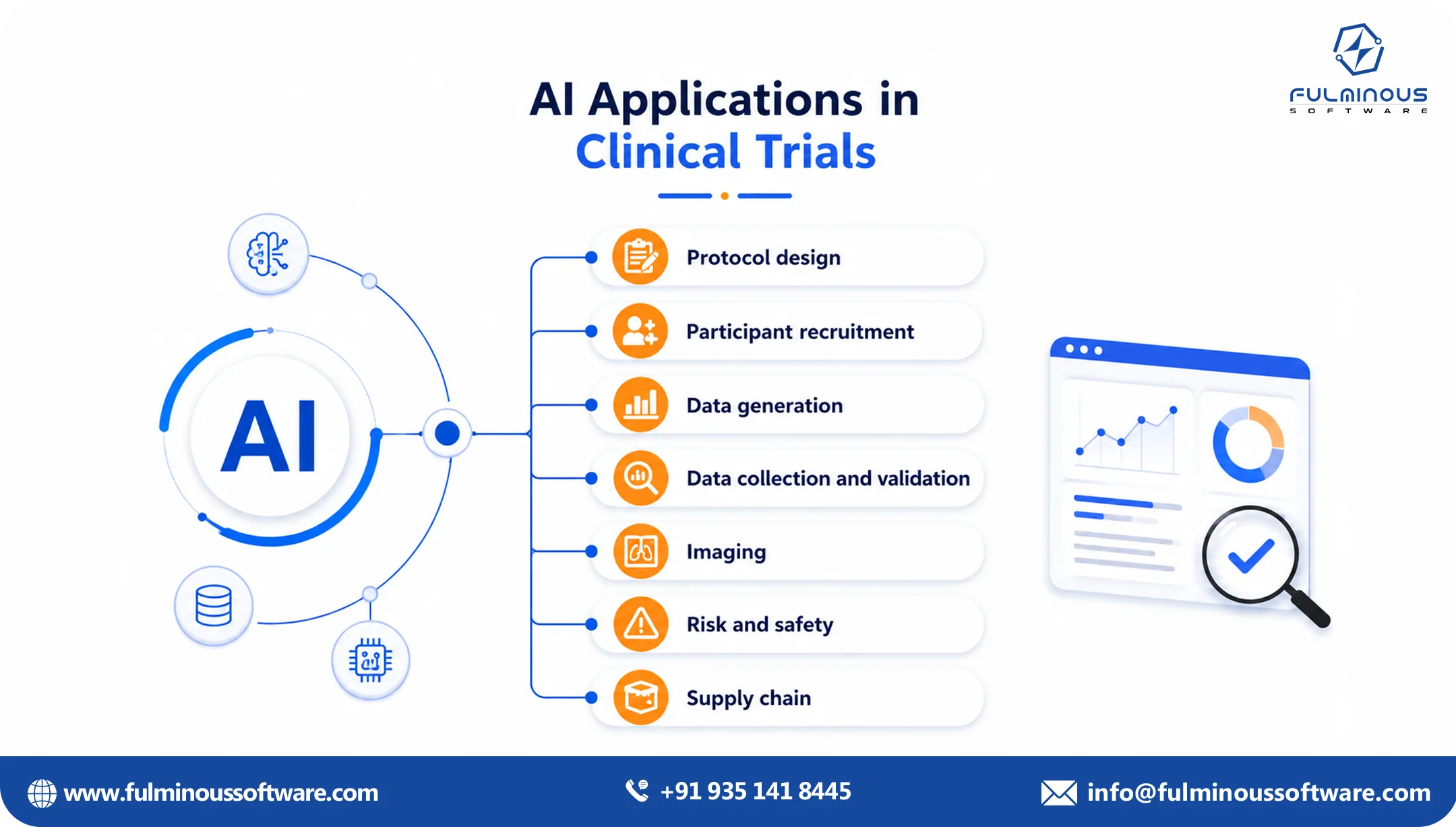
Now pharmaceutical organisations are using AI solutions that can help with all the tasks of clinical trials and evaluate millions of medical records within a short time. AI solutions help in every stage of clinical trials, including:
Why the Pharmaceutical Industry Is Investing in AI
Do you know why AI in clinical trials is getting more popular and the market is about to reach $11.61 billion by 2035? Definitely, the growing adoption of AI solutions in the pharmaceutical sector is based on its advantages. Some of the most discussed benefits are:
- Cut down trial timelines by 30% to 50%
- Raises patient enrollment rates by up to 65%
- Reduces overall development costs by 40%
- Clinical success rates of 80% to 90%
But as the use cases also increase, AI in clinical trials is more useful. The countless benefits in all aspects of pharmaceutical tasks, including drug discovery and clinical trials, attract almost all pharmaceutical businesses. Yes, beyond documentation benefits, AI for drug development solutions is bringing more benefits:
- Faster Drug Discovery: AI minimises the time needed to identify or test drug candidates.
- Lower Development Costs: AI in clinical trials automates several tasks, and it reduces expensive laboratory experiments.
- Error-Free Development: AI in clinical trials eliminates maximum error and minimizes failed trials.
- Better Patient Outcomes: As AI helps clinical trial design, the number of successful treatments will increase.
- Higher Research Efficiency: Scientists and researchers can bring their maximum productivity with the help of AI in pharmaceutical tasks.
- Accurate Decision Making: AI in clinical trials gives more accurate and live data-driven analytics, which helps in the right decision-making.
AI for Drug Discovery: A New Era
Drug discovery is a highly promising sector with a unique workflow. Compared to other healthcare services like hospitals or pharmacies, pharmaceuticals are completely different in all aspects; especially, the process of drug discovery follows well-structured methods.
Drug discovery begins with finding the ideal biological target responsible for a disease. Then the researchers find the accurate chemical compounds that bring positive results in the chosen target. Earlier, scientists took months to find the right target and test millions of molecules in laboratories. It also raised the cost of drug discovery.
Today, AI in drug discovery has brought a huge impact on the whole process. It can perform virtual screening of millions of compounds within just hours. Machine learning models evaluate:
This makes the path of researchers smoother. Researchers can choose the most promising drug candidates. When they choose it before expensive laboratory testing begins, the cost and time will be minimal. It also helps in meeting all the industry standards and compliance requirements.
How AI Accelerates Drug Development
The impact of AI for drug development in accelerating drug development is not just about speed, but it covers accuracy and error-free development of drugs within a short time. Now we can see how AI is accelerating drug development and minimising the overall cost of development:
1Target Identification
In traditional methods, target identification was a long and difficult task that consumed the majority of time in drug discovery. Collecting data manually and evaluating each of them took years. You can imagine the effort and cost related to traditional methods of target identification.
But now AI for drug development analyzes millions of data points and finds therapeutic targets within a short time. This has boosted the early stage of research in drug discovery. The major use cases of AI in target identification and its benefits are:
| Applications | Benefits |
|---|---|
|
|
2Molecule Generation
Earlier, it took years to generate a new molecule. Due to difficulties, scientists limited the projects to just innovating existing molecules. In particular, emergency situations demand fast new molecule generation, and now AI has brought the solutions.
Generative AI creates entirely new molecular structures designed based on specific therapeutic goals. Researchers and scientists can generate molecules within a short period using AI in drug discovery. The major use cases of AI in molecule generation and its benefits are:
| Applications | Benefits |
|---|---|
|
|
3Predicting Drug Success
In traditional methods, prediction of drug success was tough, and failures led to costly reworks. Imagine the loss of a pharmaceutical organisation when they failed to predict drug success. This was one of the major factors that resisted investors from entering pharmaceutical businesses.
But today, machine learning models predict various advantages of drugs. Poor molecules and samples can be eliminated early, saving years of research. The major use cases of AI in predicting drug success and its benefits are:
| Applications | Benefits |
|---|---|
|
|
4Drug Repurposing
Sometimes repurposing available drugs is needed. But traditional methods need more time to find new uses and innovate existing medications. But AI brings solutions in drug repurposing too. AI for drug development analyses patient data to identify diseases that may respond to already-approved medicines.
This helps in restructuring the drugs and brings more effects. Drug repurposing minimises development costs and accelerates approval timelines. The major use cases of AI in drug repurposing and its benefits are:
| Applications | Benefits |
|---|---|
|
|
AI Improves Clinical Trial Design
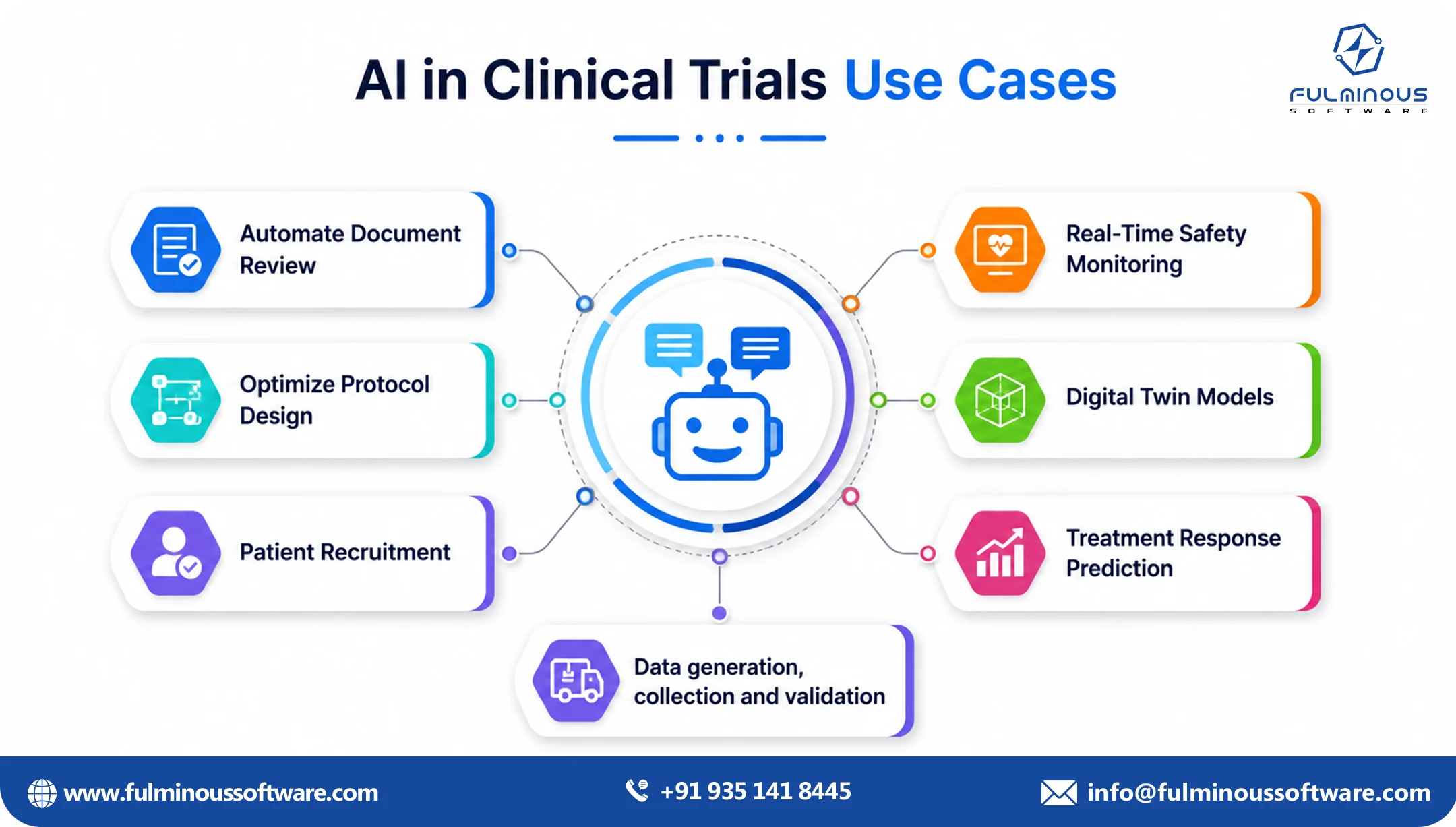
Trial designs are the foundation of each clinical trial and drug discovery. Earlier, poor designs were common in traditional clinical trials. If the trial design is poor, it may lead to expensive failures and reworks. This is one of the major reasons that delays clinical trials.
Now, AI in the pharmaceutical industry has changed the whole scenario, and researchers can simulate different trial scenarios before recruiting patients. This maximises study success rates and eliminates all the rework. AI analyzes historical trial data to recommend:
Remote Monitoring and Digital Health
In traditional methods, clinical visits and inpatient trials were the only way for continuous and remote monitoring. In those methods, it was costly to monitor patients closely and faced many inconveniences. But today, wearable devices and remote monitoring are essential parts of advanced clinical trials.
Researchers get live information through AI and IoT solutions, which eliminates waiting for scheduled clinic visits. So today, more patients participate in clinical trials through remote monitoring and digital health devices powered by AI. AI continuously analyzes data collected from:
AI and Medical Imaging
Clinical trials are directly connected depending on the evaluation of various medical images. When dealing with thousands of samples, it was difficult to evaluate reports. It is a time-consuming effort that delays the drug discovery process.
Nowadays, AI evaluates all these medical images fast and helps in accurate decision-making. AI in the pharmaceutical industry can even detect subtle changes that may not be visible during manual review of:
Natural Language Processing in Clinical Trials
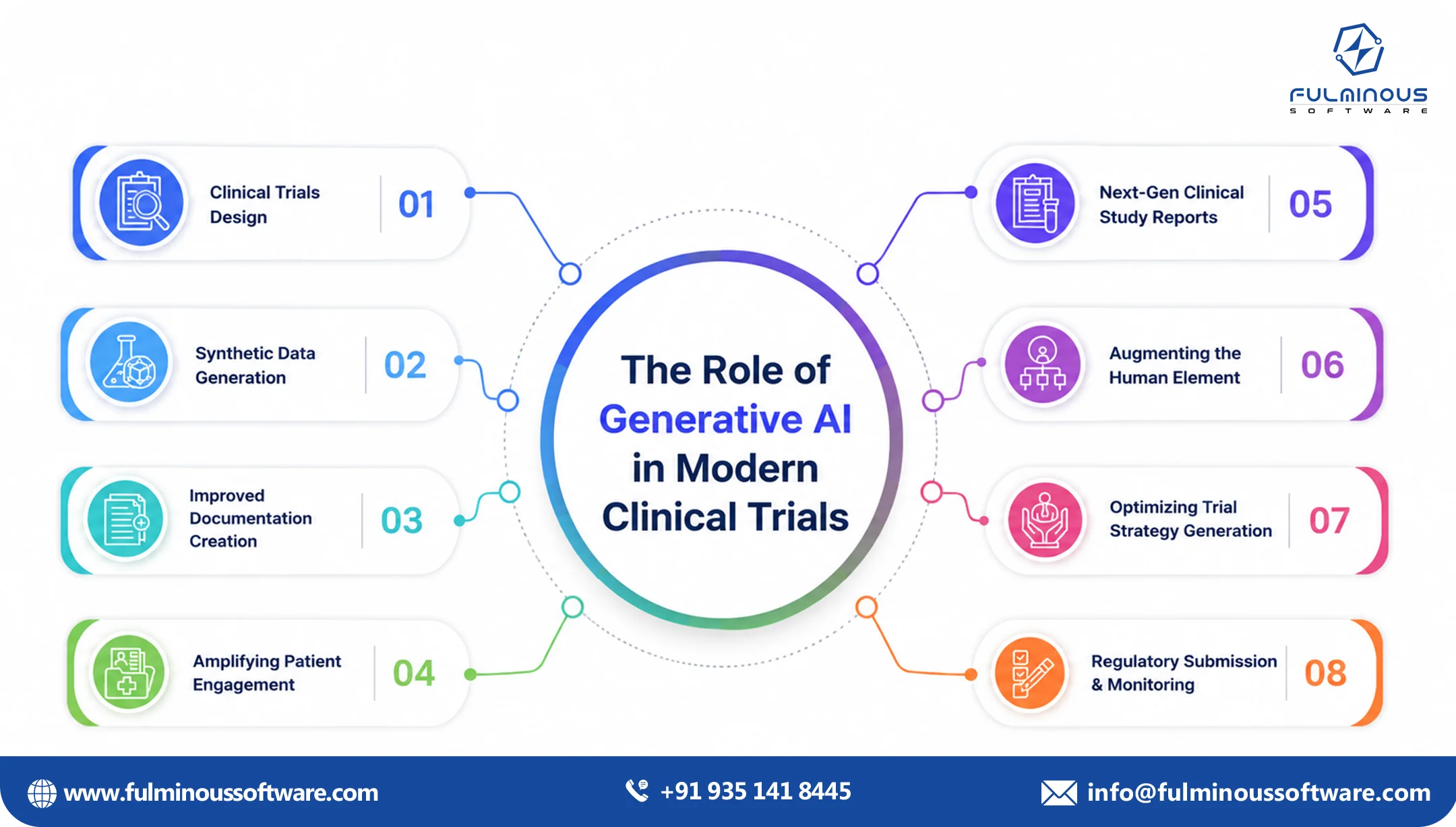
Thousands of scientific publications and clinical trial-related literature are released every week. For pharmaceutical businesses, it's impossible to evaluate each of them manually. Earlier researchers took more time to evaluate these documents and didn't get early advantages.
But AI helps pharmaceutical businesses by summarising findings and highlighting these findings in healthcare literature. The role of NLP in clinical trials is valuable, and NLP helps researchers analyze:
AI for Regulatory Compliance
Compliance with industry regulations is one aspect where almost all pharmaceutical businesses face difficulties. When government and healthcare authorities update the regulations periodically, pharmaceutical companies fail to meet all of them.
That's where AI helps with compliance tasks in clinical trials and drug discovery. AI in the pharmaceutical industry also helps in various compliance tasks, especially in preparing documentation for regulatory tasks. AI assists by:

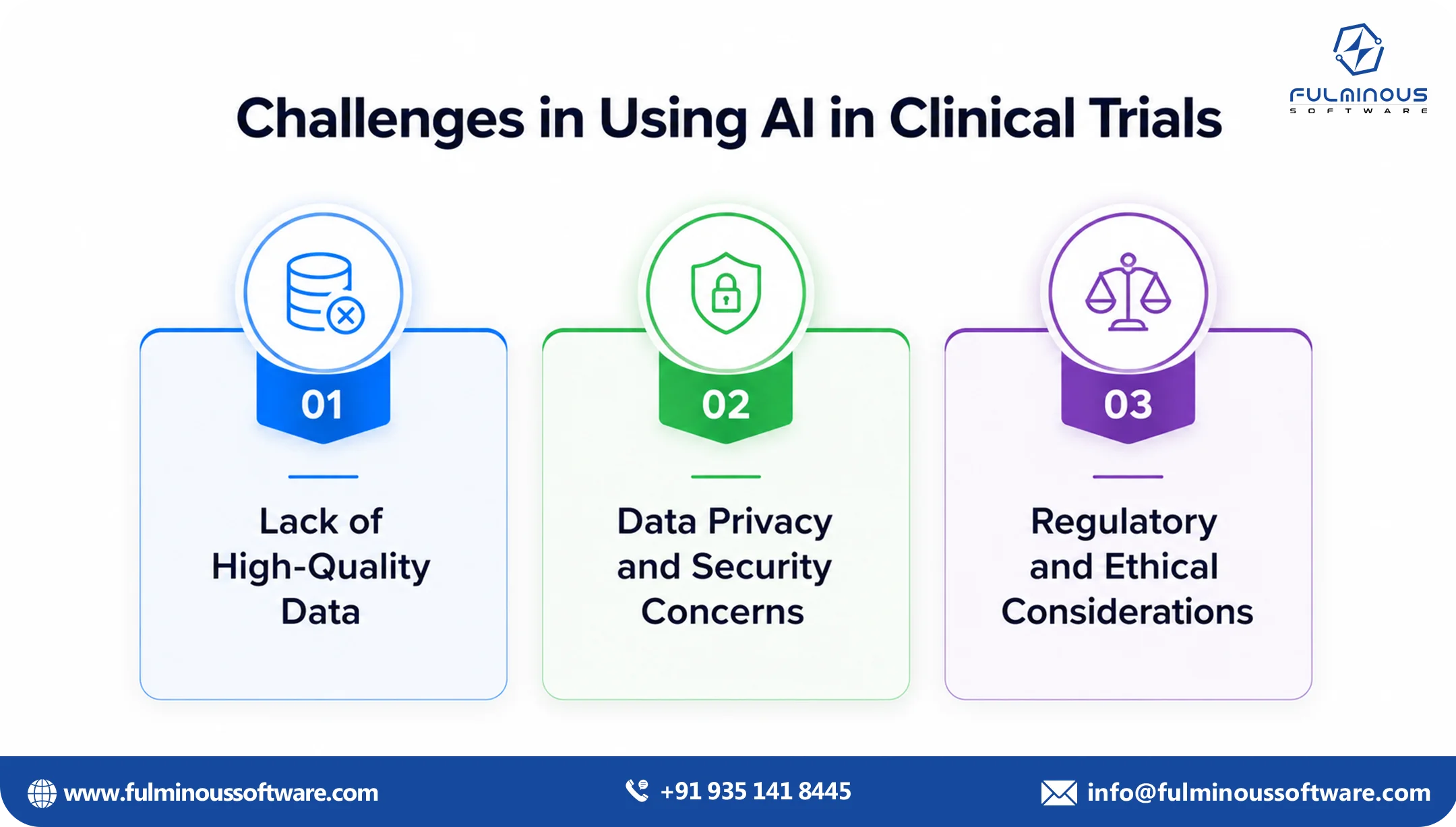
Challenges of AI in Clinical Trials
Challenges are common in most AI implementation tasks, especially when we add AI solutions to healthcare services with unique workflows and plenty of compliance requirements. Here we inform you about these challenges so that you can be prepared and overcome them easily. Some of the main hindrances that pharmaceuticals face during AI implementation are:
- Regulatory Acceptance: Health authorities and governments ask for clear evidence to prove drug discovery methods are 100% trustworthy.
- Data Privacy: Clinical trials handle plenty of sensitive patient information that needs to be 100% safe.
- Bias: AI in the pharmaceutical industry may have biases if not trained with enough data in the right way.
- Data Quality: AI drug discovery systems need top-quality data always.
- Explainability: Researchers and regulators need to know how AI brings the conclusions.
With the guidance of top healthcare AI development experts, you can overcome all these challenges. We will discuss deeply in the next section.
Best Practices for Implementing AI in Clinical Trials
Even though there are many hindrances that businesses face while implementing AI in clinical trials, agile methods and best practices can eliminate all of them. These practices are not just theories, but our team has successfully implemented them in many healthcare AI projects.
Even a small error in implementing AI in clinical trials or drug discovery may lead to costly reworks or delays in final outcomes. If you want a smooth, error-free, and cost-effective AI implementation in clinical trials, these best practices will be useful:
These tips are just like guidance that takes you on the right track to implement AI in clinical trials and drug discovery. An expert team can help you with more custom tips that can make AI implementation in clinical solutions more effective.
The Future of AI in Drug Discovery
The AI solutions in drug discovery are changing with innovative solutions day by day. A few years ago, AI in drug discovery was all about documentation, but now the scenario has changed. AI is involved in almost all the tasks of drug discovery.
That's why it's not just about adding some AI solutions to your drug discovery tasks; it's all about adding futuristic AI solutions to your tasks that bring long-term benefits. You need to consider future AI solutions in drug discovery like:
See how AI in drug discovery is updating fast, and the use cases are also expanding. You can also grab the maximum benefits of using the most advanced AI solutions. Only a top healthcare AI development company with continuously learning AI development experts can help you to add the most advanced AI solutions to your drug discovery tasks.
Best AI Solutions For Clinical Trials from Fulminous Software
As the workflow, tasks, compliance, and many other aspects of clinical trials and drug discovery are entirely different from all other healthcare services, a common AI development company may not be able to provide the exact clinical trials AI solutions you want. Yes, you need to find a healthcare AI development company with proven experience in implementing clinical trials AI solutions.
Along with the cost of implementing AI in clinical trials, quality of services and professionalism also matter. If you want a perfect tech partner for implementing AI in clinical trials or drug discovery, Fulminous Software is the best choice. Fulminous Software is trusted by global healthcare businesses as a top provider of AI solutions for clinical trials and pharmaceutical tasks.
Fulminous Software has a top team of more than 10 clinical trials AI solutions development experts. The AI drug discovery development experts of Fulminous Software are well aware of the workflow in both clinical trials and drug discovery organisations. As we have delivered more than 8+ AI projects specifically for various clinical trials and pharmaceutical businesses, we can bring you the exact outcomes you want. We focus on helping you with:
Yes, you get a complete package of AI solutions for clinical trials under one roof. The cost of AI solutions for clinical trials at Fulminous Software is also very reasonable and accessible for all sizes of organisations. Fulminous Software also offers choices to hire AI experts for AI solutions for clinical trials or drug discovery at just $10-$30 per hour. You can explore more about our healthcare AI solutions.
If you want to develop custom AI solutions for clinical trials or drug discovery, Fulminous Software can help you with advanced, HIPAA-aware AI development solutions. Contact us now!
Get a Free Quote Explore Our ServicesNow Get the AI Solutions For Clinical Trials and Pharmaceutical Tasks
In simple words, AI solutions have been enhancing the way clinical trials and pharmaceuticals work. From documentation to accurate clinical trial decisions, we see that the role of AI is important in all the steps of clinical trial tasks. We especially see the benefits of clinical trial AI in cost reduction and time saving along with accuracy.
Seeing the countless applications and benefits of AI in clinical trials, all pharmaceutical and drug discovery organisations are adopting various AI solutions. It's no longer a choice; pharmaceuticals can't ignore the role of AI in clinical trials. If you want to make use of the best AI solutions in clinical trials, the services of a top healthcare AI development company are needed.
Fulminous Software is always the first-priority tech partner for global pharmaceutical organisations. Now it's time to get custom AI drug discovery solutions for clinical trials within the budget. You can connect to Fulminous Software and get the most advanced AI solutions for clinical trials, pharmaceuticals, and drug discovery. Contact us now!
FAQs
Q1. What is AI in clinical trials?
AI in clinical trials is all about using various AI solutions in the phases of clinical trials and drug discovery in pharmaceutical tasks.
Q2. How does AI help in clinical trials?
AI helps researchers find suitable patients, analyze large amounts of data, identify risks, and monitor clinical trials faster and more efficiently.
Q3. How to find the best service for AI in clinical trials?
You get the best AI solutions for clinical trials and pharmaceutical tasks from Fulminous Software at very affordable costs starting at just $10-30 per hour.
Q4. How much does it cost to develop AI for clinical trials?
The cost to implement AI in clinical trials can be $5,000 to $50,000.
Q5. How long does it take to develop AI for clinical trials?
The development of AI in clinical trials may take 2-7 months.
Q6. What are the main benefits of AI in clinical trials?
The main benefits of using AI drug discovery and AI in the pharmaceutical industry are:
- Faster patient recruitment
- Better data analysis
- Reduced manual work
- Improved trial monitoring
- Lower operational costs
- Faster decision-making
Q7. How does AI help in the management of clinical trial data?
AI in clinical trials will help to manage and evaluate large amounts of clinical trial data and healthcare literature, which helps in fast drug discovery.
Q8. How do I incorporate AI into my clinical trial system?
You can partner with an AI development company like Fulminous Software to create a custom AI solution for clinical trials at top quality and minimum investment with the assistance of top healthcare AI experts.
 Verified
Expert in Software & Web App Engineering
Verified
Expert in Software & Web App Engineering
I am Johnson Mathew, an experienced Content Writer at Fulminous Software, focused on delivering creative and beneficial knowledge that helps businesses and global audiences to succeed in digital transformation. As a researcher and storyteller, I aim to provide content that drives growth, sparks new ideas, and fosters competitiveness. With a deep understanding of the growing digital and technological realm, I learn continuously and craft content that not only informs but also inspires action. Over the years, I have worked extensively on creating blogs, articles, and web content on topics like software development, App development, Web development, IoT, AI, and emerging digital trends. My mission is to bridge the gap between businesses and technology by delivering content that highlights innovation, educates readers, and empowers business owners to grow.

Partner with Top-Notch Web Application Development Company!
Discuss your Custom Application Requirements on info@fulminoussoftware.com or call us on +91-935 141 8445.
15 Days Risk-Free Trial