
BigCommerce Development Cost in 2027: Pricing, Factors & Budget Guide

Manish Kumawat
Last Updated on: 12 November 2026



Quick answer: BigCommerce development cost in 2027 typically ranges from about $5,000 for a basic store to $20,000–$50,000+ for enterprise builds with integrations, B2B logic, or a headless storefront. The BigCommerce subscription is billed separately and starts at $29 per month on annual billing. Your final figure depends on scope, integrations, and the team you hire.
If you are planning a store for 2027, the hardest part of estimating BigCommerce development cost is knowing which numbers belong together. Many quotes blur three different things: what you pay BigCommerce, what you pay a development team, and what it costs to run the store afterwards. This guide separates them, so you can compare proposals on equal terms, understand BigCommerce website development cost by project type, and plan a realistic first-year budget.
A note on pricing: platform prices below were checked against BigCommerce’s published pricing in November 2026, the latest available as 2027 budgets are set. BigCommerce renamed its plans and changed its fee structure on June 1, 2026, so older guides that list Standard, Plus and Pro are out of date. Always confirm current rates on the official BigCommerce pricing page before you finalise a budget.
How Much Does BigCommerce Development Cost in 2027?
Most businesses should budget $5,000–$10,000 for a basic BigCommerce store, $10,000–$20,000 for a custom build with integrations, and $20,000–$50,000+ for enterprise, B2B or headless projects. Add the platform subscription, which starts at $29 per month on annual billing, and ongoing support of roughly $500–$2,000 per month if you want a managed team.
| Project type | One-time development cost | Typical timeline | Best for |
|---|---|---|---|
| Basic BigCommerce store | $5,000 – $10,000 | 3–6 weeks | Startups and small catalogs |
| Custom BigCommerce website | $10,000 – $20,000 | 2–4 months | Mid-sized brands with specific design or workflow needs |
| Enterprise BigCommerce solution | $20,000 – $50,000+ | 4–8+ months | Large catalogs, B2B, multi-storefront or headless |
| Hourly or on-demand work | $25 – $75 per hour | As needed | Fixes, updates, optimisation |
| Monthly maintenance and support | $500 – $2,000 per month | Ongoing | Updates, security checks, minor features |
These are planning ranges, not quotes. Real projects land above or below them depending on scope. As a cross-check, one independent Australian cost guide places professional BigCommerce stores at AUD 8,000–30,000, B2B and wholesale builds at AUD 15,000–50,000, and migrations at AUD 5,000–25,000, which points in the same direction as the USD ranges above (source). A template-led store can launch in weeks, while a custom or headless build with integrations usually takes months.
BigCommerce Platform Fees vs. Development Costs: What Are You Actually Paying For?
BigCommerce development cost is what you pay a developer or agency to design, build, integrate and launch your store. The platform subscription is a separate, recurring fee paid to BigCommerce for hosting, security and core features. Keeping the two apart is the single most useful step in budgeting.
- Platform costs: monthly subscription, GMV-based upgrades or overages, and payment-provider fees charged by BigCommerce.
- Development costs: design, theme work, integrations, custom apps, migration and testing, usually one-time.
- Operating costs: paid apps, payment processing, support, maintenance and marketing, usually recurring.
BigCommerce Plans and Pricing for 2027 Budgets
BigCommerce’s four plans are now called Core, Growth, Scale and Performance. They replace Standard, Plus, Pro and Enterprise respectively. The figures below come from BigCommerce’s own plan and pricing update.
| Plan (former name) | Monthly price | Annual billing (per month) | Sales threshold (Inclusive GMV) | Open Payment Provider Fee |
|---|---|---|---|---|
| Core (Standard) | $39 | $29 | $30K trailing 12 months, then auto-upgrade to Growth | 2.0% |
| Growth (Plus) | $105 | $79 | $100K trailing 12 months, then auto-upgrade to Scale | 1.0% |
| Scale (Pro) | $399 | $299 | $33,333 per month, then 0.9% on GMV above it | 0.6% |
| Performance (Enterprise) | Custom, from as low as $1,499 | Custom | $250K per month, then 0.6% above it | Custom; not applied on contracted terms |
Core no longer includes phone support. It is a coming add-on for Core customers, while Growth, Scale and Performance include it. Chat and email support remain available on every plan.
What Is the Open Payment Provider Fee?
The Open Payment Provider Fee is a monthly charge BigCommerce applies to orders processed through payment providers that are not on its Embedded Payment Provider list. It applies to self-serve plans, is billed to you rather than the shopper, and is separate from your processor’s own fees. Providers such as Stripe, PayPal, Adyen, Klarna and Affirm are on the embedded list, so orders they process are not charged.
This matters for development planning because your gateway choice is partly an engineering decision. A custom integration with a non-embedded gateway can add a permanent percentage cost that a one-time development budget never shows.
Worked Example: Platform Costs for a $1M Store on Scale
Here is a simplified calculation based on BigCommerce’s published rates, assuming sales are spread evenly across the year. BigCommerce measures Inclusive GMV, which is gross order value after a 10% reduction on self-serve plans.
| Line item | Calculation | Annual cost |
|---|---|---|
| Scale subscription (annual billing) | $299 × 12 | $3,588 |
| Overage above $33,333 per month | $1M gross → $900K Inclusive GMV, or $75,000 per month. $41,667 above the cap × 0.9% × 12 | $4,500 |
| Open Payment Provider Fee, if all orders use a non-embedded gateway | $900K × 0.6% | $5,400 |
| Same store using only embedded providers | Fee removed | $0 |
| Platform total, non-embedded gateway | Sum of the first three lines | $13,488 |
| Platform total, embedded providers only | Subscription plus overage | $8,088 |
The gateway decision alone changes this store’s platform bill by $5,400 per year. It is worth settling before development starts. This is an illustrative calculation, not a quote, and your own GMV pattern will differ.
Not sure which plan and gateway setup fits your store?
Get a Custom BigCommerce EstimateBigCommerce Development Cost Breakdown by Project Type
Project type is the biggest lever on BigCommerce development cost. These three tiers cover most of what businesses ask us about, and each maps to a different level of design, integration and testing effort.
Basic BigCommerce Store: $5,000–$10,000
A basic build suits startups and small catalogs, and it is the lowest BigCommerce development cost tier. It typically covers a purchased or lightly adapted theme, mobile-responsive layout, product and category setup, payment and shipping configuration, essential integrations and launch testing. Expect roughly three to six weeks when your content and product data are ready.
Custom BigCommerce Website: $10,000–$20,000
Mid-sized businesses with specific branding or workflows usually land here. The scope adds a custom theme design, advanced UX and UI, API integrations and tailored features such as custom product configurators or account areas. Timelines commonly run two to four months.
Enterprise BigCommerce Solution: $20,000–$50,000+
Enterprise builds involve complex backend logic, ERP, CRM and PIM integrations, multi-storefront setups, custom apps and sometimes a headless front end. Planning, architecture and QA take a larger share of the budget, and timelines often stretch beyond four months.
Factors That Affect BigCommerce Website Development Costs
Two stores with the same product count can receive very different quotes. These are the factors that usually explain the gap in BigCommerce development cost.
Design Complexity and Custom UX
Adapting a ready theme costs far less than designing a custom storefront. Wireframes, mockups, brand systems and conversion testing all add hours. If you already have approved designs, a PSD to BigCommerce conversion can reduce design spend.
Number and Type of Integrations
Each connection to an ERP, CRM, PIM, POS, tax or shipping system needs mapping, development and testing. Integrations are a common reason projects exceed their first estimate, so list every system before requesting quotes.
Catalog Size and Data Quality
Thousands of SKUs with variants, custom attributes and inconsistent data take longer to import and validate. Clean data before the project begins and you will save both development time and launch delays.
B2B Requirements
Customer-specific pricing, quotes, purchase orders, net payment terms and multi-user accounts raise scope. BigCommerce supports many B2B needs natively, which can reduce custom code, though some capabilities may carry separate platform costs, so confirm them with BigCommerce.
Headless or Composable Architecture
A headless build decouples the front end, often using a framework such as React or Next.js, from BigCommerce’s back end through its APIs. It offers speed and design freedom but adds front-end development, hosting and maintenance.
Custom Apps and Features
Before commissioning custom functionality, check whether BigCommerce already provides it natively or through its app marketplace. Building around native features is a frequent source of avoidable cost.
Timeline and Team Structure
Compressed timelines raise costs because more specialists work in parallel. Team location and engagement model also matter: offshore and nearshore rates differ widely from agency rates in the US, UK or Australia.
Post-Launch Support
Launch is not the end of spending. Security updates, bug fixes, performance tuning and new features continue, so decide early whether you need a retainer, an hourly arrangement or an internal owner.
BigCommerce Theme Development and Customization Costs
BigCommerce storefronts run on Stencil themes, and theme work is where design ambition turns into BigCommerce development cost. You can start from the free and premium themes in BigCommerce’s store design tools or commission something fully custom. Our web design team can help scope the right level.
| Theme work | Typical cost | What it includes |
|---|---|---|
| Premium theme purchase | Low hundreds of dollars, one time | Ready-made design you configure yourself |
| Theme customization | $1,500 – $5,000 | Layout, branding, templates, minor feature changes |
| Fully custom theme | $5,000 – $20,000+ | Original UI and UX design, custom templates, performance tuning |
| PSD to BigCommerce | Scoped per design file | Converting approved designs into a responsive store |
For BigCommerce website design cost, the practical question is how much of your design must be unique. Conversion-critical pages such as product, cart and checkout deserve the most design attention, while secondary pages can often reuse proven templates.
BigCommerce Integration, Payment Gateway and Custom App Development Costs
Integrations make a store operate as part of your business instead of an isolated website, and they are often the line item that moves BigCommerce development cost the most. Our BigCommerce API development work connects ERPs, CRMs and third-party tools through BigCommerce’s REST and GraphQL APIs, and backend development shapes how orders, products and customers are managed.
| Item | Planning range | Notes |
|---|---|---|
| Payment gateway integration | $500 – $2,500 per gateway | Check embedded-provider status to avoid the Open Payment Provider Fee |
| Shipping and tax integration | $1,000 – $4,000 | Depends on carriers, regions and rules |
| POS or PIM integration | $3,000 – $12,000 | Inventory and product data sync |
| ERP or CRM connector (Salesforce, NetSuite, others) | $5,000 – $20,000 | Often the largest integration line item |
| Custom app, basic functionality | $3,000 – $10,000 | Single-purpose features |
| Custom app, advanced functionality | $10,000 – $50,000+ | Complex logic, dashboards, multi-system workflows |
| Headless storefront | $25,000 – $80,000+ | Front-end build, hosting and API orchestration |
The platform also lists more than 1,200 apps in its app marketplace. Paid apps carry recurring fees, so compare a monthly app subscription against the one-time cost of custom development over three years.
BigCommerce Migration Costs
BigCommerce migration cost typically ranges from $2,000–$5,000 for small catalogs, $5,000–$15,000 for mid-sized stores and up to $15,000–$40,000+ for complex migrations. The wide spread reflects data volume, custom functionality and SEO protection requirements rather than the platform you are leaving.
| Migration scenario | Planning range | What drives the cost |
|---|---|---|
| Small store, under roughly 1,000 products | $2,000 – $5,000 | Product, customer and order import; URL redirects |
| Mid-sized store | $5,000 – $15,000 | Variants, attributes, order history, theme rebuild |
| Complex or multi-system store | $15,000 – $40,000+ | ERP and CRM connections, B2B pricing, multiple storefronts |
A migration quote should itemise redirect mapping, data validation and post-launch monitoring. Skipping redirects is the most common way a replatform loses organic traffic. BigCommerce publishes its own migration resources, and pairing the move with SEO support helps protect rankings through the transition.
How Much Does It Cost to Hire a BigCommerce Developer?
Hiring a BigCommerce developer typically costs $25–$75 per hour, about $1,500–$4,000 per month for a dedicated resource, or a fixed project price starting near $5,000. Rates vary with seniority, location and complexity, and Western agencies commonly charge much higher hourly rates than offshore teams.
| Engagement model | Typical cost | Best for |
|---|---|---|
| Hourly engagement | $25 – $75 per hour | Bug fixes, quick updates, plugin installation, optimisation |
| Dedicated developer | $1,500 – $4,000 per month | Ongoing roadmaps and continuous improvement |
| Fixed-price project | From about $5,000 | Clearly defined scope and deadline |
| Milestone-based | Paid per delivery stage | Larger builds where scope evolves |
| Monthly maintenance | $500 – $2,000 per month | Updates, security checks, minor additions |
When you hire a BigCommerce developer, ask for the model that matches how certain your scope is. Fixed pricing rewards clear requirements, while dedicated or milestone models handle evolving ones better.
Need a BigCommerce developer for your 2027 roadmap?
Discuss Your BigCommerce ProjectBigCommerce Enterprise Development Cost
Enterprise BigCommerce development typically costs $20,000–$50,000+ in one-time build fees, plus a Performance plan priced by quote from as low as $1,499 per month. Costs rise with the number of storefronts, integrations, B2B rules and any headless front end.
Enterprise BigCommerce development cost usually includes these components:
- Architecture and discovery: mapping systems, data flows and roadmap before code is written.
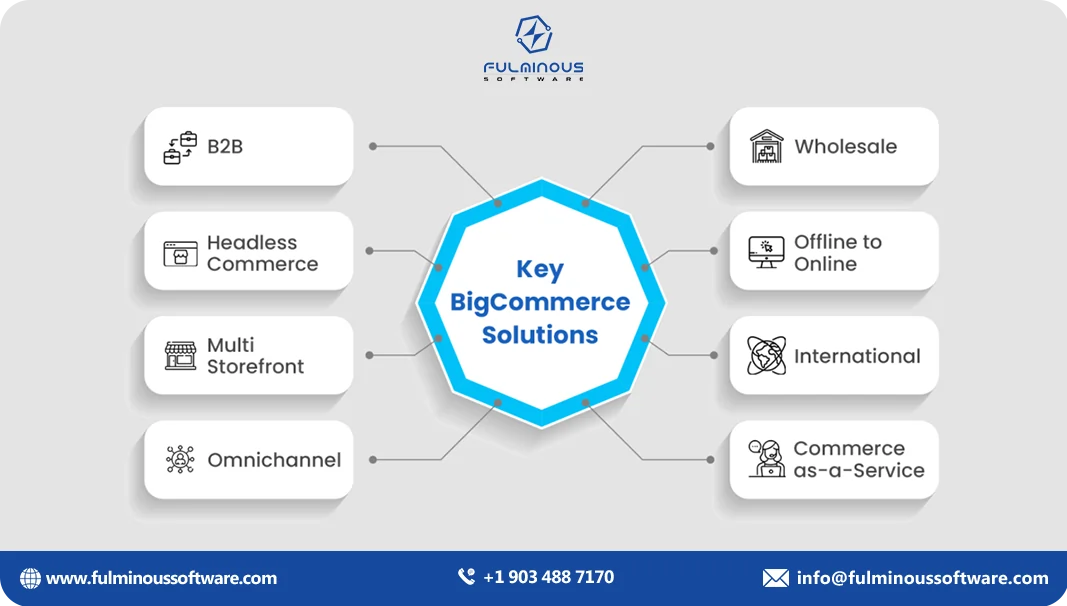
- Multi-storefront setup: separate brands or regions managed from one back end, with catalogs, pricing and content tailored per storefront.
- ERP, CRM and PIM integration: typically the most expensive and risk-prone part of the build.
- B2B functionality: custom catalogs, quoting, purchase orders, payment terms and multi-user accounts.
- Headless or composable front end: custom storefront performance, with more to build and maintain.
- Security, performance and QA: load testing, accessibility checks and staged releases.
Performance contracts are negotiated with BigCommerce directly, and BigCommerce states that contracted Performance terms are not subject to the Open Payment Provider Fee. Terms can change, so verify them with your account team. Large builds also benefit from software consulting during the planning stage.
BigCommerce vs. Shopify: Development Cost Comparison
BigCommerce and Shopify are priced almost identically at the entry and mid tiers, so development scope, not subscription cost, usually decides total spend. The table compares published US plan pricing; see Shopify’s pricing page for current Shopify figures.
| Cost area | BigCommerce | Shopify |
|---|---|---|
| Entry plan (monthly / annual) | Core: $39 / $29 | Basic: $39 / $29 |
| Mid plan | Growth: $105 / $79 | Grow: $105 / $79 |
| Upper self-serve plan | Scale: $399 / $299 | Advanced: $399 / $299 |
| Enterprise plan | Performance: custom, from as low as $1,499 per month | Plus: from $2,300 per month |
| Third-party gateway fee | Open Payment Provider Fee 2.0% / 1.0% / 0.6% (Core / Growth / Scale); embedded providers exempt | 2.0% / 1.0% / 0.6% / 0.2% (Basic / Grow / Advanced / Plus) when not using Shopify Payments |
| Typical build cost | Driven by scope: theme, integrations, B2B, headless | Driven by scope: theme, apps, integrations, headless |
Neither platform is automatically cheaper to build on. BigCommerce often suits businesses that need native B2B, multi-storefront and open APIs with less custom code, while Shopify can fit simpler direct-to-consumer stores that rely on its app ecosystem. The right answer comes from comparing your requirements, not the headline subscription price. Our website development services team can give you a platform-neutral view before you commit.
One-Time vs. Recurring Costs: Sample First-Year Budgets
These examples show how BigCommerce development cost combines with subscription fees. They use the planning ranges above with BigCommerce’s annual-billing prices. They exclude paid apps, payment processing, marketing and any Open Payment Provider Fee or overage, so treat them as a floor, not a full forecast.
| Scenario | One-time build | 12 months platform (annual billing) | First-year floor |
|---|---|---|---|
| Small business, Core or Growth | $5,000 – $10,000 | $348 – $948 | $5,348 – $10,948 |
| Mid-sized brand, Growth or Scale | $10,000 – $20,000 | $948 – $3,588 | $10,948 – $23,588 |
| Enterprise, Performance plan | $20,000 – $50,000+ | From $17,988 ($1,499 × 12) | From $37,988 |
Add support on top. A $500–$2,000 monthly retainer adds $6,000–$24,000 per year, which is why many growing stores choose on-demand hours until volume justifies a retainer. Our software maintenance and support services cover both approaches.
How to Reduce BigCommerce Development Costs Without Compromising Quality
Lower BigCommerce development cost should come from smarter scope, not thinner engineering. These tactics consistently help:
- Launch in phases. Release a strong core store first, then add advanced features after real customer data arrives.
- Use native features first. Confirm BigCommerce does not already offer what you plan to build.
- Finalise integrations early. Late changes to ERP or CRM scope are costly.
- Clean your data before migration. Duplicate SKUs and inconsistent attributes inflate testing time.
- Choose embedded payment providers. This avoids a recurring fee that no development discount can offset.
- Agree fixed scope with a change process. Documented change requests prevent surprise invoices.
- Match the engagement model to your certainty. Fixed price for clear scope, dedicated or milestone models for evolving work.
Is BigCommerce Worth the Investment?
Weighing BigCommerce development cost against returns, the platform is usually worth the investment for businesses that need B2B features, multiple storefronts, open APIs or headless flexibility, because these needs are supported on the platform instead of being bolted on. SaaS hosting, PCI-compliant infrastructure and managed security also reduce the infrastructure work you would otherwise fund yourself.
It may be less compelling for very small stores with simple needs, or for businesses that must use non-embedded payment providers at high volume, where the Open Payment Provider Fee becomes a meaningful running cost. Model your own numbers before deciding, and avoid choosing a platform on subscription price alone.
How to Choose the Right BigCommerce Development Partner
The cheapest quote is rarely the lowest total BigCommerce development cost. A cheap build that needs replacing in two years costs more than a well-planned one. Use this checklist when comparing proposals:
- Certified BigCommerce developers and relevant experience in your project type, such as B2B, headless or migration.
- An itemised quote that separates design, development, integrations, migration and testing.
- A named plan tier, with the Open Payment Provider Fee and overage addressed.
- Ownership of your BigCommerce account, domain and billing from day one.
- A documented change process, realistic milestones and clear post-launch support terms.
- Willingness to tell you honestly if another platform fits better.
Why Businesses Work With Fulminous Software
- Certified BigCommerce developers.
- Responsive design and development across devices.
- Transparent pricing and flexible plans, without hidden charges.
- A focus on meeting agreed deadlines and post-launch support.
- Clients served globally, with local expertise in Toronto, Vancouver, Montreal, Sydney, Melbourne, Brisbane, London, Manchester and Birmingham.
- Dedicated developer, fixed-price, hourly and milestone-based engagement models.
Ready to get an itemised BigCommerce estimate for 2027?
Request a Free ConsultationBigCommerce Development Cost FAQs
Q1: How much does BigCommerce development cost?
BigCommerce development cost typically ranges from $5,000–$10,000 for a basic store, $10,000–$20,000 for a custom build, and $20,000–$50,000+ for enterprise, B2B or headless projects. The BigCommerce subscription is separate and starts at $29 per month on annual billing (Core plan). Your final BigCommerce development cost depends on design, integrations, data volume and timeline.
Q2: How much does it cost to build a BigCommerce store?
The cost to build a BigCommerce store with a template starts at about $5,000–$10,000, including theme setup, product import, payment and shipping configuration. A custom theme with ERP or CRM integrations pushes BigCommerce website development cost into the $10,000–$20,000 range or higher. Platform subscription fees are billed separately by BigCommerce.
Q3: What factors affect BigCommerce development costs?
The main drivers of BigCommerce development cost are design complexity, number of integrations, catalog size, B2B requirements, headless architecture, custom app needs, data migration effort, timeline and the team’s hourly rate. Payment-provider choice also changes your running costs because of BigCommerce’s Open Payment Provider Fee on self-serve plans.
Q4: How much does a BigCommerce plan cost in 2027?
Based on BigCommerce’s published pricing in late 2026, Core costs $39 per month ($29 on annual billing), Growth $105 ($79), and Scale $399 ($299). Performance, the former Enterprise plan, is custom-priced from as low as $1,499 per month. Confirm current rates on the BigCommerce pricing page before budgeting.
Q5: How much does it cost to migrate to BigCommerce?
Migration usually costs $2,000–$5,000 for small catalogs, $5,000–$15,000 for mid-sized stores, and $15,000–$40,000+ for complex, multi-system migrations. The range depends on SKU count, customer and order history, custom functionality, URL redirect mapping and testing. Treat these as planning figures and request an itemised quote.
Q6: How much does it cost to hire a BigCommerce developer?
Hourly engagement typically runs $25–$75 per hour, a dedicated developer about $1,500–$4,000 per month, and fixed-price projects start around $5,000. Rates vary with experience, location and project complexity. Agencies in the US, UK and Australia often charge significantly more per hour than offshore teams.
Q7: Is BigCommerce cheaper than Shopify to develop?
Not automatically. Entry, mid and upper plans are priced identically at $39, $105 and $399 per month on monthly billing, and development cost follows project scope rather than platform brand. BigCommerce’s native B2B and multi-storefront tools can lower custom-code needs, while Shopify’s app ecosystem can suit simpler direct-to-consumer stores.
Q8: How can I reduce BigCommerce development costs?
Start with a phased launch, use native BigCommerce features before building custom apps, choose a well-built theme, fix your integration list early, and route payments through Embedded Payment Providers. Clean product data before migration and request a fixed-scope estimate with a documented change process.
Q9: Why choose Fulminous Software for BigCommerce development?
Fulminous Software works with certified BigCommerce developers, offers flexible engagement models (dedicated developer, fixed-price, hourly and milestone-based), provides post-launch support and aims for transparent pricing and on-time delivery. We serve clients across Canada, Australia, the UK, the USA and India.
Final Thoughts on BigCommerce Development Cost
The clearest way to control BigCommerce development cost is to separate platform fees from build costs, settle your payment-provider and integration decisions early, and choose an engagement model that fits your scope. Start with a phased plan, and revisit your budget once your 2027 pricing is confirmed on BigCommerce’s website.
If you want a realistic figure for your own store, share your requirements with our team and we will help you map scope, timeline and cost.
HIRE A TOP SOFTWARE DEVELOPMENT COMPANY
 Verified
Expert in Software & Web App Engineering
I am Manish Kumawat, co-founder of Fulminous Software, a top leading customized software design and development company with a global presence in the USA, Australia, UK, and Europe. Over the last 10+ years, I am designing and developing web applications, e-commerce online stores, and software solutions custom tailored according to business industries needs. Being an experienced entrepreneur and research professional my main vision is to enlighten business owners, and worldwide audiences to provide in-depth IT sector knowledge with latest IT trends to grow businesses online.


Partner with Top-Notch Web Application Development Company!
Discuss your Custom Application Requirements on info@fulminoussoftware.com or call us on +91-935 141 8445.
15 Days Risk-Free Trial